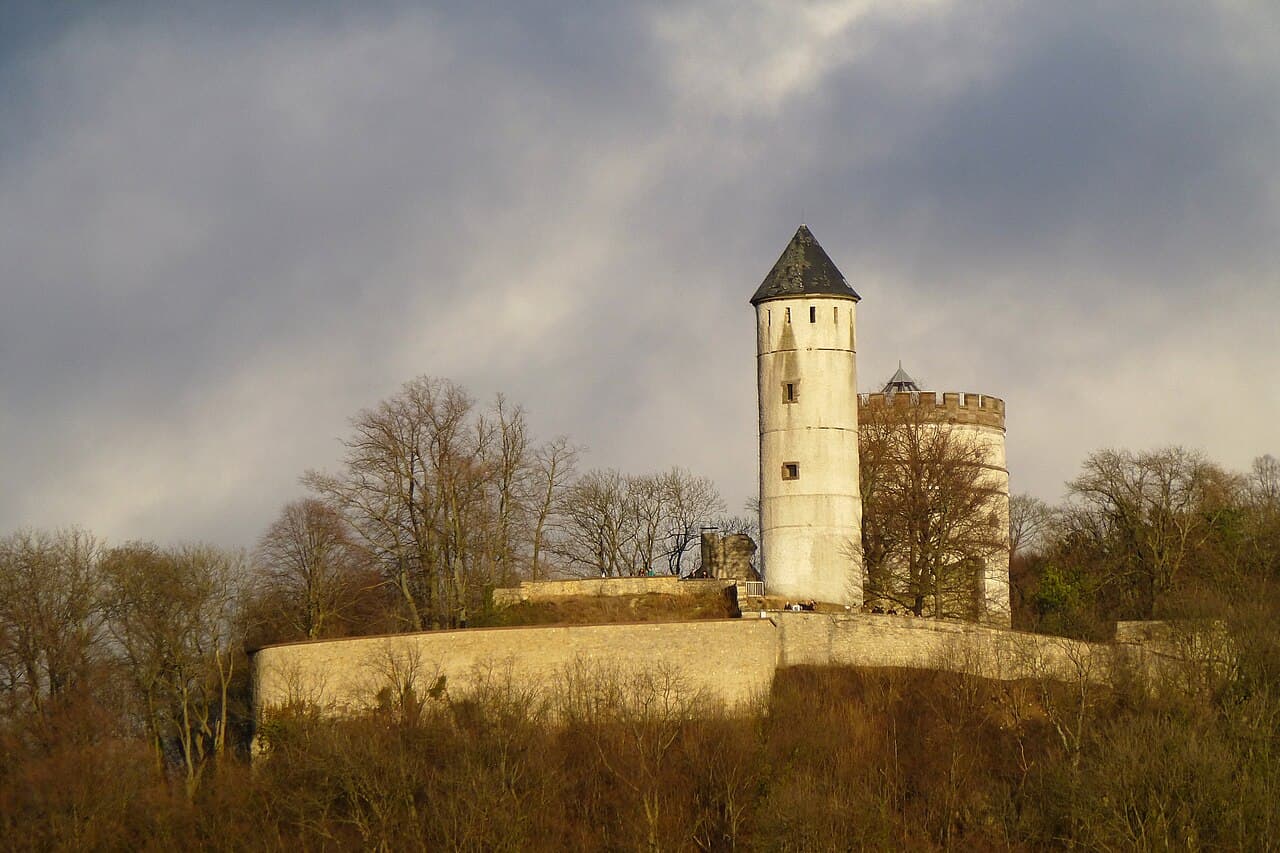
Plesse Castle
Plesse Castle is a prominent medieval hill castle located in the municipality of Bovenden, near the city of Göttingen in Lower Saxony, Germany. This fortress stands on a natural spur of the Wittenberg hill, rising to 386 meters, commanding a strategic vantage point over the Leine river valley and surrounding landscape. Its elevated position on a Muschelkalk (shell limestone) rock formation provided significant defensive advantages, characteristic of classic spur castles built during the High medieval period.
Historical background and ownership
The origins of Plesse Castle trace back to the early 11th century, with the estate initially held by Meinwerk, bishop of Paderborn. In 1015, the estate was transferred to the city of Paderborn. Although the exact date of the castle's construction remains uncertain, architectural and documentary evidence suggests it was likely built in the early 12th century. By around 1150, it became the seat of the noble family known as the lords of Plesse, who took their name from the castle itself.
Throughout the 12th century, the castle played a strategic role in regional power struggles, particularly under the influence of the counts of Winzenburg, who used it to control the upper valley of the Leine River. The castle changed hands several times, notably in 1192 when Emperor Henry VI exchanged Plesse Castle for Desenberg Castle near Warburg, a transfer reversed by 1195.
The 15th century marked significant political shifts. In 1447, amid the fragmentation of the Duchy of Brunswick-Göttingen and increasing regional conflicts, the lords of Plesse handed over the castle to Landgrave Ludwig of Hesse, receiving it back as a fief. This arrangement secured protection under Hesse during a turbulent period.
The Protestant Reformation reached the castle's domain in 1536, initially inspired by the Dutch theologian Petrus Noyen van Weert. Later, after intervention by Martin Luther, the region aligned more fully with Lutheran theology. The Plesse noble line ended in 1571 with the death of Dietrich IV, after which Landgrave William IV of Hesse-Kassel assumed control. His successor, Moritz of Hesse-Kassel, imposed the Reformed confession in 1614, reflecting ongoing religious transformations.
During the Thirty Years’ War (1618–1648), Plesse Castle served as a refuge for Moritz between 1623 and 1624 but was besieged in 1627. Control briefly shifted to Landgrave George II of Hesse-Darmstadt before the castle was abandoned in 1660. After abandonment, local villagers dismantled large portions of the fortress for building materials.
In the 19th century, the castle's ruins attracted attention from cultural figures such as Johann Wolfgang von Goethe, who visited in 1801. Political changes following the Napoleonic Wars saw the castle's dominion incorporated into the Kingdom of Westphalia and later the Kingdom of Hanover. Restoration efforts began in 1821, with major work from 1853 to 1864 under Hanoverian royal patronage and further projects in 1909. Since 1945, the castle has been owned by the state of Lower Saxony and protected as a historic monument from 1978 onward.
Architectural features and defensive structures
Bergfried and towers
The most striking feature of Plesse Castle is its bergfried, a tall defensive tower originally about 30 meters high. In 1542, it was lowered to 23 meters due to concerns about cannon fire damage. The tower’s base measures over 15 meters in diameter with walls exceeding four meters thick. The lower section consists of finely dressed stone blocks from the 12th century, while the upper part features 19th-century rubble masonry restorations, including reconstructed battlements. Visitors can access the bergfried via an internal staircase, offering panoramic views over the village of Eddigehausen and the broader Leine valley.
Another important tower, known as the Sydekum, functioned as a watchtower at the castle’s most exposed point on the spur. This tower stands approximately 22 meters tall, about 7 meters in diameter, with walls over two meters thick at the base. Its entrance was originally about 10 meters above ground level, similar to the bergfried, providing enhanced defensive security.
Walls, gates, and moat
The castle complex includes well-preserved defensive elements such as a moat, an outer gate, and a middle gate with a gatehouse. The outer defensive walls survive in parts, including sections known as the Caningarten wall in the outer bailey and corner bastions named Eichsfeld and Catzengarten. These structures formed integral parts of the castle’s protective enclosure.
Residential and religious buildings
Within the main castle lies the Steinhaus or stone house, a significant residential building. The ruins of a chapel dedicated to St. Peter and Paul are also present, with archaeological excavations in 1983 revealing traces of an earlier medieval structure dating to around 1200. Remarkably, the chapel was built atop foundations from the Iron Age (8th to 6th centuries BCE), indicating long-term human occupation of the site.
Castle well and underground passages
The castle well is a notable feature surrounded by legend, described in 16th-century accounts as extremely deep, possibly between 150 and 170 meters. Water-lifting technology was installed in the 17th century under Landgrave Wilhelm IV of Hesse. Archaeological investigations have yet to confirm the well’s exact location within the castle grounds. Historical documents from 1802 mention an underground passage connecting the castle to a cellar in the nearby village of Eddigehausen. After abandonment, the well remained accessible through the Bornhaus, a courtyard structure behind the gatehouse, though not the original 12th-century cistern. A separate well at the Deppoldshausen outwork reaches 100 meters deep but is unrelated to the main castle's water supply.
Cultural significance and current status
Plesse Castle holds cultural importance as a site reflecting medieval defensive architecture and the complex history of territorial control in the region north of Göttingen. Its connection to the lords of Plesse, the Landgraves of Hesse, and its role during the Reformation and Thirty Years’ War highlight its historical significance.
The castle’s ruins are accessible to the public and form part of the Solling-Harz-Querweg hiking trail. The site offers visitors insight into medieval fortification design and the layered history of human settlement, from the Iron Age to modern times. The enduring religious affiliations of surrounding villages with the Evangelical Reformed Church rather than the dominant Evangelical Lutheran Church in Hanover reflect the castle’s lasting influence on local cultural identity.
Today, Plesse Castle is well preserved through ongoing conservation efforts and is protected as a historic monument by the state of Lower Saxony. Its combination of architectural remains, archaeological significance, and scenic location makes it a valuable destination for history enthusiasts and tourists alike.
Frequently asked questions (FAQ)
- How do I get to Plesse Castle from Göttingen?
- Plesse Castle is located near Bovenden, just north of Göttingen. Visitors can reach the castle by car or local bus services, followed by a short hike up the Wittenberg hill where the castle stands.
- What are the main architectural features of Plesse Castle?
- Key features include the tall bergfried tower with thick stone walls, the Sydekum watchtower, the castle moat, multiple defensive gates, and the ruins of a medieval chapel built atop Iron Age foundations.
- When was Plesse Castle built?
- While the exact founding date is uncertain, evidence suggests Plesse Castle was constructed in the early 12th century and became the seat of the lords of Plesse around 1150.
- Can I visit the interior of the bergfried tower?
- Yes, the bergfried is accessible to visitors via an internal staircase, offering panoramic views of the Leine valley and surrounding villages.
- Why was the bergfried tower lowered in height?
- In 1542, the bergfried was reduced from about 30 meters to 23 meters due to concerns that it might collapse under cannon fire during the evolving warfare of the period.
- Is Plesse Castle open year-round?
- The castle ruins are generally accessible year-round as an outdoor historical site, but it is advisable to check local tourism information for any seasonal restrictions or guided tour availability.
Photo gallery

Information
Website
Visit websiteSources & official resources
Verify the information above using these authoritative references.
Loading map...
Visitor reviews
No reviews yet. Been here? Write the first review and help other travelers!
Write the first reviewVisited this castle? Share your experience
Your review helps other travelers and adds first-hand knowledge to our encyclopedia.



