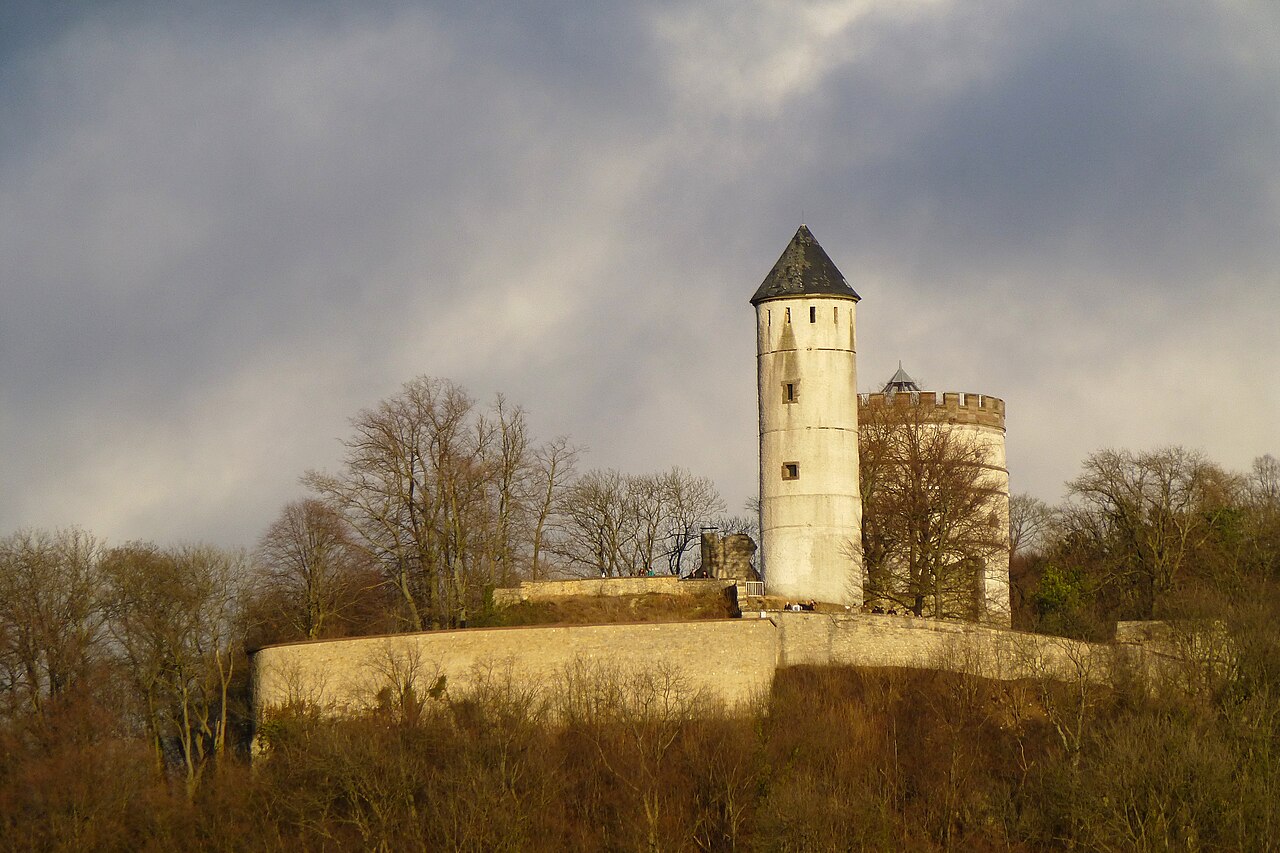
Burg Adelebsen
Burg Adelebsen is a prominent hill castle situated within the municipality of Adelebsen in Lower Saxony, Germany. Established in the early 13th century, this castle stands on a natural sandstone spur overlooking the Schwülme valley, offering a commanding view of the surrounding Solling hills. Its strategic location and robust medieval architecture reflect its historical role as a fortified noble residence and administrative center.
Early history and noble lineage
The origins of Burg Adelebsen trace back to the early 1200s when the noble family of Wibbecke relocated their seat to the sandstone ridge. The family, later known as de Adelevessen and eventually von Adelebsen, is first mentioned in documents dating to 1234. The castle itself appears in records by 1253, with clear documentation by 1295. For nearly eight centuries, it remained the ancestral home of the baronial von Adelebsen family, witnessing generations of noble stewardship.
Medieval architecture and fortifications
The castle's oldest surviving structure is a towering residential and defensive tower dating from the late 14th century, constructed in stages beginning around 1370. This tower reaches nearly 39 meters in height on its rock-facing side and features walls tapering from 4.3 meters thick at the base to 1.7 meters at the summit. Its partly pentagonal and hexagonal sandstone design includes Gothic-style windows and medieval masonry marks, highlighting the craftsmanship of the period.
Inside, the tower contains rooms on the second and third floors equipped with fireplaces, and an elevated main entrance approximately four meters above the courtyard floor, emphasizing its defensive purpose. The lower section reflects construction techniques from about 1370–1380, while the upper levels, added in the early 15th century, remain largely intact.
By the late 14th century, the castle complex included this dominant tower, the Moishus—a multi-purpose residential and economic building at the southeast corner—and an enclosing ring wall measuring roughly 47 by 32 meters. The 15th century saw expansions with the addition of the Hinterhaus and the Mittelkemenate, increasing living and service spaces.
Conflicts and reconstruction
Burg Adelebsen endured significant turmoil during its history. In 1466, the castle was severely damaged when it was set ablaze by the Bishop of Hildesheim during regional conflicts. Further destruction occurred during the Thirty Years’ War in the 17th century, which left the fortress in a damaged state.
Reconstruction efforts began in the mid-17th century, aiming to restore and expand the castle's facilities. This rebuilding phase transitioned the fortress from a purely defensive stronghold to a more residential and administrative estate.
Transformation into a residential estate
By the mid-18th century, Burg Adelebsen had evolved significantly. The original moat separating the inner castle from the outer bailey was filled in, signaling a shift away from military defense towards residential and economic functions. New buildings such as a forester’s house (built in 1685) and a rococo-style rent office (constructed between 1748 and 1750) were added, reflecting the estate's administrative role.
Additional structures in the outer bailey, including the New House, barns, a round tower, and an old gate, though now partially preserved, provide insight into the castle's operational complexity. Around 1900, stylistic updates introduced a mansard roof, altering the castle's silhouette and blending historic and modern architectural elements.
Architectural features and natural setting
The castle's position on a Buntsandstein sandstone ridge offers natural defensive advantages, with a steep drop of about 30 meters on the southern side overlooking the valley. The complex includes a berggarten (castle garden) and a functional courtyard situated in the valley below, integrating natural topography with architectural design.
The main tower now serves as a habitat for a large colony of jackdaws, noted as the most significant in southern Lower Saxony, adding an ecological dimension to the site’s historical importance.
Modern stewardship and preservation
The von Adelebsen family maintained ownership of the castle until the death of the last male heir, Georg Freiherr von Adelebsen, in 1957. Prior to this, in 1947, he established a private foundation dedicated to preserving the castle and its grounds. Today, the site remains under the stewardship of this foundation, managed by a family descendant, ensuring the castle's conservation and historical legacy.
Cultural and historical significance
Burg Adelebsen stands as a testament to the architectural evolution from medieval fortification to aristocratic residence. Its enduring structures, from the towering defensive keep to the rococo administrative buildings, reflect centuries of noble life, regional power struggles, and adaptation to changing political and social contexts. The castle's integration with its natural sandstone environment and its role in local history make it a valuable cultural landmark in Lower Saxony.
Frequently asked questions (FAQ)
- When was Burg Adelebsen originally built?
- Burg Adelebsen was originally established in the early 13th century, with the first records mentioning the castle dating to 1253 and clear documentation by 1295.
- What architectural style characterizes Burg Adelebsen?
- The castle primarily features Gothic architectural elements, especially visible in its late 14th-century tower with Gothic-style windows and medieval masonry.
- Is Burg Adelebsen open to the public?
- The castle is currently managed by a private foundation. Visitors should check in advance for public access information as it may be limited or by appointment only.
- What significant historical events affected Burg Adelebsen?
- The castle suffered damage during conflicts such as the 1466 attack by the Bishop of Hildesheim and the widespread destruction of the Thirty Years’ War in the 17th century.
- How has Burg Adelebsen changed over time?
- Originally a fortified medieval stronghold, Burg Adelebsen evolved into a residential estate by the 18th century, with added administrative buildings and stylistic updates like a mansard roof around 1900.
Information
Sources & official resources
Verify the information above using these authoritative references.
Loading map...
Visitor reviews
No reviews yet. Been here? Write the first review and help other travelers!
Write the first reviewVisited this castle? Share your experience
Your review helps other travelers and adds first-hand knowledge to our encyclopedia.