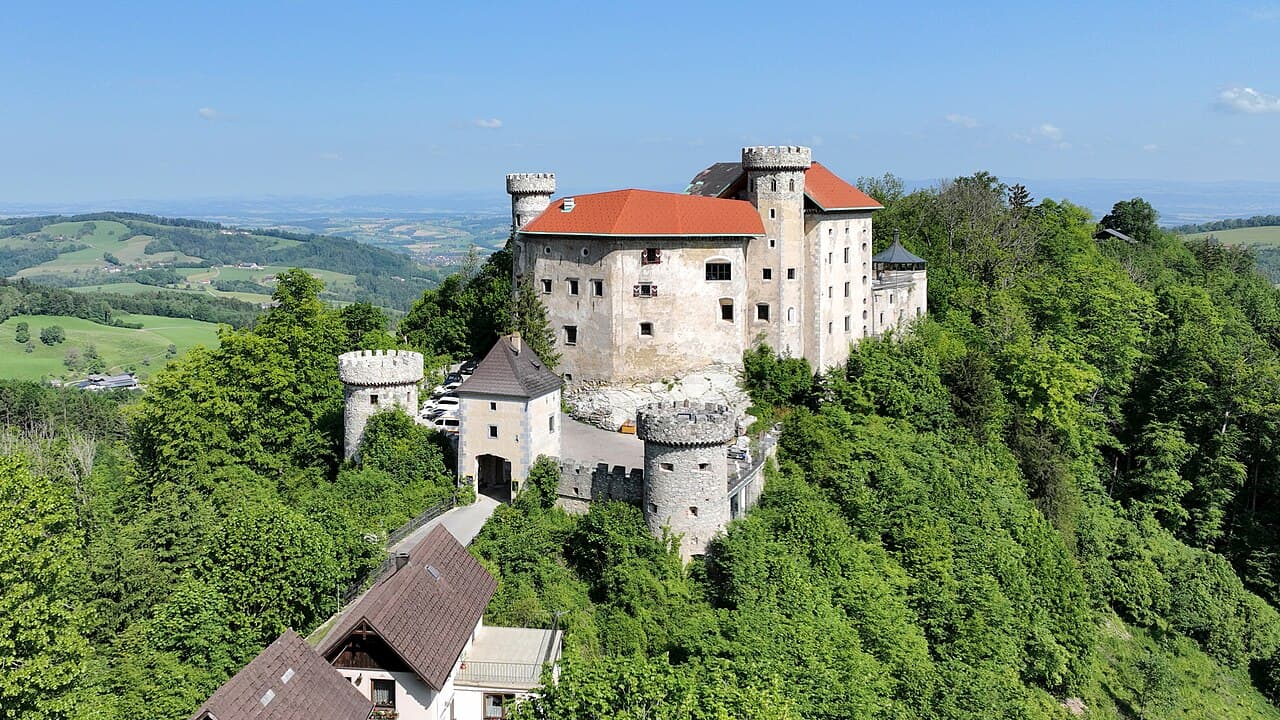
Plankenstein Castle
Plankenstein Castle stands as a remarkable example of a medieval hill fortress located near the village of Plankenstein in the municipality of Texingtal, Austria. First documented in 1186, the castle was originally constructed by the noble von Plankenstein family, vassals to the Counts of Peilstein. This fortress has witnessed centuries of architectural evolution, noble ownership, and historical events, culminating in its current role as a hotel and cultural venue.
Perched approximately 700 meters above sea level on a rocky, forested ridge, Plankenstein Castle commands a strategic position overseeing the confluence of the Pielach, Melk, and Erlauf rivers. Its location atop a steep escarpment provided natural defense advantages, with access limited to a single southern entrance once protected by a drawbridge. The castle’s design expertly integrates the natural terrain with constructed fortifications, including protective walls that follow the cliff edge to control the surrounding landscape.
Historical origins and noble lineage
The castle’s foundation dates to the high medieval period, with its first recorded mention in 1186. The von Plankenstein family, whose name derives from the Old High German word "blanc" meaning "white," likely referencing the castle’s distinctive light-colored stone, established the fortress as their seat. Initially, the family served as vassals to the Counts of Peilstein, later aligning under the Schaunberg counts and ultimately the powerful Habsburg dynasty.
Throughout the 15th century, the von Plankensteins expanded their influence in the region. Notably, Pankraz von Plankenstein undertook significant renovations in 1453, enhancing the castle’s defensive and residential features, although he did not reside there permanently. The castle subsequently passed through several noble families, including the Ravbar, Windischgrätz, and Tattenbach, each contributing to its architectural and functional transformation.
Architectural evolution and features
Medieval fortress to Renaissance residence
Originally designed as a fortified hill castle, Plankenstein’s layout divides into two main sections: the Upper Castle (citadel) and the Lower Castle (outer bailey). The Upper Castle served as the stronghold and main residence, while the Lower Castle housed service buildings and support facilities.
The northern part of the castle features a substantial three-story residential wing built around a core palace dating back to the 13th century. This area showcases a late Gothic spiral staircase, indicative of medieval craftsmanship and architectural style. The southern wing underwent multiple rebuilds over the centuries, including a distinctive four-story polygonal tower topped with a tent-shaped roof.
Chapel and religious art
The castle’s early Gothic chapel is located on the ground floor of the southern wing. It retains original Romanesque features such as round-arched funnel windows from the mid-13th century. The chapel’s interior walls display secco paintings with Protestant iconography from the late 16th century, depicting biblical scenes including the baptism and resurrection of Christ, as well as saints Jude Thaddeus, John, and Bartholomew.
In 1786, the chapel was expanded with a three-aisled nave featuring lunette and cross vaulting, reflecting evolving liturgical requirements. This blend of architectural styles and religious art illustrates the castle’s continuous adaptation through changing historical contexts.
Defensive and residential structures
The southwestern corner of the southern wing is anchored by a round tower that modestly projects beyond the main building, enhancing defensive capabilities without dominating the overall design. The lower western wing, with its hipped roof, is shorter and includes remnants of former fortifications, such as the so-called "knights’ hall." Beneath the living quarters, expansive vaulted cellars carved from bedrock provided essential storage space.
Historical significance and events
Plankenstein Castle played a notable role during the Ottoman sieges of 1683. Approximately 1,500 local inhabitants sought refuge within its walls during a siege lasting about three weeks. The castle’s defenders successfully withstood the attack until relief arrived from imperial cavalry forces, highlighting its strategic importance in regional defense.
Ownership changes in the ensuing centuries reflect broader social and political shifts. The Tinti family acquired the castle in the early 18th century and maintained possession for over two hundred years. However, their preference for other estates led to the castle’s gradual decline during the 19th century.
In 1939, the von Nagel-Dorinik family purchased Plankenstein, but post-World War II Soviet occupation authorities confiscated it, only to return it in 1955. Despite deterioration, religious ceremonies continued in the castle chapel until 1952.
Restoration and modern use
A major restoration initiative began in 1975 under the direction of architect Hans-Peter Trimbacher. His extensive campaign, supported by significant investment, focused on stabilizing the structure, renewing the roofing, and repairing masonry, ensuring the castle’s preservation for future generations.
By the late 20th century, Plankenstein had been repurposed as a hotel and cultural venue, hosting exhibitions and events that celebrate its rich heritage. In 2012, Viennese entrepreneur Erich Podstatny acquired the property and enhanced the interiors by combining antique furnishings with modern amenities, further elevating its appeal as a destination for accommodation, celebrations, and cultural gatherings.
Architectural details and decorative elements
The castle’s walls are constructed primarily of limestone blocks, a material typical of the region, which contributes to its characteristic light appearance. The courtyard is arranged on two levels, connected by stone steps, and features two stone lions clutching shields, likely dating from around 1701. These sculptures bear the insignia of the Kunitz family, former estate holders.
Access to the chapel is marked by a marble portal adorned with the coat of arms of the Tinti family. The western façade of the courtyard includes cross-vaulted arcades with wide arches and balustrades supported by bulbous columns. Walls are decorated with plaster joints imitating sgraffito, and painted shutters display the black-and-white colors of the Plankenstein coat of arms on a red background, honoring the original noble family.
Inside, the furnishings are mostly later additions or collectible pieces, as the original medieval furniture has not survived. The rooms maintain a simple yet practical character, reflecting the castle’s historical function as a fortified noble residence transitioning through various architectural and social phases.
Frequently asked questions (FAQ)
- How do I get to Plankenstein Castle?
- Plankenstein Castle is located near the village of Plankenstein in Texingtal, Lower Austria. It is accessible by car via local roads connecting to the main highways, with parking available nearby. Public transportation options are limited, so driving is recommended.
- What is the best time to visit Plankenstein Castle?
- The best time to visit Plankenstein Castle is during the warmer months from late spring to early autumn when the weather is pleasant for exploring the castle grounds and surrounding natural scenery. The castle also hosts cultural events during this period.
- Can I stay overnight at Plankenstein Castle?
- Yes, Plankenstein Castle operates as a hotel offering accommodation to guests. Visitors can experience staying in a historic setting with modern amenities, making it a unique lodging option in the region.
- What architectural styles are visible at Plankenstein Castle?
- Plankenstein Castle showcases a blend of <strong>high medieval</strong> architecture with later <strong>Renaissance</strong> modifications. Key features include a late Gothic spiral staircase, Romanesque chapel elements, and Renaissance residential enhancements.
- Is the castle wheelchair accessible?
- Due to its historic structure and hillside location, Plankenstein Castle has limited wheelchair accessibility. Visitors with mobility concerns should contact the management in advance to inquire about accommodations.
- Are guided tours available at Plankenstein Castle?
- Guided tours are sometimes offered during special events or cultural exhibitions. Visitors are advised to check the castle's official website or contact the hotel for current tour availability and schedules.
Photo gallery

Information
Website
Visit websiteSources & official resources
Verify the information above using these authoritative references.
Loading map...
Visitor reviews
No reviews yet. Been here? Write the first review and help other travelers!
Write the first reviewVisited this castle? Share your experience
Your review helps other travelers and adds first-hand knowledge to our encyclopedia.



