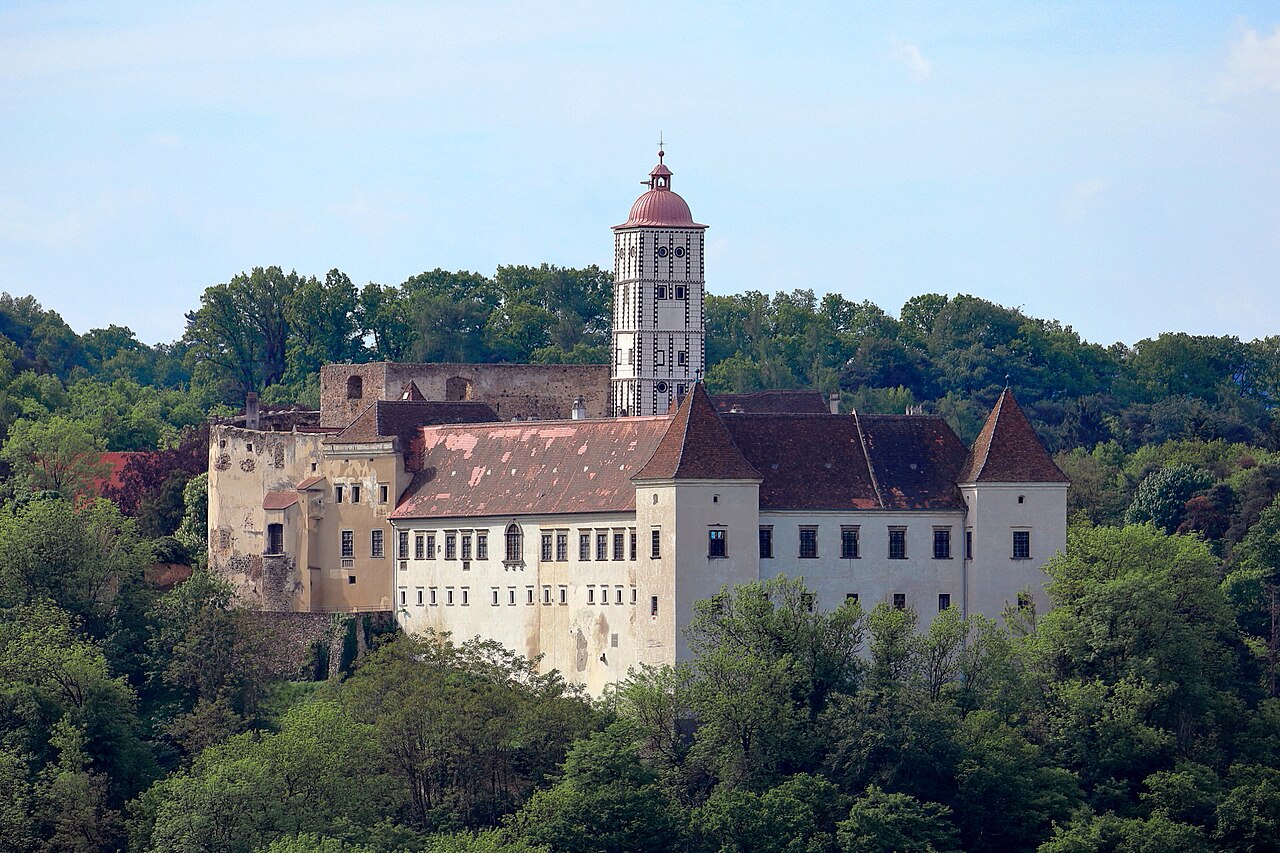
Burgruine Zelking
Burgruine Zelking stands as a compelling example of a medieval hill castle strategically positioned on the slopes of Hiesberg hill in the municipality of Zelking-Matzleinsdorf, Lower Austria. Its origins trace back to the early 12th century, with the earliest documented mention dating to around 1100. The castle's history is intimately linked to the noble Zelking family, who established their ancestral seat here and maintained control over the fortress for several centuries, shaping the region's medieval landscape.
Founding and noble lineage
The castle's foundation is attributed to medieval builders whose specific identities remain unknown, but the earliest known figure associated with the site is Wernher von Zelking. Despite earlier assumptions, no confirmed genealogical connection exists between Wernher and the Hagenau family. The Zelking family rose to prominence in the region, with notable members such as Petrissa von Zelking, who forged an important alliance through her marriage to Henry II of Liechtenstein in the early 14th century. This union exemplifies the castle's role as a center of noble power and influence during the High and Late Medieval periods.
Ownership transitions and historical significance
Following the extinction of the Zelking lineage in 1634, ownership of Burgruine Zelking transferred through marriage to the Polheim family and later to Andrä Joachim Graf Sinzendorf around 1662. The castle played a defensive role during the Ottoman siege of Vienna in 1683, providing refuge for local villagers escaping Turkish raids across western Lower Austria. This highlights the fortress's enduring military relevance even as warfare evolved.
Administrative functions gradually shifted to the nearby settlement of Matzleinsdorf, leading to the castle's decline in strategic importance and eventual abandonment. By the early 19th century, the property passed through several noble hands, including the Kinsky, Harrach, Counts of Rohrau, and the Galgozy-Galantha families. Over the course of the 19th and 20th centuries, Burgruine Zelking fell into ruin and ceased to serve as a residence or military stronghold.
Architectural features and defensive elements
The ruins of Burgruine Zelking comprise masonry structures dating primarily from the 12th to 16th centuries. The castle was constructed entirely of stone, reflecting its purpose as a fortified residence designed to withstand sieges and assaults. Its hillside location on Hiesberg hill provided natural defensive advantages, supplemented by robust architectural features.
Gate and entrance
A prominent surviving feature is the large gate with a rounded arch, a typical medieval architectural element that served as a critical point of defense and controlled access to the castle's interior. This gate has been the subject of reconstruction efforts and is well documented through historical and photographic records, offering insight into the castle's original appearance and defensive strategy.
Arrow slits and fortifications
The castle walls retain several narrow vertical openings known as arrow slits or Schartenfenster. These apertures allowed defenders to launch arrows at attackers while remaining protected behind thick stone walls, underscoring the castle’s military function during periods of conflict such as the Ottoman incursions in the late 17th century.
Other defensive elements likely included battlements and fortified curtain walls, though much of the structure has succumbed to decay. The remaining masonry walls stand in situ, enabling visitors and scholars to reconstruct the castle's layout and understand medieval fortification techniques employed over several centuries.
Decline and preservation status
With the relocation of regional administration to Matzleinsdorf and the changing political landscape, Burgruine Zelking gradually lost its strategic and residential functions. By the late 19th century, the castle was largely abandoned and fell into ruin. Today, it is classified as a ruin, with fragmentary walls and architectural features that evoke its former stature.
The site does not contain decorative elements such as inscriptions or mosaics, focusing instead on the raw, functional aspects of medieval military architecture. Photographic documentation has played a crucial role in preserving knowledge about the castle’s form, especially the distinctive rounded gate arch.
Burgruine Zelking remains an important cultural and historical monument, offering valuable insights into the evolution of medieval hill castles in Austria and their role in regional defense and noble residence.
Visiting burgruine zelking
Although the castle is in ruins, it attracts visitors interested in medieval architecture, history, and the scenic landscapes of Lower Austria. The hillside location provides picturesque views and a tangible connection to the region’s medieval past. Visitors can explore the remaining structures, including the gate and arrow slits, to appreciate the castle’s defensive design.
Access to the site is typically on foot via hiking trails in the municipality of Zelking-Matzleinsdorf. Due to its ruinous condition, visitors should exercise caution while exploring. The site’s historical significance and evocative remains make it a noteworthy destination for those interested in Austria’s rich castle heritage.
Frequently asked questions (FAQ)
- When was Burgruine Zelking built?
- Burgruine Zelking was constructed in the 12th century, with the earliest records dating back to around 1100.
- What is the historical significance of Burgruine Zelking?
- The castle was the ancestral home of the Zelking family and played a defensive role during the Ottoman siege of Vienna in 1683.
- What architectural features remain at Burgruine Zelking?
- The ruins include a large gate with a rounded arch and several arrow slits, highlighting its medieval defensive design.
- Is Burgruine Zelking accessible to visitors?
- Yes, visitors can access the ruins on foot via hiking trails in Zelking-Matzleinsdorf, but should be cautious due to the ruinous condition.
- Why did Burgruine Zelking fall into ruin?
- The castle was gradually abandoned after administrative functions moved to Matzleinsdorf, and it ceased to be used as a residence or fortress by the 19th century.
Information
Loading map...
Visitor reviews
No reviews yet. Been here? Write the first review and help other travelers!
Write the first reviewVisited this castle? Share your experience
Your review helps other travelers and adds first-hand knowledge to our encyclopedia.