Burg Reinsberg
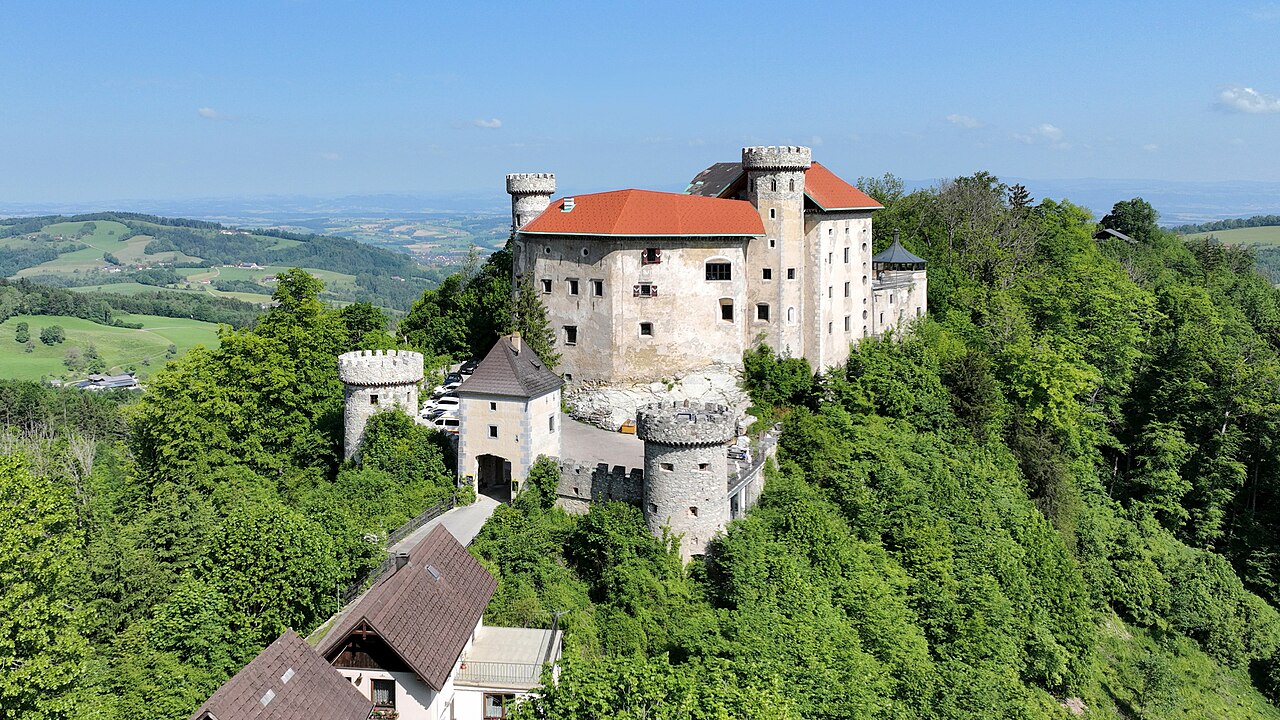
Burg Reinsberg stands as a remarkable example of a medieval hill castle ruin located in the municipality of Reinsberg, Austria. Its origins date back to the early 13th century, with the first documented mention in 1215, when it was recorded as "castrum in Rainsperch" under the control of Bishop Otto II of Freising as a fief of the bishops of Regensburg. This early reference situates the castle firmly within the High Medieval period, reflecting the strategic importance of such fortifications in the region during that era.
The castle's historical narrative is closely tied to a succession of influential noble families and ecclesiastical authorities. In the mid-13th century, the castle was held by Engelschalk von Reinsperg, and following his death, his widow Alhaid (Adelheid) assumed possession by bishop's grant. She notably contributed to the religious development of the area by founding the parish of Reinsberg in 1291, the parish of Randegg in 1294, and a women’s monastery in 1296. These foundations highlight the castle's role not only as a military stronghold but also as a center of religious and community life in medieval Austria.
Ownership and historical significance
The castle's administration was overseen by burgraves, with the earliest known being Heinrico Reinsperger in 1275. Over the centuries, ownership transitioned through various noble families, including Christian von Lengenbach (1315), Reinprecht I. von Walsee, Otto von Zelking (1384), and Stefan von Zinzendorf around 1499. The 16th and 17th centuries saw stewardship by Wolfgang von Oedt (1532/34), Wolf Niklas von Grünthal (1602), and the prominent Dietrichstein family. In 1687, Wolf Engelbert Count Auersperg acquired the castle, maintaining control until 1834.
A significant event in the castle's history occurred in April 1597, when it was attacked and plundered by peasants led by a figure named Markgraber during a period of social unrest. This incident reflects the broader tensions and upheavals affecting rural communities and feudal estates in late medieval and early modern Europe.
Architectural features and layout
Perched atop a hill overlooking the village of Reinsberg, Burg Reinsberg exemplifies the typical medieval adaptation of fortifications to natural terrain. The castle's layout is dominated by the palas, the main residential and administrative building, located on the upper courtyard level. This structure is the oldest surviving part of the castle and was fortified with modern structural supports during renovation to preserve its integrity. Its elevated position provides commanding views over the lower courtyard and surrounding landscape.
The lower courtyard serves as the central open space within the castle complex. A distinctive modern architectural intervention is the addition of a mobile elliptical roof structure covering this courtyard. Ingeniously supported by a stationary crane originally designed for trucks, the roof can rotate and be repositioned as needed. The roof is anchored by steel cables to the ground, allowing it to be easily dismantled when not in use, demonstrating a sensitive balance between preservation and contemporary functionality.
Adjacent to the lower courtyard is a modern building that supports the castle's current use as a cultural and event venue. This facility includes a buffet, kitchen, offices, and a generously covered spectator terrace on the ground floor, with two basement levels providing additional performance-related spaces and storage.
Of particular architectural interest is the vaulted upper courtyard area beneath the palas. This section, likely constructed using traditional medieval stone vaulting techniques, remains largely untouched by modern interventions, preserving its potential for future archaeological research. These vaulted chambers would have served as robust storage or service areas essential to the castle's operation.
Preservation and modern use
The conservation of Burg Reinsberg has been undertaken with careful respect for its historical fabric. Supervised by the Federal Monuments Office, restoration efforts have sought to maintain the castle's medieval characteristics while allowing for adaptive reuse. The transformation into a cultural venue ensures the site remains active and accessible, blending heritage preservation with contemporary community engagement.
Ownership of the castle has evolved over time, passing from noble families to Emperor Franz I in the 19th century, then to the Republic of Austria and the Austrian Federal Forests. Since 1997, the municipality of Reinsberg has managed the site, emphasizing local stewardship and public access.
Historical context and regional importance
Burg Reinsberg occupies a significant place in the historical landscape of Austria. As a hill castle, it demonstrates the medieval strategy of utilizing elevated terrain for defense and control over surrounding territories. Its continuous occupation and modification over several centuries reflect the shifting political and social dynamics of the region.
The castle's connection to religious foundations and its role in local governance illustrate the intertwined nature of feudal, ecclesiastical, and noble power structures in medieval Austria. The events of 1597, including the peasant uprising, underscore the castle's involvement in broader historical currents of social change and conflict.
Architectural style and construction period
While detailed stylistic analysis is limited by the ruinous state, Burg Reinsberg predominantly exhibits characteristics of High Medieval fortifications. Its core structures, such as the palas and vaulted chambers, align with typical medieval castle architecture of the 13th century, emphasizing functionality, defense, and residential needs.
Visitor experience and cultural events
Today, visitors to Burg Reinsberg can explore the evocative ruins set against a scenic hilltop backdrop. The site hosts various cultural events, leveraging the modern facilities integrated within the historic fabric. The innovative mobile roof allows for versatile use of the lower courtyard, accommodating performances, markets, and community gatherings while protecting the medieval remains.
The castle's preservation as a cultural venue exemplifies successful heritage management, balancing public engagement with conservation. Visitors gain insight into medieval life, architecture, and the castle's evolving role through the centuries.
Frequently asked questions (FAQ)
- When was Burg Reinsberg originally built?
- Burg Reinsberg was originally constructed in the early 13th century, with the first documented mention in 1215.
- What architectural features are notable at Burg Reinsberg?
- Notable features include the medieval palas, vaulted chambers beneath the upper courtyard, and a modern mobile elliptical roof covering the lower courtyard.
- Can visitors attend events at Burg Reinsberg?
- Yes, the castle functions as a cultural venue hosting various events, utilizing modern facilities integrated into the historic site.
- Who currently owns Burg Reinsberg?
- Since 1997, the castle has been owned and managed by the Municipality of Reinsberg.
- What is the historical significance of Burg Reinsberg?
- The castle played a key role in regional governance and religious foundations, with a history of noble ownership and involvement in social unrest during the 16th century.
Information
Sources & official resources
Verify the information above using these authoritative references.
Loading map...
Visitor reviews
No reviews yet. Been here? Write the first review and help other travelers!
Write the first reviewVisited this castle? Share your experience
Your review helps other travelers and adds first-hand knowledge to our encyclopedia.