Pirkštejn Castle
Pirkštejn Castle stands as a significant medieval hill castle located in the town of Rataje nad Sázavou in the Czech Republic. Established in the early 14th century, this fortress was founded by Jindřich of Lipé, a member of the Bohemian nobility who owned the nearby town. The castle was intended to serve both as a stronghold and as the primary residence connected with the settlement, reflecting the strategic and residential needs of the era.
The earliest documented mention of Pirkštejn Castle dates back to 1346, where it is referenced alongside the upper castle in Rataje. Initially, the castle belonged to the Lords of Lipé, a prominent noble family influential in Bohemian politics and society during the High Medieval period. By the mid-14th century, ownership passed to the Lords of Pirkštejn, who derived their name from their ancestral home, Sloup Castle. Among the most notable figures of this family was Hynce Ptáček of Pirkštejn, a significant political leader active after the Hussite Wars. His death in 1444 and burial in the Church of St. Matthew in Rataje highlight his local prominence.
Architectural features and strategic design
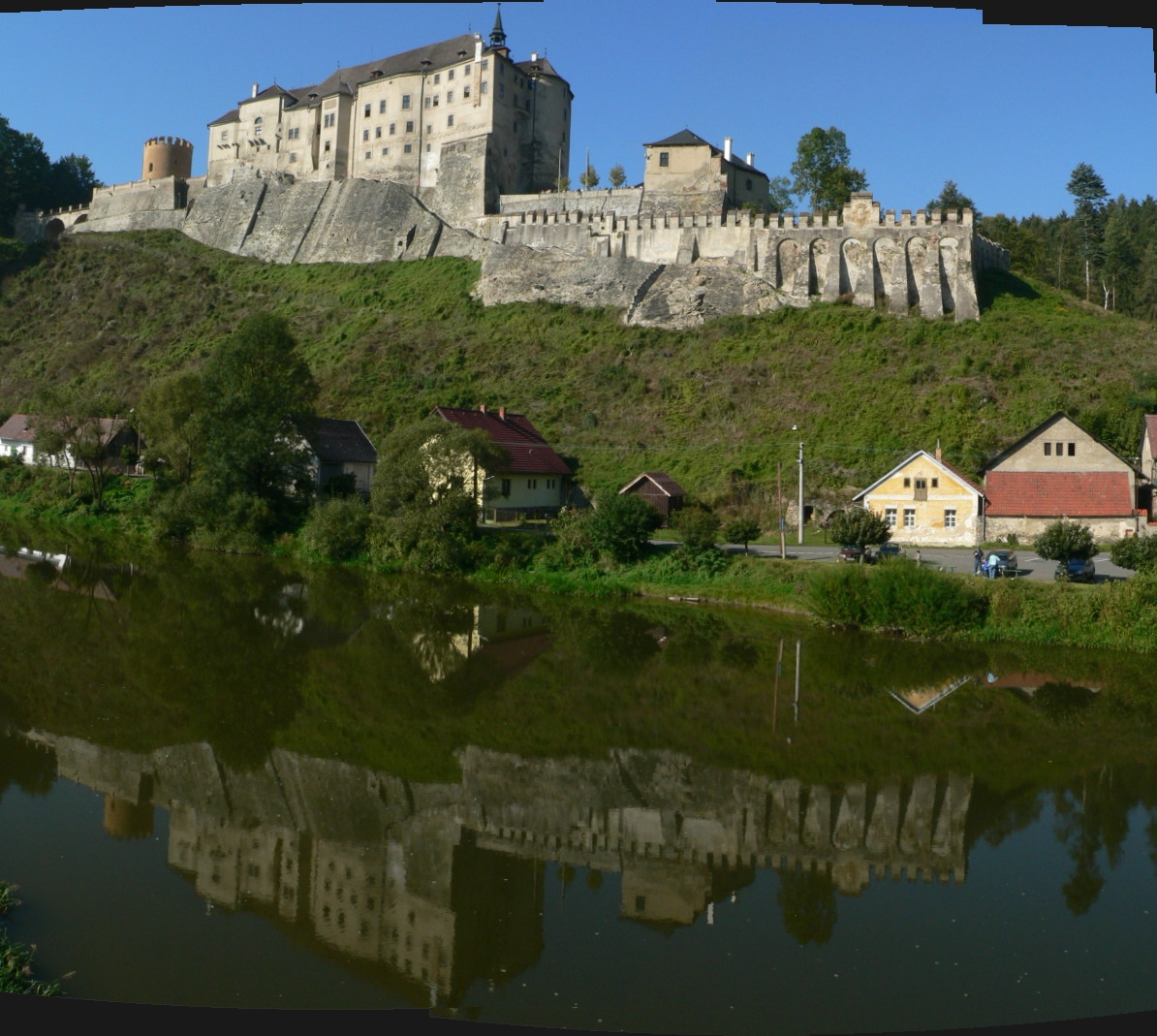
Pirkštejn Castle is an exemplary model of a bergfried castle, a type prevalent in medieval Central Europe characterized by a tall, freestanding bergfried tower that served as a last line of defense. The castle is strategically positioned on a southwestern promontory overlooking the town of Rataje nad Sázavou, utilizing natural landforms to enhance its defensive capabilities.
Unlike many contemporaneous castles, Pirkštejn notably lacks a bailey or enclosed courtyard, likely due to its proximity to the adjacent town. Instead, a neck ditch was carved to separate the castle’s rocky promontory from the urban area, creating a formidable natural and man-made barrier against attackers.
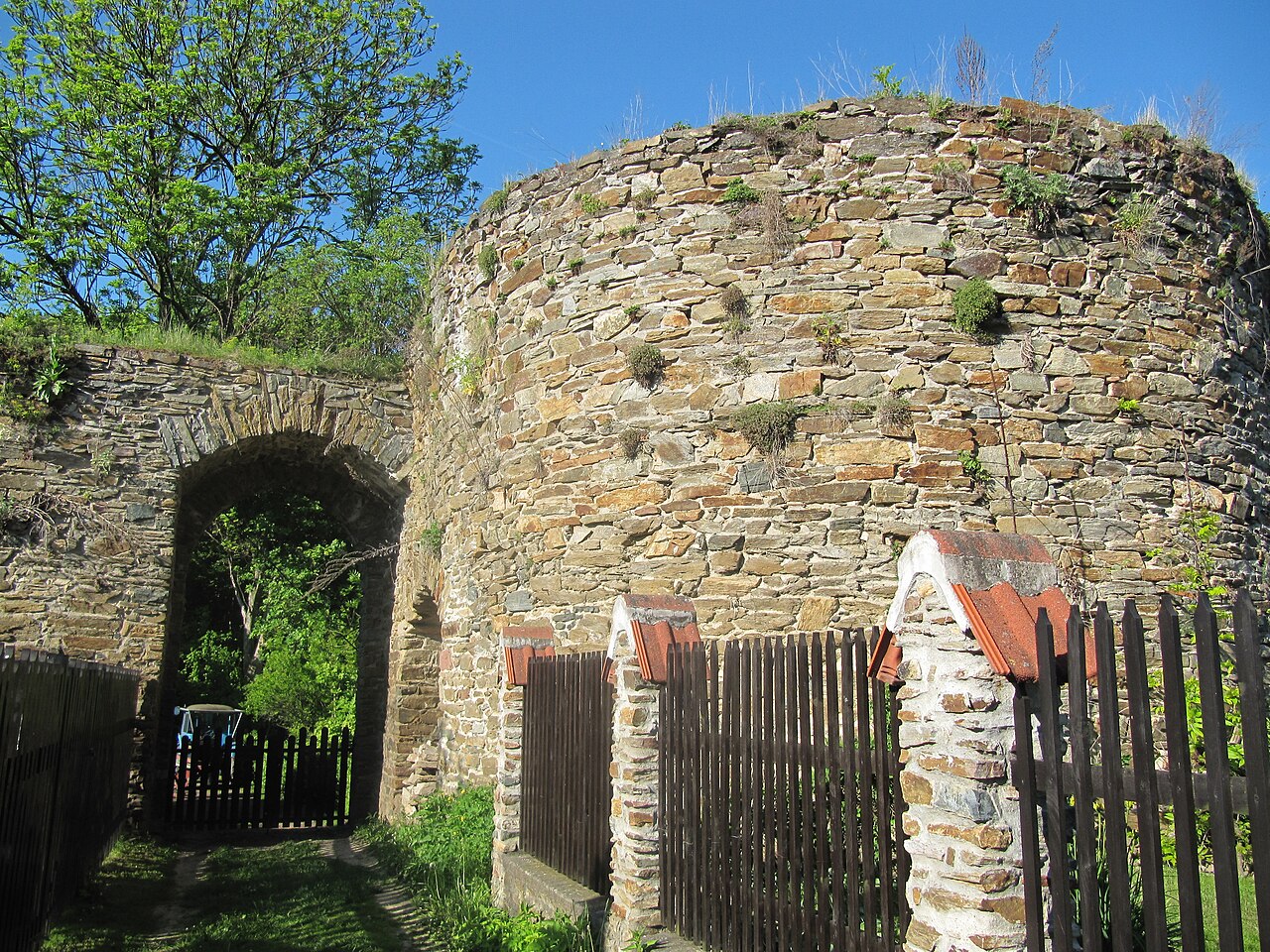
The heart of the castle is dominated by a free-standing, round bergfried tower, which was the main defensive structure. Surrounding this tower is a curtain wall, a robust stone barrier designed to protect the inner areas. The battlement walkway atop the curtain wall allowed guards to monitor the castle entrance and the surrounding landscape effectively.
At the rear of the castle, on the slope of the promontory, lies the most secure section: a palace with a symmetrical layout consisting of three rooms on each floor. This palace reflects the residential aspect of the castle, combining comfort with defense. Below this area, the lower slopes are enclosed by a zwinger, an additional defensive wall outside the main curtain wall intended to slow down and expose attackers.
On either side of the castle courtyard, remnants of supporting economic buildings can still be seen, indicating the castle’s multifunctional nature beyond pure military defense. These structures likely housed workshops, storerooms, and other facilities essential for sustaining the castle’s inhabitants.
Historical evolution and ownership
Throughout its history, Pirkštejn Castle served as a key seat of regional power well into the 16th century. During this time, the nearby upper castle was transformed into a Renaissance-style chateau by the Malešice family, reflecting changing architectural tastes and residential preferences of the nobility. Ownership of Pirkštejn shifted multiple times, passing through prominent families such as the Švamberk family and Viktorín of Poděbrady.
The castle's military significance diminished after suffering damage during the peasant uprising of 1627. Following this event, Pirkštejn ceased to function as a military fortress and gradually transitioned to other uses.
Ecclesiastical adaptation and modern status
Between 1713 and 1724, the castle complex underwent significant changes as it was adapted for ecclesiastical use. It became a parish house complete with a bell tower, marking a shift from its original defensive and residential functions to a religious role within the community.
Since 1958, Pirkštejn Castle has been protected as a cultural monument by the Czech Republic, recognizing its historical and architectural significance. The site remains under church ownership and, since 2015, has been leased to a private individual. Despite its partial ruinous state, the castle continues to inspire cultural works, including literature and video games, underscoring its enduring legacy.
Preservation and current remains
Today, Pirkštejn Castle is preserved as visible ruins that provide valuable insight into medieval fortification architecture and the evolution of noble residences in the region. Key surviving elements include parts of the palace, the bergfried tower, and sections of the curtain walls. These remnants illustrate the castle’s original defensive layout and residential complexity.
The castle’s unique design, especially the absence of a bailey and the presence of a neck ditch, highlights the adaptation of fortifications to the natural terrain and urban proximity. The surviving zwinger and economic buildings further emphasize the castle’s multifaceted role as a fortress, residence, and economic center.
Visitors to Pirkštejn Castle can explore these ruins to appreciate the architectural ingenuity and historical depth of this High Medieval hill castle that has witnessed centuries of Bohemian history.
Frequently asked questions (FAQ)
- What is the historical significance of Pirkštejn Castle?
- Pirkštejn Castle, located in Rataje nad Sázavou, dates back to the 14th century and is a remarkable example of Gothic architecture in the Czech Republic. It served as a noble residence and played a role in the region's history, witnessing various significant events over the centuries.
- When was Pirkštejn Castle built?
- The construction of Pirkštejn Castle began in the mid-1300s, with significant modifications and expansions occurring in subsequent centuries. Its rich history reflects the architectural evolution from Gothic to Renaissance styles, showcasing the castle's long-standing importance.
- What are the opening hours for Pirkštejn Castle?
- Pirkštejn Castle typically opens to visitors from April to October, with specific hours varying by season. It's advisable to check the official website or contact the castle directly for the most accurate and current information regarding opening times.
- Can I take guided tours of Pirkštejn Castle?
- Yes, guided tours are available at Pirkštejn Castle, providing visitors with in-depth knowledge about its history and architecture. These tours are a great way to enhance your experience and learn about the fascinating stories behind the castle.
- Is it possible to access Pirkštejn Castle with a wheelchair?
- Pirkštejn Castle has some accessibility options, but due to its historical architecture, certain areas may be challenging for wheelchair users. It is recommended to contact the castle administration in advance to inquire about specific accessibility features and accommodations.
- What are the ticket prices for visiting Pirkštejn Castle?
- Ticket prices for Pirkštejn Castle vary depending on age and the type of tour. Generally, there are discounts for children and seniors, while group rates may also be available, making it an affordable destination for families and groups.
- When is the best time to visit Pirkštejn Castle?
- The best time to visit Pirkštejn Castle is during the spring and early autumn months when the weather is pleasant and the surrounding landscape is beautiful. Additionally, visiting during these times allows you to avoid the larger summer crowds.
- What nearby attractions can I explore when visiting Pirkštejn Castle?
- While visiting Pirkštejn Castle, you can also explore the scenic town of Rataje nad Sázavou and nearby natural attractions such as the Sázava River. Other historical sites and castles in the vicinity offer a rich cultural experience for visitors.
Information
Loading map...
Visitor reviews
No reviews yet. Been here? Write the first review and help other travelers!
Write the first reviewVisited this castle? Share your experience
Your review helps other travelers and adds first-hand knowledge to our encyclopedia.