Talmberk Castle
Talmberk Castle stands as a significant example of a late medieval hill castle located in the municipality of Talmberk, within the Central Bohemian Region of the Czech Republic. Constructed around the late 13th to early 14th century, it served as a strategic stronghold for the Bohemian nobility, particularly the lords of Talmberk, who played notable roles in regional politics and ecclesiastical affairs.
The castle's origins are closely linked to the noble family associated with Hroznata of Úžice, active in the 1280s, whose descendants adopted the name "of Talmberk". This lineage included influential figures such as the brothers Diviš and Nezamysl, who held the estate in the first half of the 14th century. Diviš's son, Petr of Talmberk, was distinguished for his ecclesiastical career as a canon and chaplain, underscoring the family's integration into both secular and religious spheres.
Historical significance and ownership changes
The castle's history is marked by conflict and shifting ownership. In 1385, the fortress was seized by the Medek brothers of Valdek, who imprisoned the lord Diviš for over seven years and temporarily assumed the castle's name. A legal dispute eventually restored the castle to Diviš, who later became the burgrave of Prague Castle in 1400, an important administrative role within the kingdom.
Throughout the 15th century, Talmberk Castle passed through several noble families, including the Ojíř of Očedělice, the Šumburk family, and finally the Slavatové of Chlum. Under their ownership, the castle ceased to function as a primary residence and was gradually abandoned by the early 16th century. By 1533, it was recorded as deserted, and over subsequent centuries, the structure fell into ruin with its stones repurposed for local construction.
Architectural features and defensive design
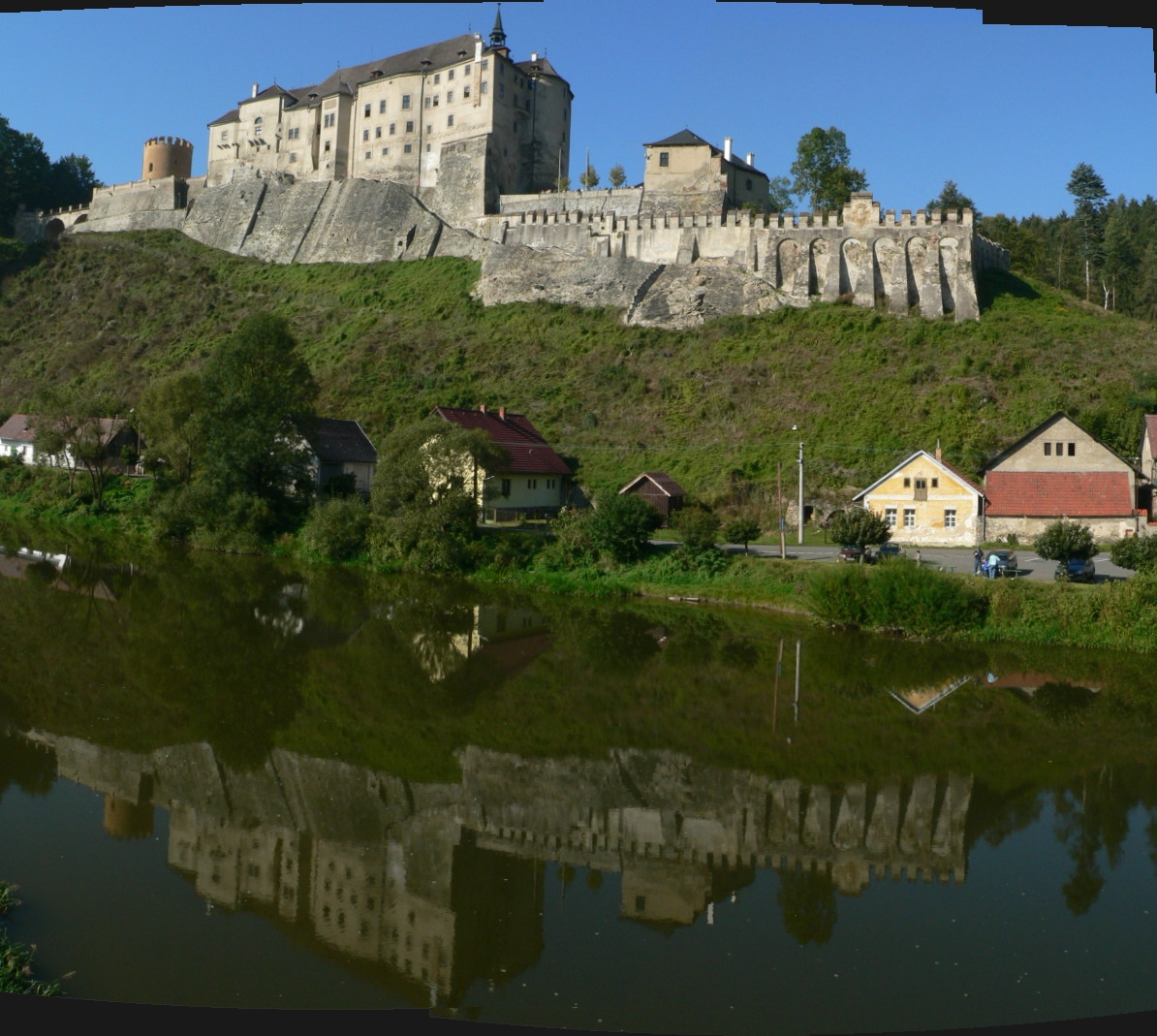
Talmberk Castle exemplifies the bergfried-type fortress typical of medieval Central Europe. Positioned on a rocky promontory about 365 meters above sea level, it commands a strategic view over the confluence of two streams. The natural topography provided steep slopes on most sides, restricting access primarily to the north and enhancing its defensibility.
The castle's defensive system included two moats separated by a rocky ridge, with a bastion situated between them, as depicted in 18th and early 19th-century illustrations. At the eastern foot of the promontory, a pond further guarded the approach, controlling access routes.
The core of the castle was an approximately rectangular enclosure with rounded northern corners. A surviving zwinger on the northern side functioned as an outer ward designed to trap attackers between walls. The main entrance was located beneath a large tower, enhancing its defensive capability.
The bergfried and towers
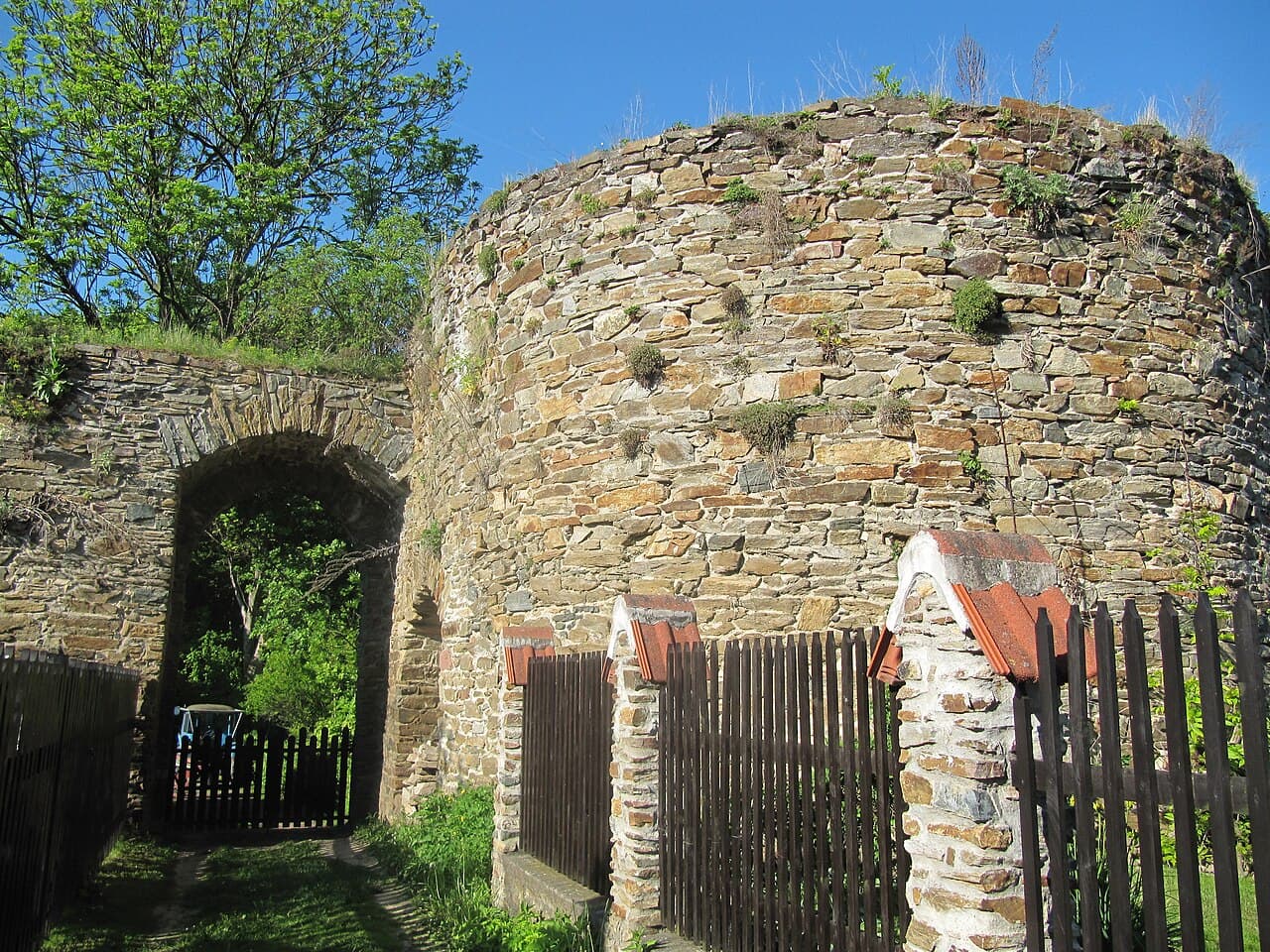
The castle's most prominent architectural feature is the large round bergfried at the northeastern corner of the curtain wall. Measuring about 9.3 meters in diameter at ground level, this tower was primarily defensive, with its entrance positioned approximately seven meters above ground to deter attackers. Small windows illuminated the floor above the entrance, while narrow arrow slits near the top allowed defenders to use bows and crossbows effectively.
Adjacent to the bergfried is a smaller round tower, which some scholars suggest may have been heated by tiled stoves, though its small interior size raises questions about this function. The southern section of the castle contained the remains of a palace complex, with only fragments of external walls surviving today.
Additional structures and later modifications
Archaeological excavations beneath the zwinger uncovered a vaulted cellar or basement, possibly part of a later addition or the core of the original residential palace. The castle's original gatehouse was replaced after the Medek family's seizure with a simpler gate in the front wall. Modern masonry visible around this gate dates mainly from reconstruction following the partial collapse of a tower in 1933, although the original portcullis slot remains intact.
Over time, the ruins became integrated into 19th-century residential buildings constructed within the castle's footprint, altering parts of the site and limiting direct access. Today, a marked hiking trail connects the castle ruins to nearby towns, offering visitors a glimpse into its medieval past despite modern encroachments.
Preservation and cultural importance
Following centuries of neglect and partial dismantling, efforts to preserve Talmberk Castle began in the 19th century but faced financial limitations. A significant tower collapse in 1933 led to partial dismantling for safety reasons. Further deterioration occurred through the 20th century until conservation measures culminated in the stabilization of the ruins in 2008.
Since 1958, the site has been legally protected as a cultural monument, recognizing its historical and architectural value. The ruins provide important insights into medieval military architecture and the socio-political history of Bohemia during the Late Middle Ages.
Visitors to Talmberk Castle can explore the remains of its defensive walls, towers, and courtyards, gaining an understanding of the strategic considerations that shaped its construction and use. The castle's location and surviving features illustrate the typical design of a bergfried castle adapted to a rocky hilltop environment, reflecting the military and residential needs of its medieval owners.
Frequently asked questions (FAQ)
- How do I get to Talmberk Castle?
- Talmberk Castle is accessible via marked hiking trails from nearby towns in the Central Bohemian Region. The site is located on a rocky hilltop near the village of Talmberk, and visitors can reach it by foot from local parking areas.
- What is the historical significance of Talmberk Castle?
- Talmberk Castle was a strategic medieval stronghold built in the late 13th or early 14th century. It served as the seat of the lords of Talmberk and played a role in regional conflicts and administration during the Late Middle Ages.
- Can I explore the interior of the castle ruins?
- While the castle is largely in ruins, visitors can walk around the site and view the remains of the bergfried, defensive walls, and courtyards. Some areas are integrated with 19th-century buildings, so access to certain parts may be limited.
- When is the best time to visit Talmberk Castle?
- The best time to visit is during the warmer months, from late spring to early autumn, when hiking trails are accessible and the weather is favorable for outdoor exploration.
- Is there an entrance fee to visit Talmberk Castle?
- There is no entrance fee to visit the ruins of Talmberk Castle, making it an accessible historical site for all visitors.
- Are there guided tours available at Talmberk Castle?
- Guided tours are not regularly offered at Talmberk Castle, but local tourist information centers may provide occasional guided walks or historical talks about the site.
Photo gallery

Information
Current owner
State
Loading map...
Visitor reviews
No reviews yet. Been here? Write the first review and help other travelers!
Write the first reviewVisited this castle? Share your experience
Your review helps other travelers and adds first-hand knowledge to our encyclopedia.