Pir Huseyn Khanqah
The Pir Huseyn Khanqah and Mausoleum is a significant architectural and historical monument located on the left bank of the Pirsaat River in Azerbaijan, approximately 126 kilometers southwest of Baku. This complex, dating to the 13th century, served as a khanqah, or dervish monastery, and mausoleum, reflecting the spiritual and cultural life of the region during the High Medieval period. It is an important example of Islamic architecture in the Shirvan region and provides valuable insight into the religious and artistic traditions of the time.
The khanqah was commissioned by Sharaf al-Dawla wal-din Hasan during the reign of the Shirvanshah Afridhun Abul-Muzaffar Fariburz III (1225–1255), as indicated by an inscription over the portal deciphered by V. Kratchkovskaya in 1952. The mausoleum within the complex houses the tomb of Pir Huseyn bin Ali, an Azeri sheikh of the Qalandari sect believed to have lived in the 11th century. His tomb was reconstructed and completed in 1280 CE by 'Umar, son of Muhammad al-Shirzadi of Qazvin. This layering of construction suggests that the site was originally sacred, with the khanqah built around the older tomb to serve as a center for Sufi religious activities.
Architectural layout and fortifications
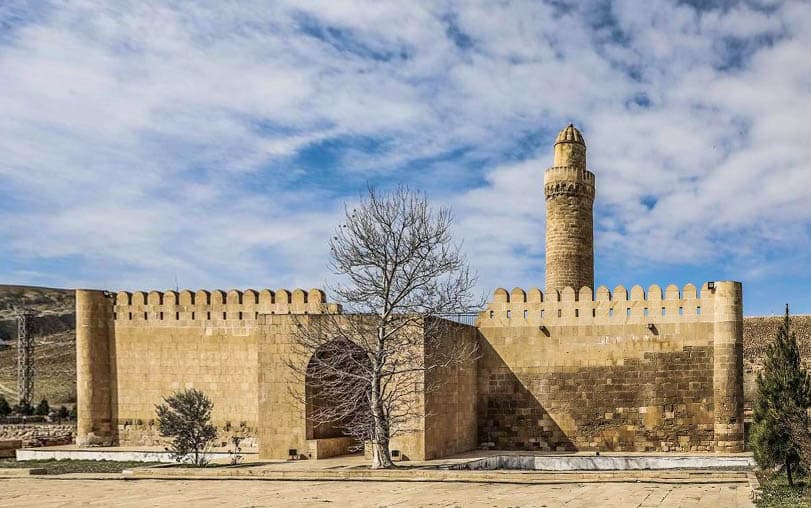
The complex is built primarily of cut stone and features a roughly rectangular plan centered on an open courtyard. The design resembles a ribat, a fortified monastery common in Islamic architecture, combining defensive features with religious functions. The courtyard is enclosed by crenellated rampart walls which are strengthened by round bastions at each corner and semicircular bastions positioned at the midpoint of the south, east, and west walls, providing strategic defensive points.
A monumental gate is located centrally on the eastern wall, serving as the main entrance to the complex. Surrounding the courtyard are halls of varying sizes, including a mosque situated on the western wing and a single minaret near the northeastern corner. These elements highlight the khanqah's dual role as both a religious center and a fortified refuge.
Defensive features
The bastioned fortress classification is appropriate given the presence of substantial defensive structures. The crenellated walls and bastions would have provided protection against invaders, while the elevated position near the riverbank enhanced its strategic value. The combination of religious and military architecture reflects the turbulent conditions of the region during the 13th century, when such complexes needed to serve multiple functions.
Artistic significance and tilework
One of the most remarkable features of the Pir Huseyn Khanqah is the extensive use of glazed tiles that decorated the interior of the mausoleum and the sheikh's sarcophagus. By the early 20th century, these tiles had largely disappeared from the site, but research by V. Kratchkovskaya in the 1940s identified over four hundred tiles in museum collections in St. Petersburg and Tbilisi.
The tiles include cross-shaped and eight-pointed star-shaped designs, with the star tiles featuring intricate floral motifs and depictions of birds, horses, and fish painted on a turquoise background. The tiles are bordered by inscriptions on a white ground, adding to their artistic and cultural value. The quality and style of the tiles suggest they were crafted by Persian artisans, likely from the renowned ceramic centers of Kashan or Tabriz, as no local ceramic workshops are known to have existed in the Shirvan Shahi territory at that time.
Cultural and religious importance
The khanqah was dedicated to Pir Huseyn Rawanan, a revered mystic and imam, whose spiritual legacy attracted followers and pilgrims. The complex served as a center for the Qalandari Sufi sect, known for its distinctive religious practices and emphasis on mysticism. The presence of a mosque and minaret within the complex underscores its function as a place of worship and religious instruction.
Historical context and legacy
The construction of the Pir Huseyn Khanqah occurred during a period of significant political and cultural development in the Shirvan region. The reign of Fariburz III was marked by efforts to consolidate power and patronize religious institutions. The khanqah reflects these trends, combining military architecture with spiritual purpose.
Over the centuries, the site has experienced varying degrees of preservation and loss. While much of the original tile decoration has been removed or lost, the surviving architectural elements provide valuable evidence of 13th-century Islamic architecture in Azerbaijan. The khanqah remains an important monument for understanding the religious and artistic history of the region.
Preservation status
Today, the Pir Huseyn Khanqah is classified as a well-preserved bastioned fortress complex, though some elements have suffered damage or loss over time. Conservation efforts have focused on maintaining the structural integrity of the ramparts, bastions, and key architectural features. The site is accessible to visitors interested in medieval Islamic architecture and Azerbaijani cultural heritage.
Visitor information and significance
While the exact city location is not specified, the khanqah's proximity to Baku and its position along the Pirsaat River make it a notable destination for those exploring Azerbaijan's medieval history. The complex offers insights into the fusion of religious, military, and artistic traditions during the 13th century. Visitors can observe the fortress-like defensive structures alongside the remains of the mausoleum and mosque, experiencing a unique blend of spiritual and architectural heritage.
Frequently asked questions (FAQ)
- When was the Pir Huseyn Khanqah built?
- The Pir Huseyn Khanqah was constructed in the 13th century during the reign of Shirvanshah Fariburz III (1225–1255).
- What architectural style characterizes the khanqah?
- The khanqah features a fortified design resembling a ribat, with crenellated ramparts, round and semicircular bastions, and a monumental eastern gate.
- Who was Pir Huseyn Rawanan?
- Pir Huseyn Rawanan was an 11th-century Azeri sheikh of the Qalandari Sufi sect, whose tomb is central to the khanqah complex.
- What is notable about the tiles found at the mausoleum?
- The mausoleum was once covered with glazed tiles featuring floral motifs and depictions of animals, crafted by Persian artisans from Kashan or Tabriz.
- Is the Pir Huseyn Khanqah accessible to visitors?
- Yes, the khanqah is accessible to visitors interested in medieval Islamic architecture and Azerbaijani cultural heritage, although specific visiting hours are not widely published.

Information
Loading map...
Visitor reviews
No reviews yet. Been here? Write the first review and help other travelers!
Write the first reviewVisited this castle? Share your experience
Your review helps other travelers and adds first-hand knowledge to our encyclopedia.