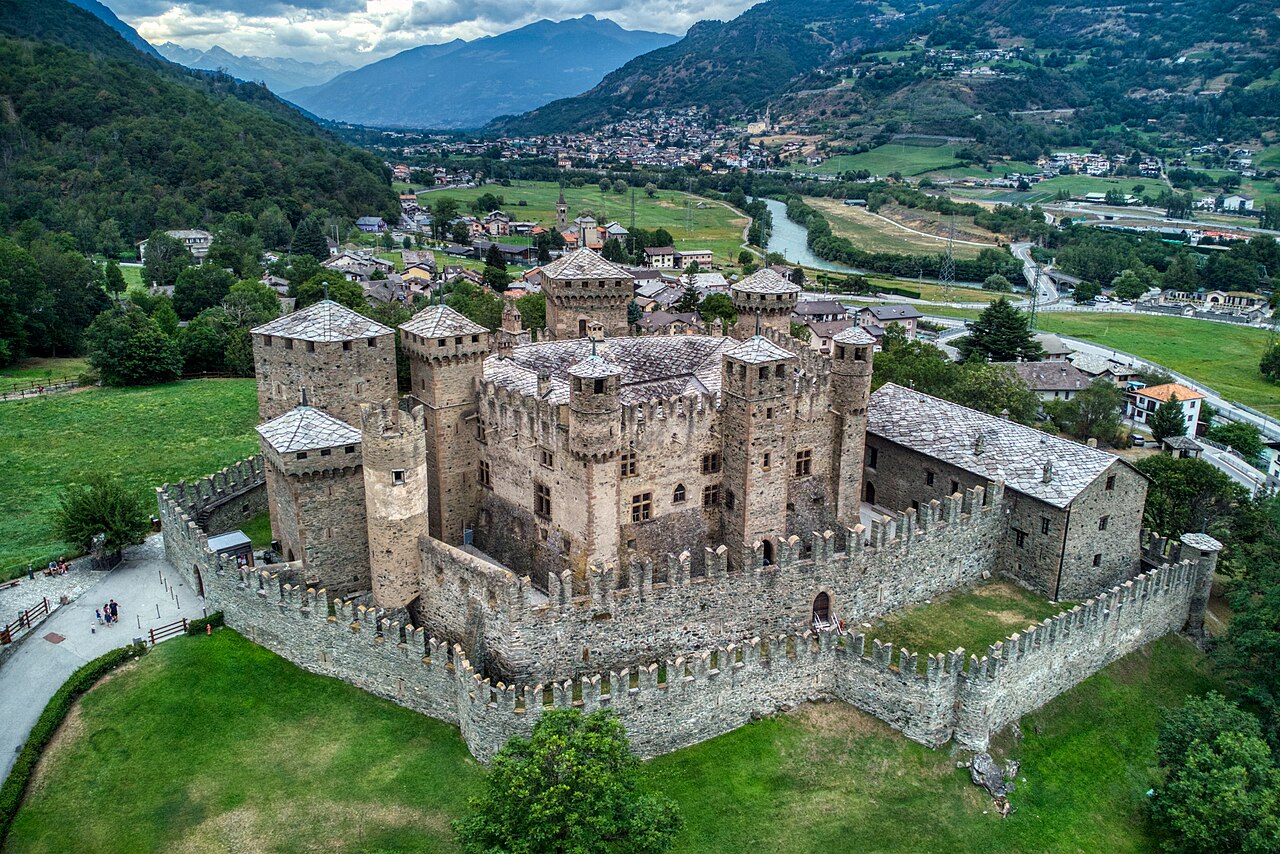
Pilato Castle stands as a significant medieval fortress located in the heart of Nus, Italy. Built during the 12th century, this hill castle was originally constructed by the lords of Nus as a fortified residence and strategic stronghold. Its position at the entrance to the village allowed it to control the route from the nearby town of Aosta, making it an important defensive and administrative center during the high medieval period.
The castle’s origins are somewhat debated, with scholarly sources suggesting construction dates ranging from the mid-12th century through the 14th century. The earliest documented mention of Pilato Castle appears in 1337, in a feudal homage involving Alexandre and Jean de Nus, where it was described as a fortified, crenellated house. This indicates the castle’s role as a noble residence and a military installation guarding local territory.
Historical background and legends
The castle’s name is linked to a local legend involving Pontius Pilate, the Roman procurator known for his role in Judea. According to tradition, Pilate stopped at the site on his way to exile in Vienne, France. This legend gained traction after the 1846 discovery of Roman coins and medals among the ruins, suggesting a Roman presence at the location. However, historical records clarify that prior to the medieval fortress, the site hosted a Roman mansio—an official lodging or rest stop along Roman roads—rather than a Roman castle or fortification.
During its active use, Pilato Castle served as the residence of the lords of Nus until a devastating fire at the end of the 16th century led to its abandonment. Following the fire, the lords relocated to a nearby fortress overlooking the Saint-Barthélemy valley, known as Nus Castle. The fire not only damaged the structure but also destroyed archival documents related to the family, resulting in a loss of much of the castle’s early history.
Architectural features and layout
The remains of Pilato Castle reveal a rectangular fortified house that originally rose to four stories. The fortress was built with bare stone walls and featured two cylindrical towers projecting at the corners, which served as lookout points and defensive positions. These towers are among the best-preserved elements of the castle today.
The castle’s southern wall was a defining feature, containing the main entrance gate flanked by defensive corner towers. This wall was removed during road widening efforts between the late 19th and early 20th centuries but was partially reconstructed later. Unfortunately, a car accident in the 1960s destroyed this section again, and it remains only partially restored to this day.
Inside the castle, remnants of domestic architecture include a large fireplace on one wall, indicating the living quarters within the fortified structure. A notable decorative element is a stone jamb carved for a cross-shaped window on the western wall, likely added during a later phase of construction, reflecting evolving architectural styles and the castle’s adaptation over time.
Restoration and visitor experience
Recent restoration efforts have focused on preserving the ruins while making the site accessible to visitors. A modern glass and steel roof protects parts of the ruins from the elements, and a steel staircase with wood cladding has been installed on the southern side where the original wall once stood. This staircase leads visitors up to the battlement walkway and the two cylindrical towers, allowing panoramic views and a tangible connection to the castle’s defensive function.
Informational panels inside the castle provide historical context about Nus village and the castle itself, enhancing the educational value of the visit. Although modern interventions are evident, they are designed to respect the castle’s medieval character and to facilitate public engagement with this important heritage site.
Significance and cultural heritage
Pilato Castle is an important example of high medieval hill castle architecture in the Aosta Valley region. Its ruins offer insights into the defensive strategies, domestic arrangements, and feudal governance of the period. The castle’s association with local legends and Roman history adds layers of cultural significance, making it a notable landmark for both historians and tourists.
Despite the damage caused by fire and modern development, the castle’s surviving structures and ongoing restorations ensure that Pilato Castle remains a valuable monument reflecting the medieval heritage of Nus and the broader region.
Frequently asked questions (FAQ)
- When was Pilato Castle built and by whom?
- Pilato Castle was built in the 12th century by the lords of Nus as a fortified residence and strategic stronghold.
- What is the legend associated with Pilato Castle?
- Local legend claims that Pontius Pilate stopped at the castle site on his way to exile, a story linked to the discovery of Roman coins and a Roman mansio at the location.
- Is Pilato Castle open to visitors?
- Yes, the castle ruins have been partially restored and are open to visitors, with access to the towers via a modern staircase.
- What remains of the original castle can be seen today?
- Visitors can see the rectangular fortified house ruins, two cylindrical towers, parts of the outer walls, and a large fireplace inside the castle.
- How has Pilato Castle been preserved?
- Restoration efforts include a protective glass and steel roof over parts of the ruins and a steel staircase for visitor access, although some sections remain only partially restored.
Information
Loading map...
Visitor reviews
No reviews yet. Been here? Write the first review and help other travelers!
Write the first reviewVisited this castle? Share your experience
Your review helps other travelers and adds first-hand knowledge to our encyclopedia.