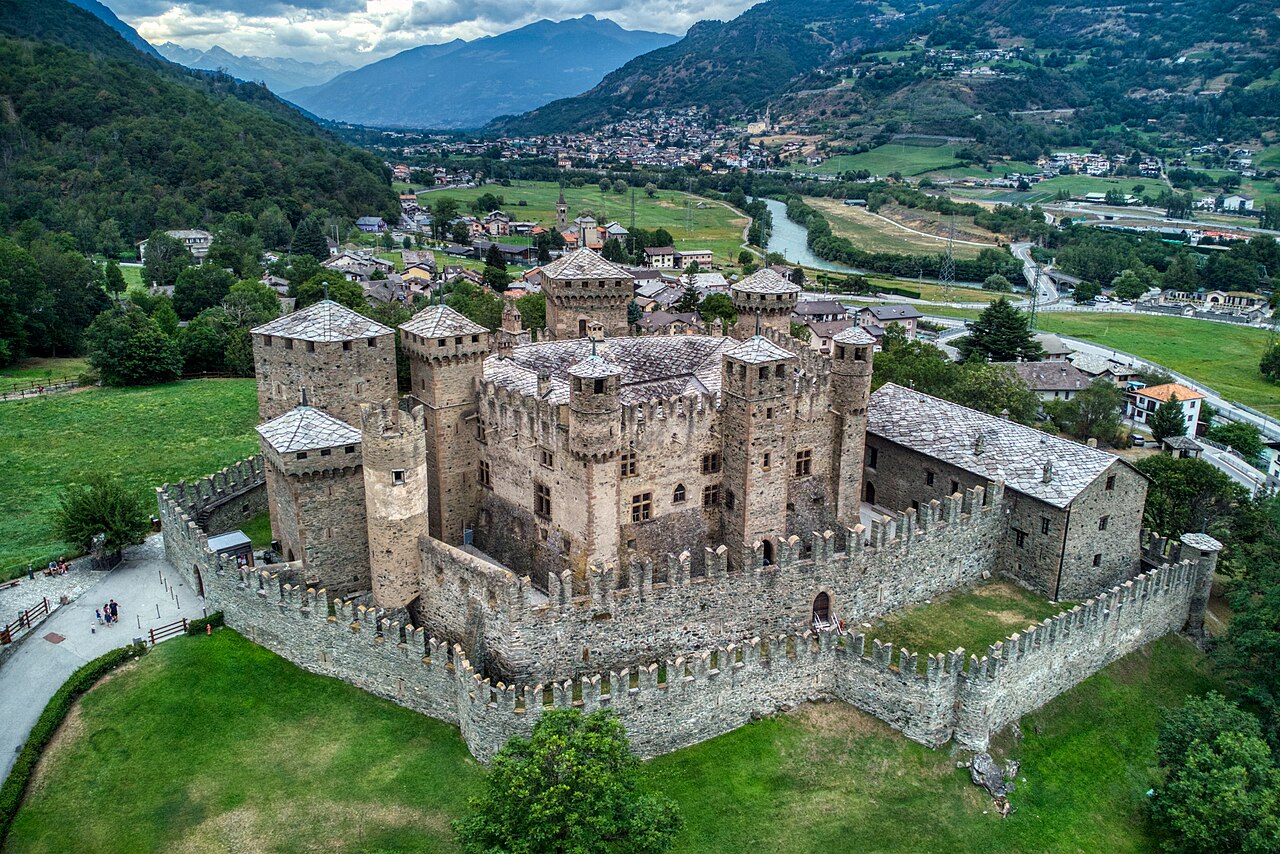
Castello di Saint-Marcel
The Castello di Saint-Marcel is a notable example of a hill castle located in the municipality of Saint-Marcel, within the scenic Aosta Valley region of Italy. Constructed primarily during the late 15th and early 16th centuries, this castle reflects the architectural and feudal traditions of the period, standing on the right bank of the valley as a symbol of noble power and regional control.
The castle was originally built by Giacomo di Challant-Aymavilles, a member of the influential Challant family, who were significant feudal lords in the Aosta Valley. The Challant lineage had a longstanding presence in the region, with their estates including the nearby Ussel fief. The earliest known lord associated with Saint-Marcel was Ebalo Magno (Yblet I. von Challant), who served as Viscount of Aosta. He expanded the family's holdings to include Saint-Marcel, Ussel, and Chenal di Montjovet, consolidating their territorial influence.
Historical development and ownership
During the 17th century, the castle changed ownership when it was acquired by Baron Paolo Emanuele di San Secondo as part of a dowry agreement related to his fiancée. Ownership later passed to Carlo Emanuele di San Secondo, and throughout much of the 18th century, the castle was held by the Bianco counts of San Secondo di Pinerolo. This period marked a transition from purely feudal control to more complex aristocratic ownership.
In a later phase, the property was acquired by the Mining Exploration Society of Saint-Marcel, indicating a shift in the castle's role from noble residence to an asset linked with industrial and economic activities in the region. By the 20th century, the castle had fallen into significant disrepair and was transferred to municipal ownership.
Architectural features and layout
The Castello di Saint-Marcel originally featured a square plan typical of late medieval rural residences. The structure was built using local stone masonry, characteristic of castles in the Aosta Valley, providing both defensive strength and durability against the mountain climate.
A prominent feature is the dominant square tower located at the northwest corner, which served both defensive and residential purposes. This tower was later reinforced during restoration efforts, particularly its southern side which had suffered partial ruin. The castle also includes two small turrets on corbels projecting from the northern and eastern corners of the main building. These turrets bear architectural similarities to those found at the nearby Ussel castle, suggesting a regional style or shared builder influence among noble estates.
The lords of Fénis contributed to the castle’s expansion by adding a rectangular wing on the western side. This addition likely served as a private apartment, enhancing the residential comfort and status of the castle’s occupants.
Interior elements
The interior of the castle once featured wooden ceilings, which combined structural support with aesthetic appeal. Several rooms retain traces of large fireplaces, essential for heating and cooking in the mountainous environment. Over time, the castle lost its roof and suffered structural weakening, leading to its decline before restoration.
Restoration and preservation efforts
Starting in the early 21st century, the castle became the focus of significant restoration projects. Regional initiatives such as the Alcotra program (2007-2013) and the European Interreg IIIA "AVER" initiative aimed to develop and test restoration techniques for medieval ruins. These efforts reflect a broader commitment to preserving the cultural heritage of the Aosta Valley.
Between 2011 and 2012, restoration work concentrated on stabilizing the square tower and the western wing. Techniques such as "ringing"—which involves reinforcing walls to prevent collapse—were applied. A new roof covering was installed to protect the interior from weather damage, and masonry repairs were made to damaged sections of the castle.
Today, the castle remains partially restored and is under the ownership of the Autonomous Region of Aosta Valley. While not fully accessible to the public, the preserved medieval features provide valuable insight into the region’s feudal architecture and history.
Significance within the Aosta Valley
The Castello di Saint-Marcel is an important example of a late medieval hill castle that illustrates the feudal dynamics and architectural styles of the Aosta Valley during the 15th and 16th centuries. Its connection to the Challant family and subsequent noble owners highlights the shifting patterns of land ownership and aristocratic influence in the region.
Architecturally, the castle’s features such as the square tower, turrets on corbels, and the stone masonry construction typify the defensive and residential needs of the period. The castle’s partial preservation allows scholars and visitors to appreciate the blend of military and domestic architecture that characterized noble residences in the Alpine valleys.
Moreover, the castle’s restoration contributes to regional cultural tourism and heritage education, linking the medieval past with contemporary conservation practices. Its location on a hill overlooking the Aosta Valley offers strategic views that would have been vital for surveillance and defense during its active use.
Frequently asked questions (FAQ)
- What is the historical significance of Castello di Saint-Marcel?
- Castello di Saint-Marcel is a medieval fortress that dates back to the 11th century. It played a crucial role in the defense of the Aosta Valley and reflects the architectural evolution of fortifications in the region over the centuries.
- When was Castello di Saint-Marcel built?
- Construction of Castello di Saint-Marcel began in the late 11th century and continued to be modified through the Middle Ages. Its strategic position made it an important military site, influencing its architectural development over time.
- What are the opening hours for visiting Castello di Saint-Marcel?
- The castle is open to visitors from 9 AM to 6 PM daily, with last entries at 5 PM. However, it is advisable to check for seasonal changes in opening hours or special closures before planning your visit.
- Can I take guided tours of Castello di Saint-Marcel?
- Yes, guided tours are available and highly recommended to fully appreciate the castle's rich history and architecture. These tours often provide insights that enhance the visitor experience and bring the castle's past to life.
- Is it possible to access Castello di Saint-Marcel with a wheelchair?
- The castle has limited accessibility due to its historical structure and uneven terrain. While some areas may be accessible, it is recommended to contact the castle administration in advance for specific information regarding mobility options.
- What is the best time to visit Castello di Saint-Marcel?
- The best time to visit is during the spring and fall when the weather is mild, and the surrounding landscape is particularly beautiful. Additionally, these seasons tend to be less crowded, allowing for a more enjoyable experience.
- Are there any nearby attractions to visit while at Castello di Saint-Marcel?
- Yes, visitors can explore several nearby attractions, including the charming village of Saint-Marcel and the stunning landscapes of the Aosta Valley. Additionally, other historical sites and hiking trails are within a short drive from the castle.
- How much do tickets cost for entering Castello di Saint-Marcel?
- Ticket prices for adults are €8, while reduced tickets for students and seniors are €5. Children under 12 can enter for free, making it an affordable option for families.
Information
Sources & official resources
Verify the information above using these authoritative references.
Loading map...
Visitor reviews
No reviews yet. Been here? Write the first review and help other travelers!
Write the first reviewVisited this castle? Share your experience
Your review helps other travelers and adds first-hand knowledge to our encyclopedia.