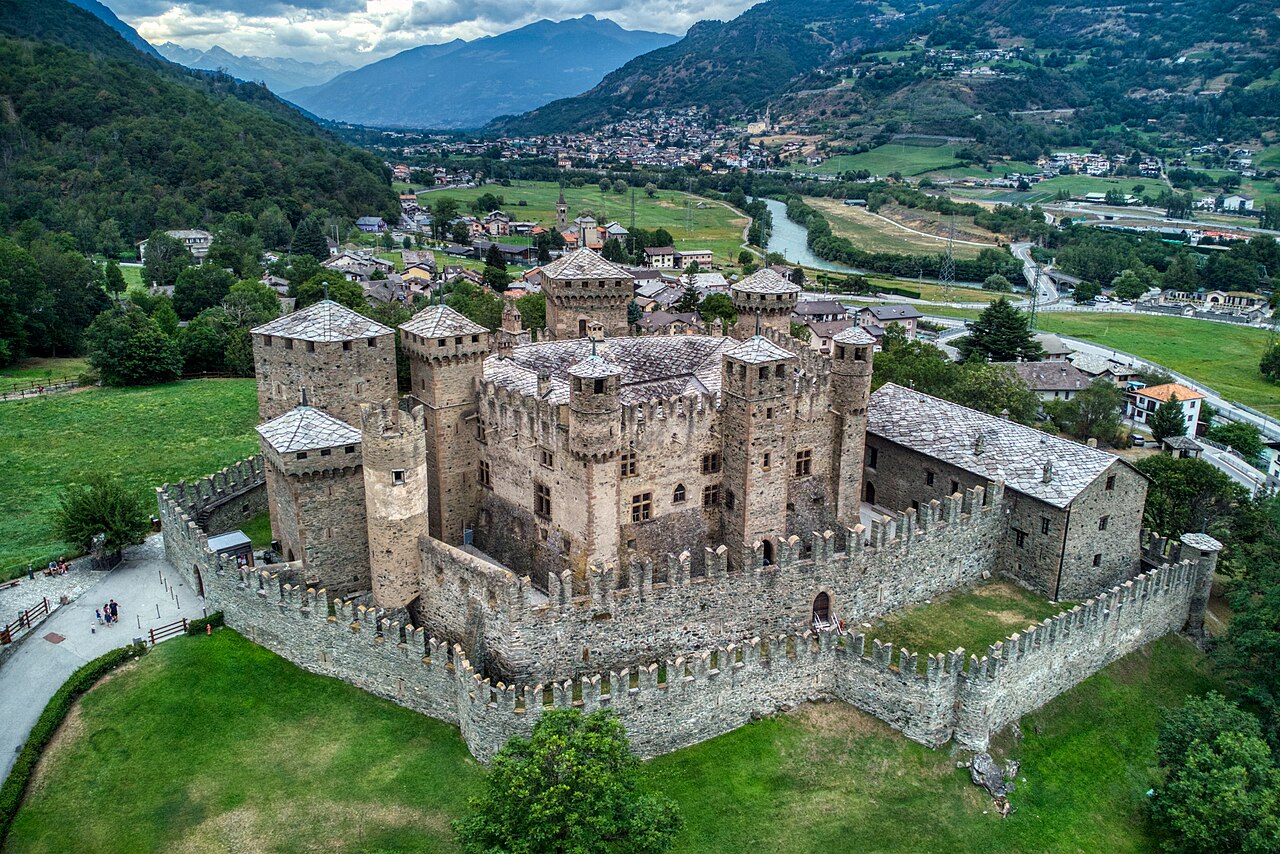
Nus Castle
Nus Castle rises prominently above the village of Nus in Italy, perched on a rugged rocky projection that commands the entrance to the Saint-Barthélemy valley. This strategic position provided both a defensive advantage and a commanding view of the surrounding landscape, crucial for controlling access through the valley during the High Medieval period. The castle's origins date back to at least the late 13th century, as documented in historical records, placing it firmly within the medieval fortress tradition of the region.
Early architectural features and origins
While the earliest surviving documentation of Nus Castle is from the end of the 13th century, architectural analysis suggests that parts of the castle, particularly the quadrangular turret located in the eastern sector, may be older. This turret, which unfortunately collapsed in the early 20th century, bore close resemblance to the defensive towers constructed in the valley during the 11th and 12th centuries. Such towers were typically built in the Romanesque style with thick stone walls and narrow arrow slits, designed primarily for defense and surveillance.
Structural evolution through the medieval centuries
The castle underwent several significant modifications during the 14th and 15th centuries. These changes reflected evolving military technologies and the needs of its occupants. The layout was adapted to improve fortifications and domestic accommodations, transitioning from a simple stronghold to a more complex fortified residence. The castle's walls, battlements, and internal structures were likely reinforced and expanded during this period to withstand sieges and accommodate a growing garrison.
Radical reconstruction in the late 16th century
A major transformation occurred around 1595, marked by a radical reconstruction campaign. This is evidenced by the date inscribed on the architrave at the entrance to the castle's courtyard. The renovation aimed to modernize the fortress, possibly adapting it to the changing nature of warfare, including the increased use of artillery. The reconstruction would have involved strengthening the walls, redesigning the courtyard, and updating living quarters to reflect Renaissance influences while maintaining defensive capabilities.
Architectural features and layout
The castle's final layout, as shaped by centuries of modifications, included a quadrangular plan typical of medieval fortifications in the region. Defensive elements such as towers, curtain walls, and a fortified courtyard were integral to its design. The collapsed eastern turret was a key feature, serving as both a lookout point and a defensive stronghold. The entrance architrave with its dated inscription is a notable architectural element, symbolizing the late Renaissance phase of the castle's evolution.
Materials and construction techniques
The castle was constructed primarily from locally sourced stone, laid in robust masonry to resist attacks and the test of time. The use of thick walls and narrow openings reflects medieval defensive strategies. The combination of medieval and Renaissance architectural techniques illustrates the castle's adaptation over centuries, blending functionality with the stylistic preferences of different eras.
Historical significance and strategic role
Nus Castle played a crucial role in controlling the entrance to the Saint-Barthélemy valley, an important route in the region. Its position allowed the occupants to monitor and regulate movement through the valley, which was significant for trade, military campaigns, and local governance. The castle's enduring presence through centuries of political and military changes highlights its importance as a regional stronghold.
Ownership and historical events
While specific details about the castle's owners and historical events it witnessed are limited, its architectural evolution suggests it remained a site of strategic and residential importance. The castle likely served local lords or feudal authorities, adapting to the shifting political landscape of medieval and Renaissance Italy.
Current condition and preservation
Today, Nus Castle stands as a partially preserved structure, with some original features lost, such as the collapsed eastern turret. Despite this, significant portions of the castle remain intact, allowing visitors to appreciate its historical and architectural value. Preservation efforts focus on maintaining the existing masonry and protecting the site from further deterioration.
Visitor experience
Visitors to Nus Castle can explore the rocky outcrop and remnants of the medieval fortress, gaining insight into its defensive design and historical context. The castle's elevated position offers panoramic views of the Saint-Barthélemy valley and surrounding landscape, enhancing the visitor experience with both cultural and natural attractions.
Frequently asked questions (FAQ)
- When was Nus Castle originally built?
- Nus Castle dates back to at least the late 13th century, with some architectural elements possibly from the 11th or 12th centuries.
- What architectural styles are reflected in Nus Castle?
- The castle features a blend of medieval defensive architecture with later Renaissance modifications from the late 16th century.
- Can I visit Nus Castle today?
- Yes, Nus Castle is partially preserved and accessible to visitors who wish to explore its historic ruins and enjoy views of the Saint-Barthélemy valley.
- What is the significance of the 1595 inscription at the castle?
- The 1595 date inscribed on the entrance architrave marks a major reconstruction phase that modernized and reinforced the castle's structure.
- Why was Nus Castle built on a rocky projection?
- Its location on a rocky outcrop provided a strategic vantage point to control the entrance to the Saint-Barthélemy valley and defend against invaders.
Information
Loading map...
Visitor reviews
No reviews yet. Been here? Write the first review and help other travelers!
Write the first reviewVisited this castle? Share your experience
Your review helps other travelers and adds first-hand knowledge to our encyclopedia.