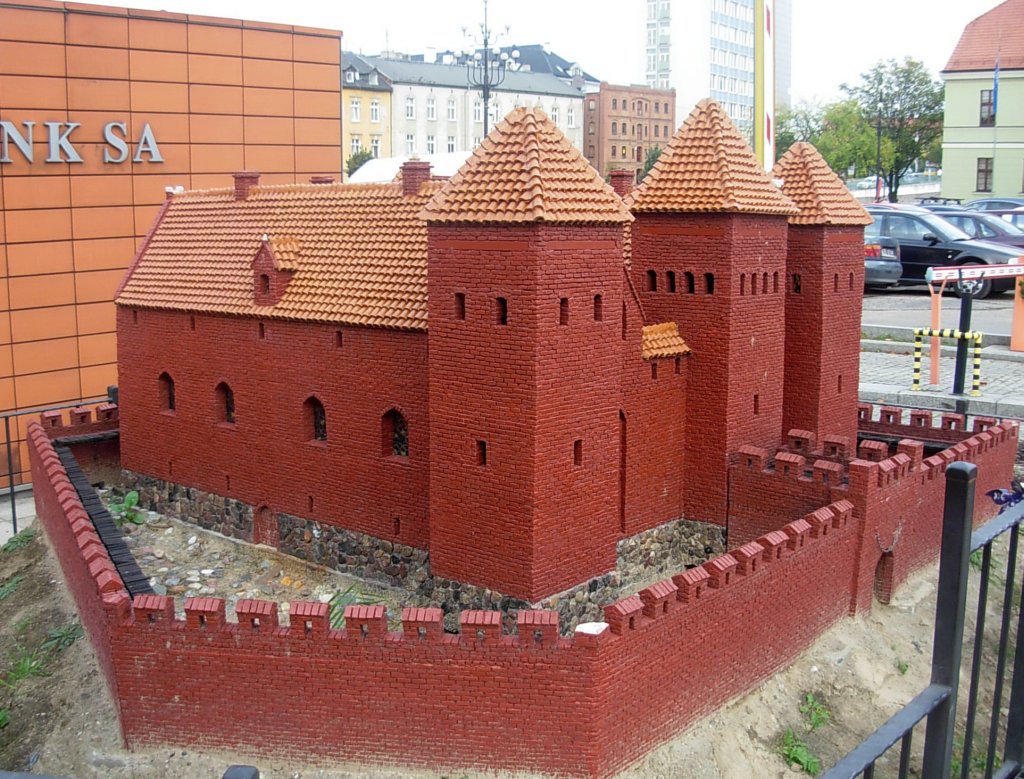
Pień
Pień Castle stands as a significant example of a high medieval bastioned fortress located in the village of Pień, Poland. Its origins trace back to the early medieval period, with written records from 1222 confirming the existence of an earlier fortified settlement or grodzisko on the site. This early stronghold was strategically positioned on a conical hill overlooking Lake Reptówka, a body of water formed from an old branch of the Vistula River. The location provided natural defensive advantages, combining elevated terrain with water barriers.
Early history and medieval origins
The initial fortified settlement was likely destroyed before the mid-13th century. Subsequently, the site came under the control of Świętopełk II, Duke of Pomerania, who is believed to have rebuilt the fortifications. Following his death in 1248, the territory was taken over by the Teutonic Knights, a powerful military order that played a crucial role in the region's medieval history.
At the beginning of the 15th century, the Teutonic Knights constructed a small stone castle on the site. This castle served as the seat of a prokuratoria (administrative district) within the Komturship of Bierzgłowo and later the Komturship of Toruń. However, historical sources do not conclusively determine whether this castle was built directly on the remains of the earlier fortification or at a nearby new location.
Architectural features and layout
Pień Castle was built atop the summit of a steep conical hill, which was naturally defensible. The castle's defensive system included a dry moat cutting off the hill's eastern side, the main approach route. This moat would have hindered attackers and provided an additional layer of protection.
Based on limited archaeological evidence and historical descriptions, the castle was probably a small, single-winged structure surrounded by a curtain wall. The exact configuration of the castle's buildings and defensive works remains unclear due to the fragmentary nature of the surviving data. There is no confirmed information about the presence of a bailey or outer ward, which might have housed auxiliary buildings or served as an additional defensive zone.
Strategic location
The castle's placement on a hill overlooking Lake Reptówka was a deliberate choice to maximize control over the surrounding landscape and waterways. The lake, formed from an ancient branch of the Vistula River, added a natural defensive barrier on several sides, complementing the man-made fortifications.
Historical significance and later developments
Pień Castle played a role in the political and military struggles of the region, especially during the conflicts between the Kingdom of Poland and the Teutonic Order. The castle's administrative function as a prokuratoria seat highlights its importance in the local governance and defense system of the Teutonic state.
Following the Second Peace of Toruń in 1466, which ended the Thirteen Years' War, the entire Chełmno Land, including Pień, was incorporated into the Kingdom of Poland. After this political shift, the castle's fate becomes obscure. There are no detailed historical records explaining its subsequent use, decline, or destruction.
Archaeological findings and current condition
Despite its historical significance, Pień Castle has not been the subject of extensive archaeological excavations. Surface surveys have failed to reveal visible remains of walls or other structural elements, making it difficult to reconstruct the castle's full layout and architectural details.
Today, the castle hill remains a prominent landmark, though the fortress itself survives only as a restored site rather than a fully preserved structure. The lack of above-ground ruins means that much of the castle's history and architecture must be inferred from historical documents and limited archaeological data.
Preservation and heritage value
Pień Castle's site holds cultural and historical importance as a testament to medieval military architecture and the turbulent history of the Chełmno Land. Efforts to preserve and study the site contribute to understanding the region's medieval past and the legacy of the Teutonic Order in Poland.
Visiting Pień Castle
The castle is situated in a picturesque setting near Lake Reptówka, offering visitors a glimpse into medieval fortification strategies and the natural landscape that shaped them. Although the physical remains are minimal, the site provides valuable context for enthusiasts of medieval history and architecture.
Visitors interested in the history of the Teutonic Knights and medieval Poland will find Pień Castle a noteworthy destination, especially when combined with visits to other nearby historic sites in the Chełmno Land region.
Frequently asked questions (FAQ)
- When was Pień Castle originally built?
- Pień Castle was originally built in 1248 by the Teutonic Knights after the site was taken over following Duke Świętopełk II's death.
- What architectural style characterizes Pień Castle?
- Pień Castle is a high medieval bastioned fortress, likely featuring a small single-winged stone structure surrounded by defensive walls and a dry moat.
- Can visitors see visible ruins of Pień Castle today?
- No visible ruins remain above ground at Pień Castle, as surface surveys have found no substantial wall remnants; the site is preserved mainly as a restored hilltop location.
- What was the strategic importance of Pień Castle's location?
- The castle was built on a conical hill overlooking Lake Reptówka, providing natural defense and control over the surrounding waterways and land routes.
- What happened to Pień Castle after the Second Peace of Toruń in 1466?
- After the 1466 treaty, Pień and the Chełmno Land became part of Poland, but the castle's later history and reasons for its decline remain unclear.
Information
Loading map...
Visitor reviews
No reviews yet. Been here? Write the first review and help other travelers!
Write the first reviewVisited this castle? Share your experience
Your review helps other travelers and adds first-hand knowledge to our encyclopedia.