Pęzino Castle
Pęzino Castle stands as a remarkable example of a medieval hill castle that evolved over centuries into a refined noble residence, located in the municipality of Pęzino in modern-day Poland. Originally constructed in the late 14th and early 15th centuries by the Knights Hospitaller (Joannites), the castle was strategically positioned on an artificial mound between two watercourses, the Krępiela River and its tributary Pęzinka, to maximize natural defenses. This location and design reflect medieval military architectural principles common in the region, inspired by nearby fortifications such as those in Łagów and Swobnica.
The castle's foundation was closely tied to the political and military arrangements of the time. In 1382, the Knights Hospitaller acquired the village of Pęzino with the approval of Duke Warcisław V, agreeing to defend the duchy in exchange for establishing their stronghold. This early phase of the castle's history is crucial to understanding its original function as a fortified religious and military outpost.
Architectural evolution from medieval fortress to renaissance residence
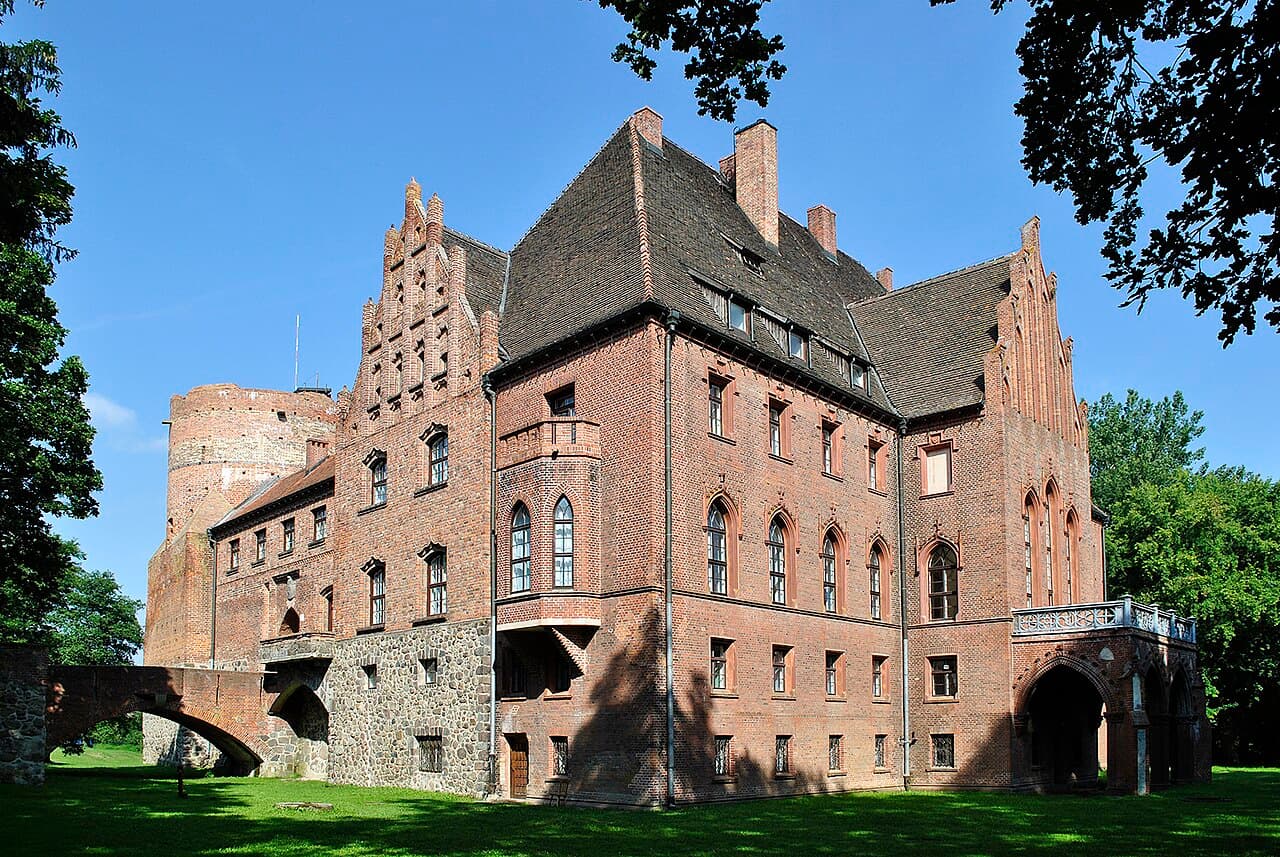
The core structure of Pęzino Castle is an irregular quadrilateral defensive wall enclosing the main residential building and a prominent southwestern tower known as the stołp. This tower served as the castle's last line of defense and combines two distinct architectural styles: a lower section built from large erratic boulders forming a square base, and an upper circular section constructed of brick. Originally reaching approximately 25 meters in height, the tower contains a deep dungeon about 14.5 meters deep, accessible only from above, highlighting its role as a secure holding cell.
Ownership passed to the Bork family in 1492, who held the castle as a hereditary fief granted by the Knights Hospitaller. During their tenure, they introduced notable modifications such as adding window openings to the eastern defensive wall and decorative gables on the residential wing. They also built a small church nearby, emphasizing the castle's dual military and spiritual roles.
Around 1600, the castle underwent significant renovation embracing the Renaissance architectural style. The fortress was transformed into a three-story residence featuring high roofs and elaborate gables, while retaining defensive elements. The walls were plastered and finished with a distinctive rusticated surface, enhancing both durability and aesthetic appeal.
Residential wings and interior layout
The western wing, developed during the Renaissance, is a three-story building approximately ten meters wide with a basement. Each floor contains a single large hall: the ground floor features a barrel vault with lunette arches and formerly housed archaeological exhibits; the first floor includes a reinforced concrete ceiling mimicking the original wooden ceiling, a Renaissance fireplace, and a dansker—a projecting latrine bay window—now used for historical exhibitions. The second floor displays historical court costumes, supported by European Union funding. The attic contains several rooms separated by half-timbered walls.
The castle's eastern section consists of two wings: the original Gothic wing with a single-tract layout and a later neo-Gothic wing built in 1853 by Berlin architect Johann Heinrich Starck. The Gothic wing features a restored courtyard-facing facade with a late Gothic window topped by a cusped arch, while the neo-Gothic wing matches its height and was unified with the Gothic wing's roof during 20th-century restorations.
Later modifications and 19th to 20th-century restorations
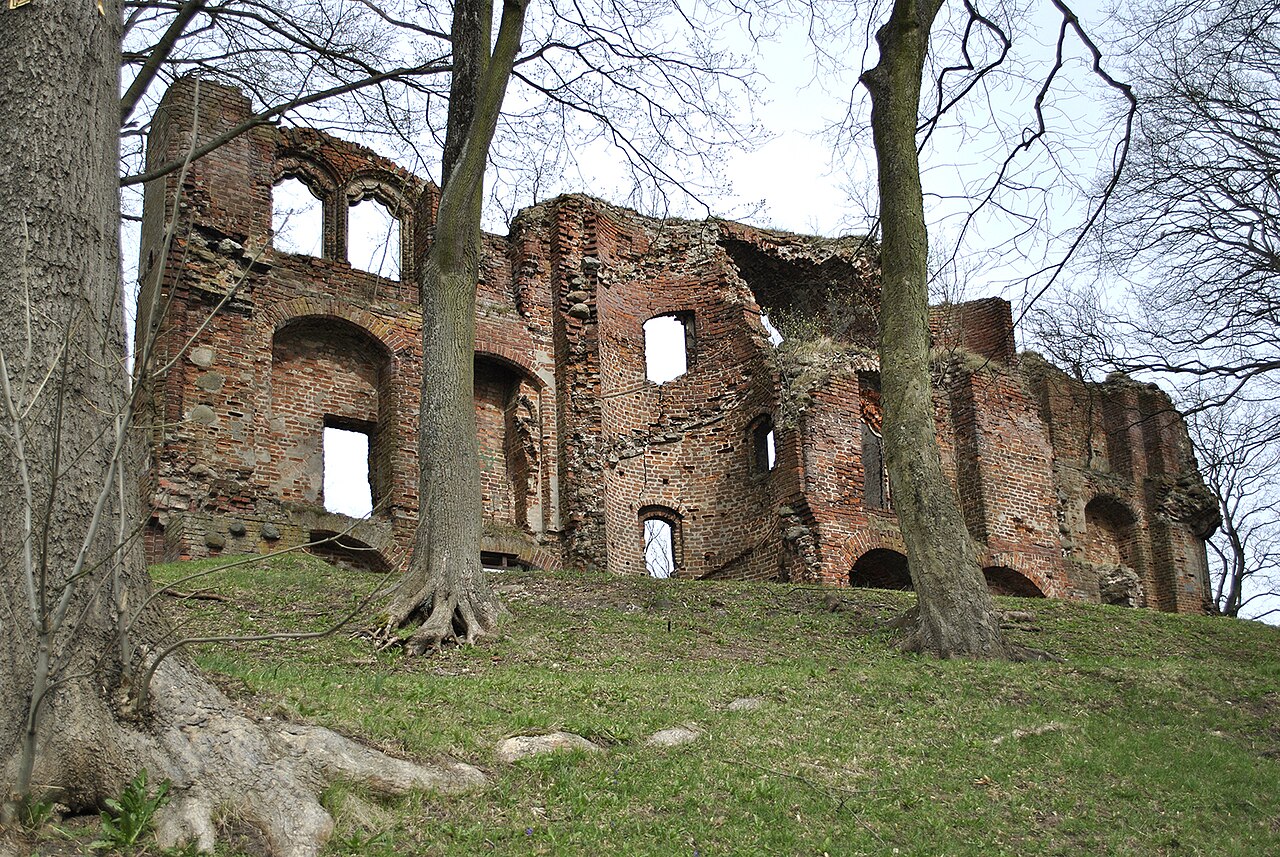
From 1680, the castle was managed by the Puttkamer family, who formally owned it from 1703. The 19th century brought the addition of the neo-Gothic wing and landscape transformations including the removal of farm buildings, creation of green spaces, a garden pavilion, and the deliberate construction of chapel ruins to enhance the estate's picturesque quality.
A lightning strike in 1935 caused a damaging fire in the eastern wing. Restoration work from 1936 to 1940 unified the roofs of the Gothic and neo-Gothic wings, extended the southern facade, and added a new gatehouse wing with a covered passage to the inner courtyard. The gatehouse integrates parts of the original defensive curtain wall and central gate, featuring an arcade wall with five large windows and a gable roof. The Puttkamer family coat of arms from the early 18th century is prominently displayed on the exterior facade above the gate.
Defensive features and courtyard layout
The northern courtyard side is enclosed by a defensive curtain wall, pierced in the late 18th century by a now-closed gate leading to the adjacent park. Historically, a wooden ramp allowed descent from the elevated courtyard to the park, accommodating the terrain's slope. An enclosed corridor above the gate connects the western and eastern wings, providing discreet internal passage.
The castle's defensive nature remains evident in its irregular stone walls, massive stołp tower, and strategic siting between two rivers. These features, combined with the residential wings' Renaissance and neo-Gothic architecture, reveal a complex layering of military and noble residential functions.
Modern history and current use
After World War II, the castle passed to a local state agricultural enterprise, during which its condition deteriorated. A comprehensive restoration began in 1977 aiming to restore the castle to its 1939 appearance and repurpose it as a cultural center housing a library and regional museum. This project was completed in 1990.
In 1996, Pęzino Castle entered private ownership and today serves as a venue for organized events, blending its rich history with contemporary cultural functions. It has been officially listed as a historic monument since 1955, underscoring its cultural and architectural significance in Poland's heritage.
Frequently asked questions (FAQ)
- How do I get to Pęzino Castle?
- Pęzino Castle is located in the charming village of Pęzino, Poland. You can reach it by car or public transport from nearby cities such as Szczecin. There are local bus services that connect the village with larger towns, making it accessible for visitors.
- What is the historical significance of Pęzino Castle?
- Pęzino Castle dates back to the 14th century and played an important role in the region's defense during various conflicts. It is an excellent example of medieval architecture in Poland, showcasing the historical transitions in construction styles over the centuries. The castle has been a witness to many significant events in Polish history, contributing to its cultural heritage.
- When was Pęzino Castle built?
- Pęzino Castle was originally constructed in the early 14th century, with significant modifications made in subsequent centuries. The castle reflects architectural styles from different periods, including Gothic and Renaissance influences. Its enduring structure offers a glimpse into the past and the evolution of castle designs in Poland.
- Can I take guided tours of Pęzino Castle?
- Yes, guided tours of Pęzino Castle are available for visitors. These tours provide an in-depth look at the castle's history, architecture, and the surrounding landscape. It's recommended to book in advance during peak tourist seasons to ensure availability.
- Why is Pęzino Castle a popular tourist attraction?
- Pęzino Castle attracts visitors due to its rich history, stunning architecture, and picturesque setting. The castle offers a unique opportunity to explore medieval life and enjoy beautiful views of the surrounding countryside. Additionally, its proximity to other historical sites makes it a great stop for tourists in the region.
- Is it possible to host events at Pęzino Castle?
- Yes, Pęzino Castle is available for hosting various events, including weddings and corporate gatherings. The venue provides a unique and historical backdrop, making any event memorable. It's advisable to contact the castle administration for details on availability and arrangements.
- What are the opening hours of Pęzino Castle?
- Pęzino Castle is typically open to visitors from 10 AM to 5 PM, but hours may vary depending on the season. It's best to check the official website or contact the castle for the most current information before planning your visit. Special hours may apply during holidays or special events.
- What are the ticket prices for visiting Pęzino Castle?
- Ticket prices for Pęzino Castle are generally affordable, with discounts available for students and seniors. Children under a certain age may enter for free. For the most accurate pricing, it's recommended to visit the official website or check with the ticket office upon arrival.
- When is the best time to visit Pęzino Castle?
- The best time to visit Pęzino Castle is during the late spring and early autumn months when the weather is mild and pleasant. These seasons also provide beautiful scenery, enhancing your experience of the castle and its surroundings. Additionally, visiting during special events or festivals can add to the enjoyment of your trip.
- Are there any nearby attractions to visit along with Pęzino Castle?
- Yes, there are several nearby attractions, including historical sites, parks, and local museums that complement your visit to Pęzino Castle. Exploring the surrounding countryside is also a popular activity, offering scenic views and outdoor experiences. Be sure to check local guides for recommendations on the best nearby spots to enhance your visit.
Photo gallery

Information
Website
Visit websiteSources & official resources
Verify the information above using these authoritative references.
Loading map...
Visitor reviews
No reviews yet. Been here? Write the first review and help other travelers!
Write the first reviewVisited this castle? Share your experience
Your review helps other travelers and adds first-hand knowledge to our encyclopedia.