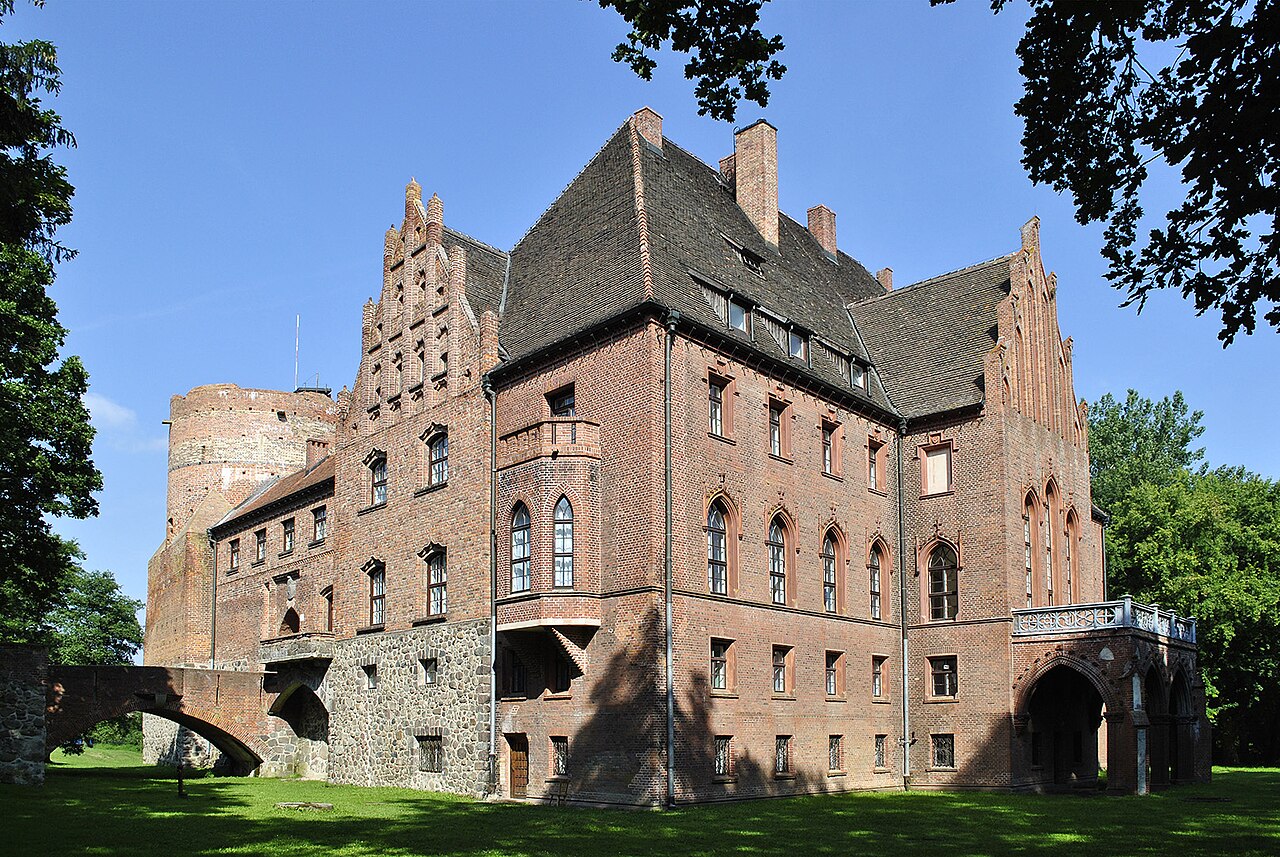
Pełczyce
Pełczyce castle stands as a significant example of late medieval defensive architecture in Poland. Originally established in the early 14th century, this hill castle was strategically positioned near the town of Pełczyce, surrounded by natural water defenses and marshlands. Its history reflects the turbulent political and military struggles in the region between Pomerania, Brandenburg, and the Duchy of Szczecin.
The origins and early history of Pełczyce castle
The earliest fortification in Pełczyce was a wooden stronghold located on an island in Lake Panieńskie, built by the knight Ludolf de Berensteyn. This initial fortress existed until approximately 1279-1280, when renewed conflicts erupted between Pomerania and Brandenburg. During this period, Pełczyce came under the control of the Margraves Otto V, Otto VII, and Albrecht III of Brandenburg. In 1298, Albrecht III sold the Pełczyce land to his cousins Otto IV, Konrad, Henryk, and Jan IV, marking a shift in regional power.
By 1315, Pełczyce passed into the hands of Duke Otto I of Szczecin. It was under his authority that a new, more durable castle was constructed by his vassal from the von der Osten family. This castle was built in stone and first documented in a 1321 record. The new fortress was likely erected to replace the earlier wooden stronghold and to consolidate ducal power in the area.
Architectural features and layout
The rebuilt castle at Pełczyce was constructed east of the town, taking advantage of natural water barriers provided by the adjacent lake and surrounding marshes. It featured a regular quadrilateral plan measuring approximately 40 by 40 meters. The castle was encircled by a high defensive curtain wall, designed to withstand sieges and assaults.
Access to the castle was controlled by a southern entrance connected to the mainland by a pile bridge over marshy terrain. Inside the courtyard, directly opposite the gate, stood the residential building, serving as the main living quarters. A cylindrical tower was located to the left of the gate; however, it was noticeably lower than the surrounding walls, suggesting that its construction might have been left incomplete.
Military history and sieges
Pełczyce castle played a notable role in regional conflicts during the 15th century. In 1451, it withstood an unsuccessful siege by the forces of the New March, commanded by the Teutonic Knights. The castle's strategic importance increased following the death of the last Duke of Szczecin, Otto III, in 1464. This event sparked succession disputes, with Brandenburg electors asserting claims over the territory.
In 1478, Elector Albrecht Achilles launched a military campaign against Pełczyce, culminating in the storming and capture of the castle on August 1st. Following this conquest, the western part of the Pełczyce land, including the town itself, was annexed to Brandenburg. The elector's marshal, George Rülicke, was appointed as the starost of Pełczyce and became the town's owner in 1482. Later, in 1485, the von Waldow brothers from Lubniewice acquired the castle and its lands.
Renaissance transformation and decline
Around 1600, the von Waldow family undertook significant renovations of the castle, adapting it to the Renaissance architectural style. The main addition was an eastern wing, which expanded the residential and functional spaces. This period marked a transition from purely defensive purposes to more comfortable noble residence standards.
However, the castle's fortunes declined during the Northern Wars in the early 18th century, when it suffered extensive damage. By 1728, Krzysztof von Waldow sold the ruined castle to the royal treasury. Over the next decades, the castle's remains were systematically dismantled, and by the mid-18th century, little of the original structure remained.
Legacy and current state
In the 19th century, a new building was erected on the castle hill, which now serves as the local parish headquarters. Today, the site of Pełczyce castle is classified as ruins, with only fragments of the medieval walls and foundations visible. Despite its ruined condition, the castle remains an important cultural and historical landmark, reflecting centuries of architectural evolution and regional power struggles.
Visitors to Pełczyce can explore the castle hill and appreciate the strategic location that once made this fortress a formidable stronghold. The site's proximity to natural water defenses and its architectural features provide valuable insights into medieval military engineering and the adaptation of castles through the Renaissance period.
Frequently asked questions (FAQ)
- When was Pełczyce castle originally built?
- Pełczyce castle was originally constructed in 1315 under the direction of a vassal of Duke Otto I of Szczecin.
- What architectural style characterizes Pełczyce castle?
- The castle was initially built in the late medieval style, with Renaissance modifications added around 1600 by the von Waldow family.
- Can visitors access the ruins of Pełczyce castle?
- Yes, visitors can explore the castle hill and view the ruins, which include remnants of defensive walls and foundations.
- What historical events affected Pełczyce castle?
- The castle was involved in regional conflicts including a siege by the Teutonic Knights in 1451 and was captured by Elector Albrecht Achilles in 1478.
- What led to the decline of Pełczyce castle?
- The castle was heavily damaged during the Northern Wars and was eventually sold in ruins to the royal treasury in 1728, leading to its dismantling.
Information
Loading map...
Visitor reviews
No reviews yet. Been here? Write the first review and help other travelers!
Write the first reviewVisited this castle? Share your experience
Your review helps other travelers and adds first-hand knowledge to our encyclopedia.