Peveril Castle
Peveril Castle is a prominent Norman medieval fortress located in the village of Castleton in the United Kingdom. Constructed in the late 11th century by William Peverel, a Norman lord rewarded with extensive lands after the conquest of England in 1066, the castle served as a crucial stronghold and administrative center in the region. Positioned on a limestone promontory overlooking the dramatic Hope Valley, the castle's strategic location allowed control over key routes and local governance.
Historical significance and ownership
The foundation of Peveril Castle dates to the years following the Norman Conquest, with William Peverel establishing it as the caput of the Honour of Peverel. This honor was a substantial feudal estate encompassing lands across Nottinghamshire and Derbyshire. The castle's role as an administrative hub fostered the growth of the nearby settlement, which evolved into the modern village of Castleton.
In 1155, King Henry II confiscated the Peveril estates from William Peverel the Younger, bringing the castle under direct royal control. Henry II is recorded to have visited the castle multiple times, including hosting King Malcolm IV of Scotland during one of these visits. The castle's defenses were notably reinforced during the Revolt of 1173–1174, increasing the garrison to twenty knights. These knights also served at nearby royal castles such as Bolsover and Nottingham.
During the late 12th and early 13th centuries, the powerful Earls of Derby laid claim to the castle and its lands through marriage alliances. In 1199, William de Ferrers, 4th Earl of Derby, paid a significant sum for control of the lordship of the Peak District, though the castle itself remained under royal authority. In 1216, King John granted the castle to William de Ferrers, but the then-castellan, Brian de Lisle, refused to surrender it. The king authorized Ferrers to seize the castle by force, although there is no record of a siege actually taking place.
By 1223, the castle had reverted to Crown ownership. Throughout the 13th century, Peveril Castle underwent multiple building campaigns, gradually achieving its full medieval form by around 1300. The barony later passed to John of Gaunt, Duke of Lancaster, in the late 14th century. His tenure is marked by neglect, as he ordered removal of building materials for use elsewhere, initiating the castle's decline.
For centuries afterward, the castle remained part of the Duchy of Lancaster. By the early 17th century, it was described as severely dilapidated and no longer functional as a fortress, though it was still used for local court meetings until about 1600. The Duchy retains ownership today.
Architectural features and layout
Peveril Castle occupies a roughly triangular site measuring approximately 90 by 65 meters on a limestone promontory with steep slopes, especially on the southeastern side where cliffs drop sharply. The main approach is from the north via a winding path.
The original entrance was located on the east side through a modest gatehouse about seven meters wide, with a short passage. Surviving stone mouldings suggest construction during the reigns of Henry II or King John in the 12th and early 13th centuries. The curtain walls enclosing the castle show evidence of multiple construction phases, including early Norman stonework in the distinctive opus spicatum (herringbone) pattern alongside later repairs. These walls once supported covered walks about five meters above ground near the gatehouse.
A small projecting tower on the northern curtain wall dates from the 12th century, though its defensive value was limited compared to larger towers built later. On the southern curtain wall, modern reconstruction aligns with the medieval footprint, incorporating remains of two round or semi-circular towers that extend outward. One tower features reused Roman tiles from the nearby Roman fort of Navio, reflecting practical material recycling and a connection to the area's Roman past. These towers likely date to the 13th century.
Foundations along the southern wall mark locations of former buildings, probably including an earlier hall and a chapel mentioned in a 1246 document. The easternmost building's east-west orientation is typical of medieval chapels. On the northern side, foundations reveal a large hall used for dining and entertaining, referenced as an "old hall" in a 1251 document, suggesting a newer hall existed elsewhere by then.
East of the hall likely stood the kitchen and pantry, though few traces remain. Additional buildings along the western curtain wall appear to have housed high-status living quarters. Besides the main northern gateway, a western gate accessed by a bridge crossing a gorge led to an outer enclosure, possibly an outer bailey or area for storage and stabling horses, though this area remains unexcavated.
The keep and defensive structures
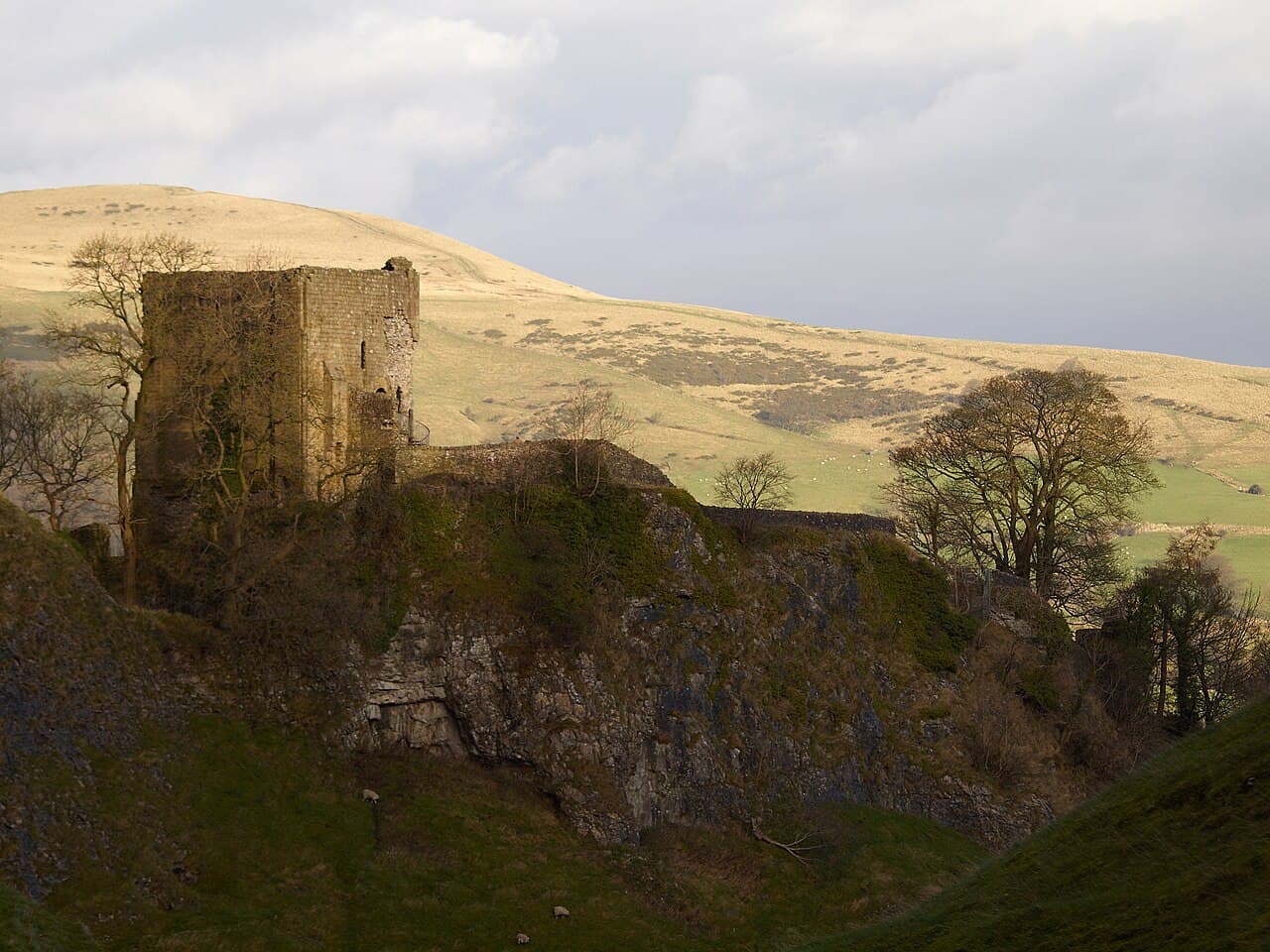
The castle's most prominent feature is its keep or donjon, constructed around 1176 during the reign of Henry II. This square tower measures less than 12 meters on each side, smaller than contemporary royal keeps like those at Dover or Scarborough. The parapets stand approximately 15 meters high on the higher ground side and about 10.5 meters on the sloping side.
The keep's exterior is weathered but retains some smooth facing stone on the southeastern side, preserved by the steep cliff that prevented stone removal. A garderobe extends from this face. Entry was originally on the first floor via an external staircase, a typical Norman design. Inside, the first floor likely housed a large public chamber, with the basement used for storage. A narrow staircase in the eastern corner connected the basement to the parapet walk, facilitating defender movement.
Location and landscape significance
Peveril Castle commands spectacular views over Hope Valley and surrounding hills including Treak Cliff, Mam Tor, Black Tor, and Lose Hill. The castle's elevated position offered strategic oversight of the landscape and control over local routes.
The nearby village of Castleton historically supplied the castle with provisions. The castle's water sources remain uncertain, a common challenge for hill castles, though its natural elevation and defensive features made it a formidable stronghold.
Cultural heritage and current status
Today, Peveril Castle stands as a significant ruined Norman hill castle, managed as part of the Duchy of Lancaster estates. Its ruins provide valuable insight into medieval military architecture and feudal administration in the Peak District. The castle's blend of early Norman masonry and later medieval additions illustrate the evolution of castle design over several centuries.
Visitors can explore the remains of the gatehouse, curtain walls, towers, and the keep, all set within a dramatic natural landscape. The site is a popular destination for those interested in English medieval history, Norman architecture, and the heritage of the Peak District.
Frequently asked questions (FAQ)
- How do I get to Peveril Castle?
- Peveril Castle is located in Castleton, United Kingdom. You can reach the castle by car, with parking available nearby, or by public transport, with regular bus services connecting to the area from larger towns. The castle is also accessible via scenic walking trails, making it an ideal stop for hikers exploring the Peak District.
- What is the historical significance of Peveril Castle?
- Peveril Castle was built in the 11th century by William the Conqueror and served as a royal fortress during the Norman Conquest. It is one of the earliest stone castles in England and played a crucial role in the defense and administration of the surrounding region. The castle's rich history offers visitors a glimpse into medieval life and the evolution of English fortifications.
- When was Peveril Castle built?
- Peveril Castle was constructed shortly after the Norman Conquest in 1068, making it over 950 years old. The castle has undergone various renovations and restorations throughout its history, reflecting the changing architectural styles and defensive needs of the time. Today, it stands as a testament to Norman military architecture.
- Can I enter the castle grounds?
- Yes, visitors can enter the castle grounds and explore the ruins. There are designated pathways for walking around the site, and interpretive signs provide information about the history and architecture. However, the interior of the castle is not fully accessible, as much of it remains in a ruinous state.
- Why is Peveril Castle a popular tourist attraction?
- Peveril Castle is popular due to its stunning location overlooking the Hope Valley and its historical significance as one of England's earliest fortifications. The breathtaking views, combined with the intriguing history of the castle, make it a must-visit for history enthusiasts and nature lovers alike. Its proximity to other attractions in the Peak District also adds to its appeal.
- Is it possible to visit Peveril Castle year-round?
- Yes, Peveril Castle is open to visitors throughout the year, although opening hours may vary seasonally. It’s best to check the official website before planning your visit to ensure you have the most up-to-date information regarding accessibility and any potential closures. The castle is particularly beautiful in spring and autumn when the surrounding landscapes are vibrant.
- What are the ticket prices for Peveril Castle?
- Ticket prices for Peveril Castle are quite reasonable, with concessions available for children, students, and seniors. Family tickets are also offered, making it an affordable option for visitors of all ages. It's advisable to purchase tickets in advance during peak season to avoid long queues.
- What are the opening hours for Peveril Castle?
- Peveril Castle typically opens at 10 AM and closes at 5 PM during the summer months, while winter hours may vary. It is closed on certain public holidays, so checking the official website for current opening times is recommended before your visit. Arriving early can help you make the most of your time exploring the grounds.
- Are there any nearby attractions to visit after Peveril Castle?
- Yes, there are several nearby attractions worth exploring, including the picturesque village of Castleton, famous for its caves and local produce. The Peak District National Park offers stunning walking trails and natural beauty, perfect for outdoor enthusiasts. You can also visit the nearby Blue John Cavern, known for its unique stone, making it a great addition to your itinerary.
Photo gallery

Information
Sources & official resources
Verify the information above using these authoritative references.
Loading map...
Visitor reviews
No reviews yet. Been here? Write the first review and help other travelers!
Write the first reviewVisited this castle? Share your experience
Your review helps other travelers and adds first-hand knowledge to our encyclopedia.