Pettingen Castle
Pettingen Castle, also known locally as Château de Pettingen, is a remarkable example of a hill castle with origins dating back to the 10th century. Situated in the village of Pettingen, north of Mersch in Luxembourg, this castle has witnessed centuries of noble lineage, military conflict, and architectural evolution. It stands today as one of Luxembourg's best-preserved fortified castles, offering insight into medieval fortification techniques and the region's turbulent history.
The origins and early history of Pettingen Castle
The earliest known fortification on this site was referred to as Pittigero Mazini in the Early Medieval period, around the 10th century. The origin of this name remains uncertain, but by the 13th century, the name had evolved to Pettingen or Pittingen. During this time, the castle was a significant stronghold for the Lords of Pettingen, who were influential members of the Luxembourg nobility. Their prominence is evidenced by their participation in important events such as the wedding of Countess Ermesinde, the coronation of Henri IV, and the marriage contract signing of John the Blind.
Noble alliances and family ties
In the early 14th century, a strategic marriage between Arnold II, Lord of Pettingen, and Margarete von Roussy, a descendant of Ermesinde, strengthened the family's social and political standing. Their son, Arnold the Younger, fathered a daughter named Irmengard, who married Johann von Criechingen (also known by the French name Créhange) in the latter half of the 14th century. This union merged the dominions of Pettingen and Larochette Castle, expanding the family's influence in the region.
Medieval conflicts and destruction
The castle's history is marked by military strife, particularly during the late 15th century. Johann von Criechingen, a descendant of the family, allied with René II, Duke of Lorraine, in his conflict against Charles the Bold, Duke of Burgundy. This alliance led to a siege and subsequent destruction of Pettingen Castle by Burgundian forces. In 1494, the Criechingen family's possessions, including the castle, were confiscated by the Luxembourg governor. However, in 1503, a decree from the Great Council of Mechelen restored half of these possessions to the family, allowing for the castle's reconstruction.
Reconstruction and architectural features
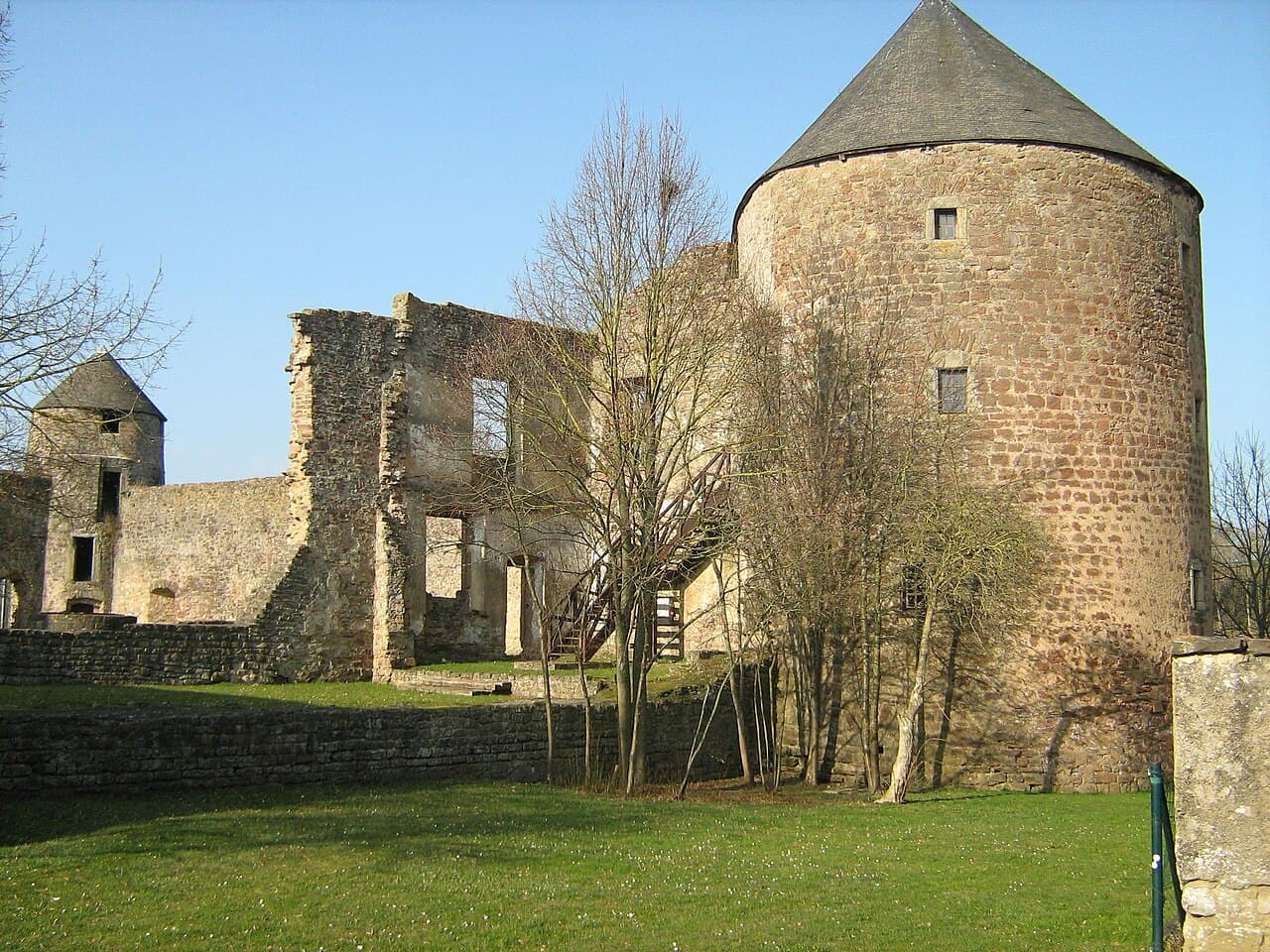
The rebuilt castle, constructed on the original foundations, dates from the early 16th century. It was designed as a square stronghold approximately 30 by 30 meters, surrounded by a wide moat fed by the nearby Alzette River and Weillerbach stream. The fortification included four round corner towers added in 1571, enhancing its defensive capabilities, and a central square keep (donjon) that served as the main refuge and command center.
Later history and decline
In 1684, the castle suffered severe damage from cannon fire during an assault by the troops of King Louis XIV of France. This attack led to the partial destruction of the structure and the filling in of the moat, which had been a critical defensive feature. Despite repairs, the castle never fully regained its former strength and gradually fell into disuse.
Ownership changes and preservation efforts
Pettingen Castle passed through several noble families over the centuries, including the Counts of Créhange, the Counts of Lapérouse, and the Dukes of Arenberg. By the 19th and early 20th centuries, the castle had largely fallen into ruin. Notably, in 1920, the southern wall collapsed, further diminishing the structure. The Luxembourg state acquired the ruins in 1947 and undertook consolidation work in the 1950s to stabilize the remaining walls and towers.
Architectural remains and current status
Today, the ruins of Pettingen Castle offer a compelling glimpse into medieval fortification design. The surviving curtain walls along the southwest side remain well-preserved, and two of the original four round corner towers still stand on the northeast side. The foundations of the central keep lie beneath a wooden platform, marking its historical location.
The castle's original moat, which was once 15 meters wide and supplied by the Weillerbach stream, is still visible in the landscape, although partially filled in. The site is freely accessible to the public and occasionally hosts cultural events, providing both educational and recreational value.
Significance and visitor experience
Pettingen Castle is not only an architectural landmark but also a symbol of Luxembourg's medieval heritage. Its strategic location on a hill overlooking the surrounding landscape exemplifies the defensive priorities of the time. Visitors can appreciate the castle's robust stone masonry, the layout of its fortifications, and the historical narrative embedded in its walls.
The castle is easily visible from the nearby train line connecting northern Luxembourg to the capital city, Luxembourg City, making it a convenient and worthwhile stop for travelers interested in history and architecture.
Frequently asked questions (FAQ)
- How do I get to Pettingen Castle?
- Pettingen Castle is located in the village of Pettingen, north of Mersch in Luxembourg. It is accessible by car and public transportation, with nearby train lines providing views of the castle from the east side.
- What is the historical significance of Pettingen Castle?
- Pettingen Castle was a key stronghold for Luxembourg nobility from the 10th century onward. It played a role in regional conflicts, noble alliances, and political events, reflecting the medieval history of the area.
- Can I visit the ruins of Pettingen Castle?
- Yes, the ruins of Pettingen Castle are freely accessible to the public. Visitors can explore the remaining walls, towers, and moat area, which occasionally hosts cultural events.
- When was Pettingen Castle built and rebuilt?
- The original fortress dates back to the 10th century. It was destroyed in the late 15th century and rebuilt around 1503, with significant additions such as the corner towers added in 1571.
- What architectural features remain at Pettingen Castle?
- Visitors can see the well-preserved curtain walls, two of the four original round corner towers, and the foundations of the central keep. The wide moat, once fed by the Weillerbach stream, is also visible.

Information
Current owner
State of Luxembourg
Address
Rue du Château, Luxembourg
Loading map...
Visitor reviews
No reviews yet. Been here? Write the first review and help other travelers!
Write the first reviewVisited this castle? Share your experience
Your review helps other travelers and adds first-hand knowledge to our encyclopedia.