Peroja Castle
Peroja Castle, located in the municipality of A Peroxa, Spain, is a medieval hill castle with origins that trace back to early medieval times, though its current ruins primarily date from the 13th century. This fortress occupies a strategic position atop a steep hill, offering commanding views of the surrounding landscape and serving as a vital defensive stronghold throughout its history.
The earliest historical references to the site suggest that a fortification may have been established around the year 793, possibly commissioned by the Kingdom of Asturias under Alfonso II of Asturias. While the exact origins remain uncertain, tradition holds that the castle was part of a defensive line protecting the region from incursions. A local legend recounts the castle's capture by Abd Al-Karim, who purportedly mistreated the inhabitants until the intervention of the Christian Apostle Santiago led to the castle's recapture and destruction, symbolizing the religious and military conflicts of the era.
Medieval ownership and feudal significance
From the 13th century onward, Peroja Castle became an important seat of power under the control of the High Steward (Adiantado-Mor) of Galicia. Beginning in 1370, this role was held by Pedro Ruíz Sarmiento, the first Lord of Ribadavia, whose family maintained possession of the castle for generations. The lineage was later elevated to the rank of Counts of Ribadavia during the reign of the Catholic Monarchs in the late 15th century, reflecting the castle's integration into the regional aristocratic network.
The castle endured significant turmoil during the 15th century, particularly during the Irmandiños revolts. These popular uprisings targeted the feudal nobility and their fortresses across Galicia, including Peroja Castle, which suffered attacks and partial destruction. Throughout its history, the castle was part of a broader feudal landscape that included the nearby castles of Maceda and Vilamarín, as well as connections to the Monastery of Sobrado dos Monxes, illustrating the complex interplay between secular and ecclesiastical powers in medieval Galicia.
Decline and partial dismantling
In the 18th century, Peroja Castle experienced decline following the widespread disentailment policies that led to the confiscation of many noble and church properties. This process diminished the castle's strategic and residential importance. Around 1920, a private owner dismantled significant portions of the castle's prominent keep tower and surrounding walls. The reclaimed granite blocks were repurposed for the construction of the local parish church of A Peroxa, contributing to the castle's current ruined state.
The castle grounds also historically hosted the traditional Feira da Peroxa, a local fair that was closely linked to the site. Archaeological remains of small vendor stalls near the castle provide tangible evidence of this cultural activity, highlighting the castle's role not only as a military fortress but also as a center of community life.
Architectural features and construction
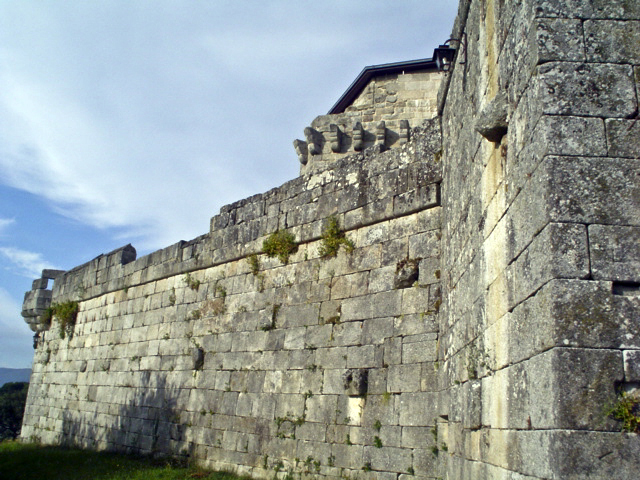
Peroja Castle is constructed entirely from carefully shaped granite ashlar masonry, a hallmark of medieval defensive architecture in Galicia. The fortress's layout is an irregular polygon tending toward an elliptical shape, conforming to the natural contours of the steep hill it crowns. This adaptation to the terrain enhanced its defensive capabilities and made it a formidable obstacle to attackers.
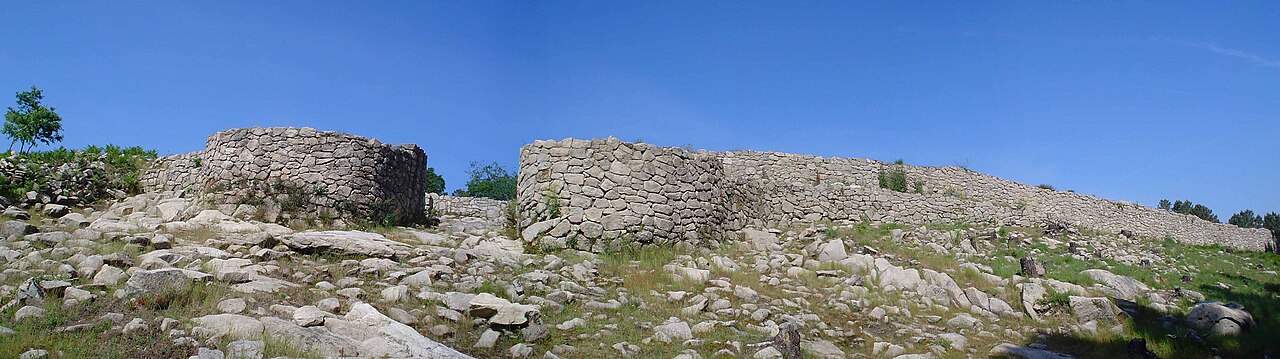
The castle's fortifications include four semicircular towers reinforcing the curtain walls, with two towers flanking the main entrance on the northeast side. The tower on the left side of the gate retains a guardhouse area featuring a simple vertical arrow slit, designed to allow defenders to shoot arrows while remaining protected. The right tower survives only as foundational remains, indicating partial destruction over time.
Along the curtain wall, remnants of the adarve—the narrow battlement walkway behind the crenellations—are preserved, offering insight into the movement and defense strategies of medieval soldiers. Inside the enclosure, traces of dividing walls suggest the presence of separate chambers or functional spaces, which would have accommodated garrison quarters, storage, or administrative rooms.
At the core of the castle stood a tall keep tower, the central defensive structure whose foundations remain intact. This keep would have been the last refuge during sieges, symbolizing the lord's authority and military strength. Adjacent to the outer wall is a building with fragments of a barrel-vaulted roof, a curved ceiling formed by a continuous arch, though its precise function remains uncertain.
A significant feature within the complex is a large cistern (aljibe) built at a lower level inside the castle. This water reservoir was essential for collecting and storing rainwater, ensuring a reliable supply during prolonged sieges when external water sources were inaccessible.
Preservation and archaeological significance
Today, Peroja Castle exists as a ruined hill castle with substantial remains that illustrate its medieval military architecture and strategic importance. The use of granite ashlar masonry demonstrates the skilled craftsmanship of its builders. Recent restoration efforts have focused on stabilizing the surviving stone structures, preserving the castle as a cultural heritage site and a valuable archaeological resource.
The castle's ruins, combined with the surrounding archaeological remains, provide a window into the feudal history of Galicia and the architectural evolution of medieval fortifications in the region. Visitors can explore the remnants of the walls, towers, and internal structures while appreciating the castle's commanding position on its hilltop setting.
Frequently asked questions (FAQ)
- What is the historical significance of Peroja Castle?
- Peroja Castle, located in A Peroxa, Spain, dates back to the medieval period and has played a crucial role in the region's defense against invasions. The castle symbolizes the rich history of the area, showcasing the architectural styles and military strategies of its time.
- When was Peroja Castle built?
- Peroja Castle was constructed in the late 12th century, during a time of significant conflict and territorial disputes in the Iberian Peninsula. Its strategic location allowed it to serve as a stronghold for various noble families throughout its history.
- Can I visit Peroja Castle?
- Yes, Peroja Castle is open to visitors who wish to explore its fascinating architecture and learn about its history. Guided tours are available, providing insights into the castle's past and its importance in the region.
- What are the opening hours for Peroja Castle?
- Peroja Castle is typically open to visitors from 10 AM to 6 PM, though hours may vary depending on the season and special events. It is advisable to check the official website or contact local tourist information for the most accurate hours before your visit.
- Is it possible to access Peroja Castle with public transportation?
- Yes, Peroja Castle can be accessed via public transportation, with local buses connecting A Peroxa to nearby towns. However, visitors may need to walk for a short distance from the bus stop to reach the castle itself.
- When is the best time to visit Peroja Castle?
- The best time to visit Peroja Castle is during the spring and fall when the weather is mild and the landscapes are particularly beautiful. Summer can be quite hot, while winter may bring cooler temperatures, so plan your visit accordingly.
- What are the ticket prices for Peroja Castle?
- Ticket prices for Peroja Castle are generally reasonable, with discounts available for students and seniors. It is recommended to check the official website for the latest pricing information and any special offers that may be available during your visit.
- Are there any nearby attractions to see while visiting Peroja Castle?
- Yes, there are several nearby attractions, including beautiful hiking trails and charming local villages. Visitors can also explore other historical sites and enjoy the scenic landscapes that the region has to offer.
Information
Loading map...
Visitor reviews
No reviews yet. Been here? Write the first review and help other travelers!
Write the first reviewVisited this castle? Share your experience
Your review helps other travelers and adds first-hand knowledge to our encyclopedia.