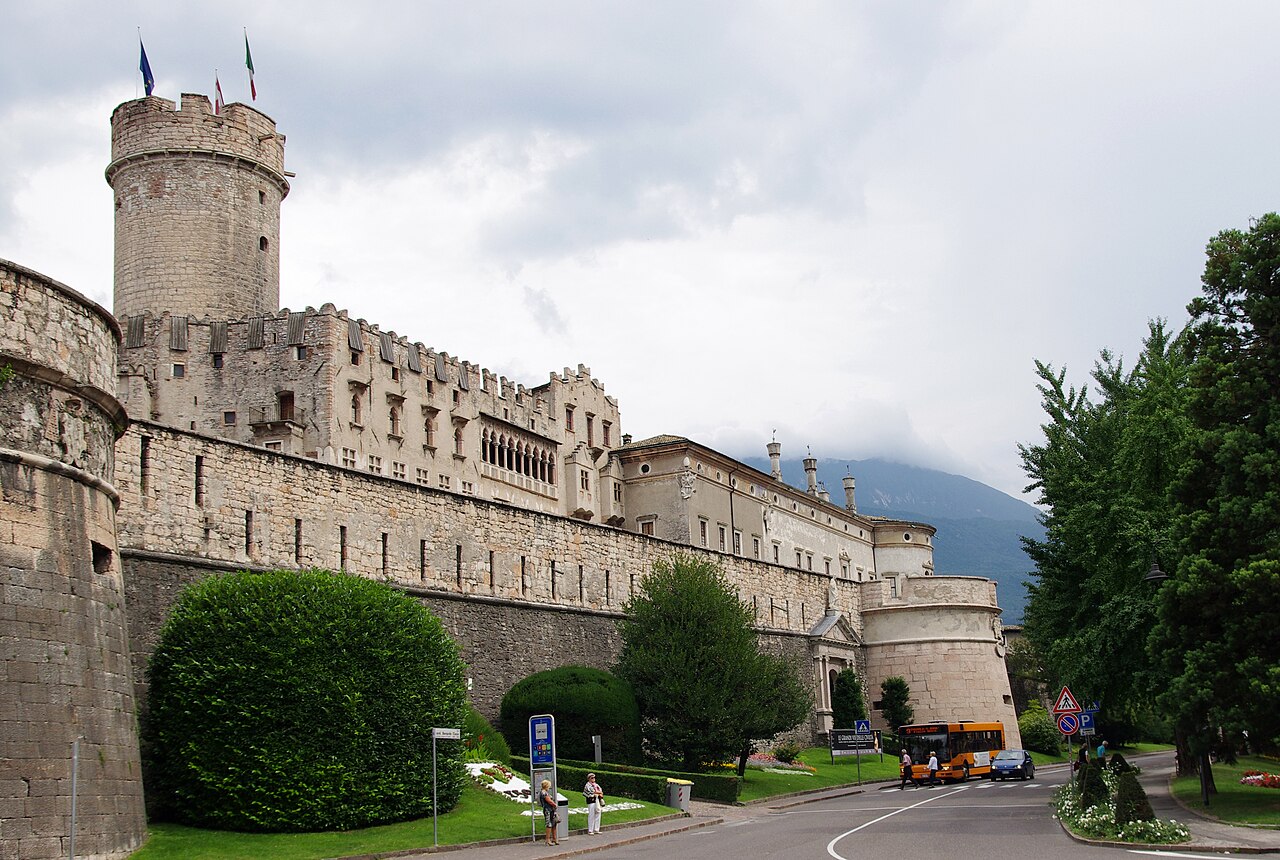
Pergine Castle
Pergine Castle, perched strategically on Colle Tegazzo near the town of Pergine Valsugana in Trentino, Italy, stands as a remarkable example of medieval fortification blending military architecture and later Gothic stylistic modifications. This 13th-century hill castle commands the historic Via Claudia Augusta Altinate, a vital ancient route connecting northern Italy with central Europe, underscoring its long-standing strategic importance.
Historians believe the site of Pergine Castle was initially a prehistoric fortress, evolving through Roman settlement phases and later becoming a Longobard stronghold. Documentary evidence first mentions the castle in the early medieval period, specifically in 845 AD, linking it to Lombard rulers who likely established or rebuilt the early fortress. The castle’s position on a hilltop provided natural defenses enhanced by man-made fortifications over centuries.
Throughout its history, Pergine Castle has witnessed a succession of noble owners and political powers, including the Dukes of Austria under Margarete Maultasch, the Holy Roman Emperor Maximilian I, and the Prince-Bishop of Trento Bernardo Cles. Its ownership reflects the complex feudal and ecclesiastical dynamics of the region, with the castle serving both military and residential functions.
Historical significance and ownership transitions
Early medieval origins and feudal conflicts
The earliest records associate the castle with the Longobard period, with its strategic location making it a coveted stronghold. In the 12th and 13th centuries, the castle was controlled by the Pergine lords, who were connected to prominent noble families in the region. During this period, it endured violent conflicts, including capture and burning by troops under Ezzelino da Romano, a testament to the turbulent political landscape of northern Italy.
Following these conflicts, restoration efforts were led by Prince Enrico II and his son Adriano, reinforcing the castle’s role as a defensive guard post overseeing passage between the Veneto and Trentino regions. Later, the castle became a fief of Mainardo II, Count of Tyrol, further embedding it in the regional power struggles involving bishops and noble families.
Bishopric control and gothic renovations
In the early 14th century, control passed to the Bishopric of Trento, with Bishop Bonaventura Gardelli appointing custodians to defend against external threats. A notable episode involved the betrayal attempt by the bishop’s nephew, Dioniso Gardelli, which was thwarted to maintain ecclesiastical authority.
The castle underwent significant architectural transformation during the 15th century, adopting Gothic style elements that remain visible today. This period marked a shift toward enhancing residential comfort alongside military functionality, reflecting broader trends in castle architecture.
Architectural features and fortifications
Layout and defensive structures
Pergine Castle exhibits a quadrangular layout atop Colle Tegazzo, surrounded by robust curtain walls with multiple watchtowers strategically placed for surveillance and defense. The walls are built from local stone, featuring battlements designed for archers and lookouts.
The main entrance is guarded by a square guard tower accessible historically via a drawbridge, now lost. Adjacent stands the imposing "torture tower", a cylindrical structure with narrow loopholes and distinctive cross-shaped windows, combining defensive and symbolic architectural elements.
Interior spaces and notable rooms
The castle’s interior connects through large stone spiral staircases that link the ground floor to upper chambers. The ground floor houses the entrance hall, kitchens, and cellars, alongside an enclosed garden visible only from inside the fortress.
The first floor features the Sala del trono (Throne Room) and the Chapel of St. Andrew, spaces reflecting the castle’s ceremonial and religious roles. The second floor contains several historically named rooms, including the Sala del Balconcino, Sala del Vescovo, Sala della Stufa Verde, Sala del Principe, and Sala della Dama Bianca, many of which serve as exhibition venues today.
Unique architectural highlights
One of the castle’s most unusual features is the huge octagonal pillar supporting the vaulted ceiling of the entrance hall, an architectural highlight demonstrating advanced medieval construction techniques. The Prigione della goccia (Prison of the Drop) is a small cell used historically for psychological torture, where drops of water would fall continuously on the prisoner’s head.
The "Camera del camino" (Fireplace Room) is steeped in local legend, reputedly haunted by a mysterious lady in white, adding a layer of cultural intrigue to the castle’s history.
Later history and modern usage
In the early 20th century, the castle was acquired by a German company led by Julius Friedrich Lehmann with plans to convert it into a hotel and restaurant. Although renovations began, authorities halted the project in 1913 to preserve the castle’s artistic and historical integrity.
Since 1956, the castle has been privately owned by the Oss family, who have overseen restoration efforts to maintain the structure’s condition. In 2018, stewardship transferred to the Fondazione Castel Pergine ONLUS, a nonprofit organization dedicated to the castle’s preservation and cultural promotion.
Today, Pergine Castle is open to the public with guided tours highlighting its rich history, architectural features, and exhibitions related to the region’s heritage. The castle remains a well-preserved example of medieval and Gothic architecture, reflecting centuries of strategic, residential, and cultural significance in northern Italy.
Frequently asked questions (FAQ)
- What is the historical significance of Pergine Castle?
- Pergine Castle, dating back to the 13th century, played a vital role in the defense of the region against invasions. It has witnessed various historical events and changes in ownership, reflecting the tumultuous history of the Trentino area.
- When was Pergine Castle built?
- Pergine Castle was constructed in the early 13th century, specifically around 1200. The castle has undergone numerous renovations over the centuries, preserving its historical architecture while adapting to changing needs.
- Can I visit Pergine Castle year-round?
- Yes, Pergine Castle is open to visitors year-round, although opening hours may vary seasonally. It is advisable to check the official website for the most current information on visiting hours and any potential restrictions.
- What are the ticket prices for visiting Pergine Castle?
- Ticket prices for Pergine Castle are typically affordable, with discounts available for children, students, and seniors. It's best to check the official website for the latest pricing and any special offers that may be available during your visit.
- Is Pergine Castle accessible for visitors with mobility challenges?
- While Pergine Castle has made efforts to be more accessible, some areas may be challenging for those with mobility issues due to uneven terrain and stairs. It is recommended to contact the castle administration in advance to inquire about specific accessibility options and accommodations.
- When is the best time to visit Pergine Castle?
- The best time to visit Pergine Castle is during the spring and fall when the weather is mild, and the surrounding landscapes are particularly beautiful. These seasons also tend to have fewer tourists, allowing for a more tranquil experience.
- What nearby attractions can I explore while visiting Pergine Castle?
- While visiting Pergine Castle, you can also explore the charming town of Pergine Valsugana, which offers lovely shops and cafes. Additionally, nearby natural attractions include the Valsugana Valley and Lake Caldonazzo, perfect for hiking and outdoor activities.
- What are the opening hours for Pergine Castle?
- Opening hours for Pergine Castle can vary, but it generally opens in the morning and closes in the early evening. It’s recommended to check the official website or contact the castle directly for the most accurate and up-to-date information on their hours of operation.
Information
Website
Visit websiteSources & official resources
Verify the information above using these authoritative references.
Loading map...
Visitor reviews
No reviews yet. Been here? Write the first review and help other travelers!
Write the first reviewVisited this castle? Share your experience
Your review helps other travelers and adds first-hand knowledge to our encyclopedia.