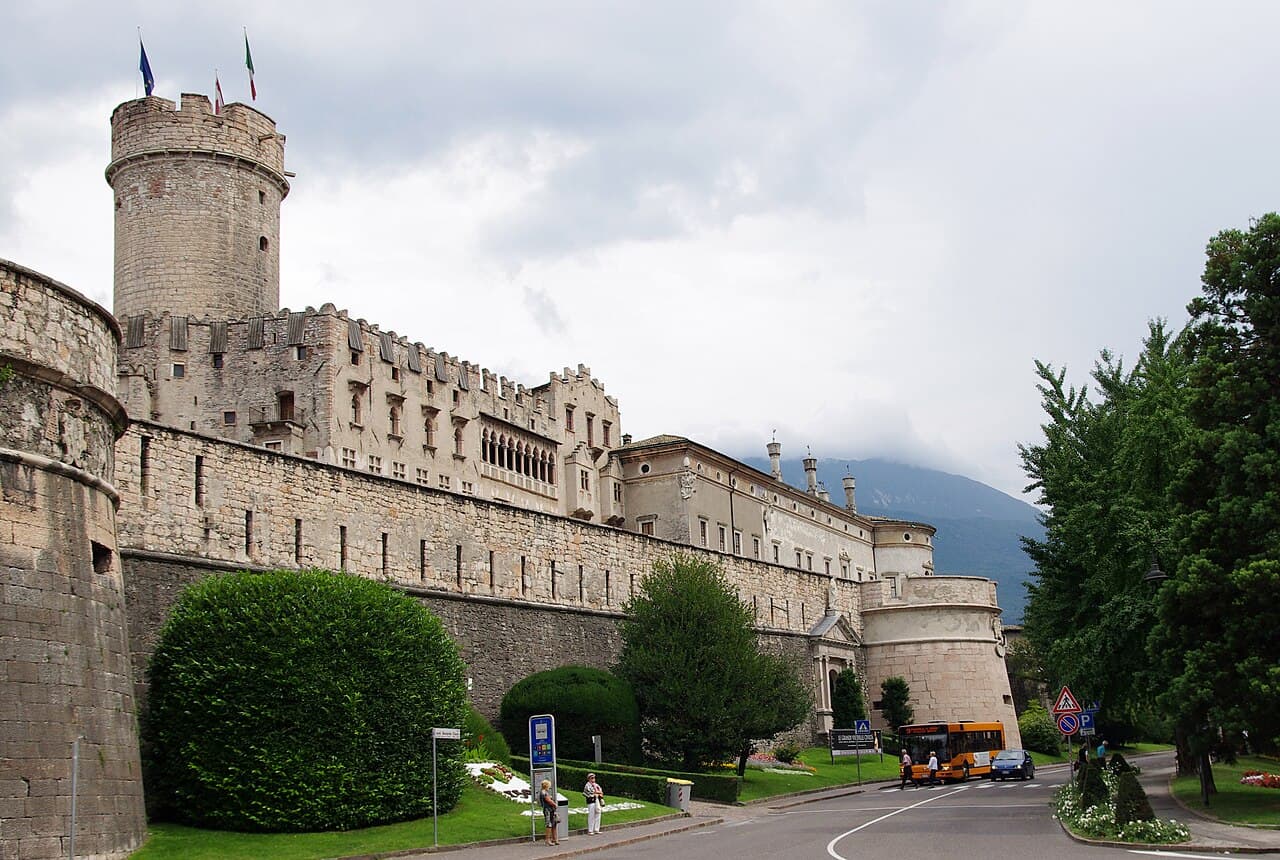
Buonconsiglio Castle
Buonconsiglio Castle stands as a monumental symbol of Trento and the Trentino-Alto Adige region, renowned for its impressive size and complex architectural evolution. Perched on a rocky hill that once hosted a Roman castrum, this hill castle originated in the 13th century as a fortified residence for the Prince-Bishops of Trento, who wielded both spiritual and temporal power. It remains one of the largest and most significant fortified complexes in the Alps, embodying a rich blend of Romanesque, Gothic, and Renaissance styles.
The castle complex is composed of multiple interconnected buildings from different periods, enclosed within defensive walls that dominate the cityscape from an elevated vantage point. Its oldest nucleus, the Castelvecchio ("Old Castle"), dates back to the 12th century and features robust Romanesque elements, including the massive cylindrical Augustus Tower built upon Roman military foundations. This tower exemplifies medieval military architecture and serves as a central landmark within the castle.
The medieval origins and gothic expansions
During the High medieval period, Buonconsiglio Castle evolved from a purely defensive fortress into a refined episcopal residence. Significant expansions were undertaken in the late 14th and early 15th centuries under the rule of Prince-Bishops Giorgio di Liechtenstein and Johannes Hinderbach. These additions included the construction of the Torre Aquila (Eagle Tower), famed for its exceptional late medieval fresco cycle known as the Cycle of the Months. Painted around 1397, these frescoes vividly depict noble court life and rural seasonal activities, offering an invaluable glimpse into 14th-century society and culture. Although one panel was lost to fire, the remaining eleven panels remain a masterpiece of Gothic art.
Johannes Hinderbach also commissioned the distinctive double loggia and the Gothic entrance gate, enhancing the castle's aesthetic and defensive features. These elements reflect influences from Venetian Gothic architecture, integrating elegance with fortification. The castle's walls were further fortified with battlements and defensive structures during this period, adapting to the military needs of the time.
Renaissance transformation under cardinal bernardo clesio
The castle reached its architectural and cultural zenith in the early 16th century during the episcopacy of Cardinal Bernardo Clesio (1485–1539). He commissioned the construction of the Magno Palazzo (Grand Palace), a grand Renaissance wing that dramatically expanded the castle's residential and representative functions. This addition reflects the ideals of the Italian Renaissance, emphasizing symmetry, proportion, and artistic decoration.
The Magno Palazzo houses richly frescoed rooms by prominent painters such as Girolamo Romanino, Dosso Dossi, Battista Dossi, and Marcello Fogolino. The frescoes cover a wide range of themes, including mythological, biblical, and historical scenes, and are particularly notable in the loggia and the Sala Grande (Great Hall). The loggia frescoes by Romanino portray allegorical and moralistic themes focusing on virtues, pride, and the seasons, enriching the castle's symbolic narrative.
A remarkable architectural feature is the suspended bridge supported by candelabra-shaped columns, connecting the Magno Palazzo to the Castelvecchio, facilitating internal circulation. The palazzo also includes terracotta figures by Zaccaria Zacchi and elaborately decorated chambers such as the Sala degli Specchi (Hall of Mirrors), the Camin Nero, and the Stua della Famea dining hall.
Baroque additions and later history
In the late 17th century, the castle complex was unified by the Giunta Albertiana, commissioned by Bishop Francesco Alberti Poja (1686). This Baroque addition linked the Castelvecchio and the Magno Palazzo, featuring stuccos and frescoes by Giuseppe Alberti. It improved the castle's internal accessibility and added new decorative richness.
After the secularization of the Prince-Bishopric in 1803, Buonconsiglio Castle underwent various military uses, including serving as an Austrian barracks and a jail. It was incorporated into Trento’s defensive system until the early 20th century. During World War I, the castle was the site of the tribunal that condemned Italian irredentists Cesare Battisti, Fabio Filzi, and Damiano Chiesa, who were executed in the castle courtyard in 1916, marking a tragic chapter in its history.
Modern restoration and museum function
Following World War I and the annexation of Trentino-Alto Adige to Italy, Buonconsiglio Castle was transferred to Italian state ownership. In the 1920s, it was restored and converted into a national museum. Since 1992, it has housed the Provincial Gallery of Art, showcasing an extensive collection of art ranging from archaeology to modern and contemporary works.
The castle’s preservation efforts have maintained the Renaissance frescoes in excellent condition, particularly those in the Magno Palazzo. Some medieval frescoes, such as the lunettes in the Stua della Famea, show signs of wear but remain significant cultural treasures. The castle also houses important archaeological artifacts, including the Tabula Clesiana, a 1st-century bronze tablet shedding light on Roman-era regional governance.
Architectural features and cultural significance
The castle complex exemplifies a rare architectural layering, combining Romanesque solidity, Gothic elegance, and Renaissance refinement. Its defensive walls, towers, and battlements reflect its original military purpose, while the richly decorated palaces and frescoes illustrate its role as a seat of ecclesiastical power and cultural patronage.
The Cortile dei Leoni (Lions’ Courtyard) is a notable open space within the castle, featuring a frescoed loggia by Romanino that integrates mythological and historical iconography. The castle’s water conduit, built in 1484, is an example of practical engineering, channeling fresh spring water to the residence.
The castle’s garden, established in the 16th century by Cardinal Clesio, remains a characteristic feature, though it has undergone changes over time. Legend speaks of a secret tunnel connecting the castle to Trento’s cathedral, allowing the prince-bishops discreet movement, though this remains unconfirmed.
Today, Buonconsiglio Castle stands as a well-preserved monument and museum, attracting visitors with its architectural grandeur, historical depth, and rich artistic heritage. It remains a symbol of Trento’s complex history, from Roman times through medieval ecclesiastical rule to modern cultural stewardship.
Frequently asked questions (FAQ)
- How do I get to Buonconsiglio Castle?
- Buonconsiglio Castle is located in the heart of Trento, Italy, making it easily accessible by public transportation. You can take a bus or train to Trento and then walk to the castle, which is just a short distance from the city center.
- What is the historical significance of Buonconsiglio Castle?
- Buonconsiglio Castle is one of the most important historical monuments in Trento, serving as the residence of the Prince-Bishops for centuries. Its architecture and art reflect the wealth and power of the ecclesiastical rulers, showcasing a blend of Gothic, Renaissance, and Baroque styles.
- When was Buonconsiglio Castle built?
- Construction of Buonconsiglio Castle began in the 13th century, with various expansions and renovations occurring over the following centuries. The castle complex evolved through different architectural styles, culminating in its current form by the late 17th century.
- Can I take guided tours of Buonconsiglio Castle?
- Yes, guided tours are available at Buonconsiglio Castle, providing visitors with in-depth knowledge of its history and architecture. These tours are typically conducted in multiple languages and can enhance your experience by offering insights that self-guided visits may not provide.
- Why is Buonconsiglio Castle a popular tourist destination?
- Buonconsiglio Castle is popular due to its rich history, stunning architecture, and beautiful frescoes, particularly in the Eagle's Tower. Additionally, its scenic location overlooking the Adige River and proximity to other attractions in Trento make it a must-visit for travelers.
- Is it possible to host events at Buonconsiglio Castle?
- Yes, Buonconsiglio Castle offers venues for hosting various events, including weddings, conferences, and cultural activities. The castle's breathtaking setting and historical ambiance provide a unique backdrop for special occasions.
- What are the opening hours for Buonconsiglio Castle?
- Buonconsiglio Castle is typically open to visitors from 9:00 AM to 5:30 PM, with extended hours during the summer months. It's best to check the official website for any seasonal changes or special closures before planning your visit.
- What are the ticket prices for Buonconsiglio Castle?
- Ticket prices for Buonconsiglio Castle vary depending on age and any applicable discounts, such as for students or seniors. Generally, adult tickets range around €10, while children under 18 can enter for free or at a reduced rate, making it an affordable option for families.
- When is the best time to visit Buonconsiglio Castle?
- The best time to visit Buonconsiglio Castle is during the spring and early fall when the weather is mild and the tourist crowds are smaller. Additionally, visiting during these seasons allows you to enjoy the surrounding gardens and views without the heat of summer.
- Is Buonconsiglio Castle accessible for visitors with disabilities?
- Yes, Buonconsiglio Castle is committed to accessibility and offers facilities for visitors with disabilities. Ramps and designated pathways are available, ensuring that everyone can enjoy the castle's historical wonders.
Photo gallery

Information
Sources & official resources
Verify the information above using these authoritative references.
Loading map...
Visitor reviews
No reviews yet. Been here? Write the first review and help other travelers!
Write the first reviewVisited this castle? Share your experience
Your review helps other travelers and adds first-hand knowledge to our encyclopedia.



