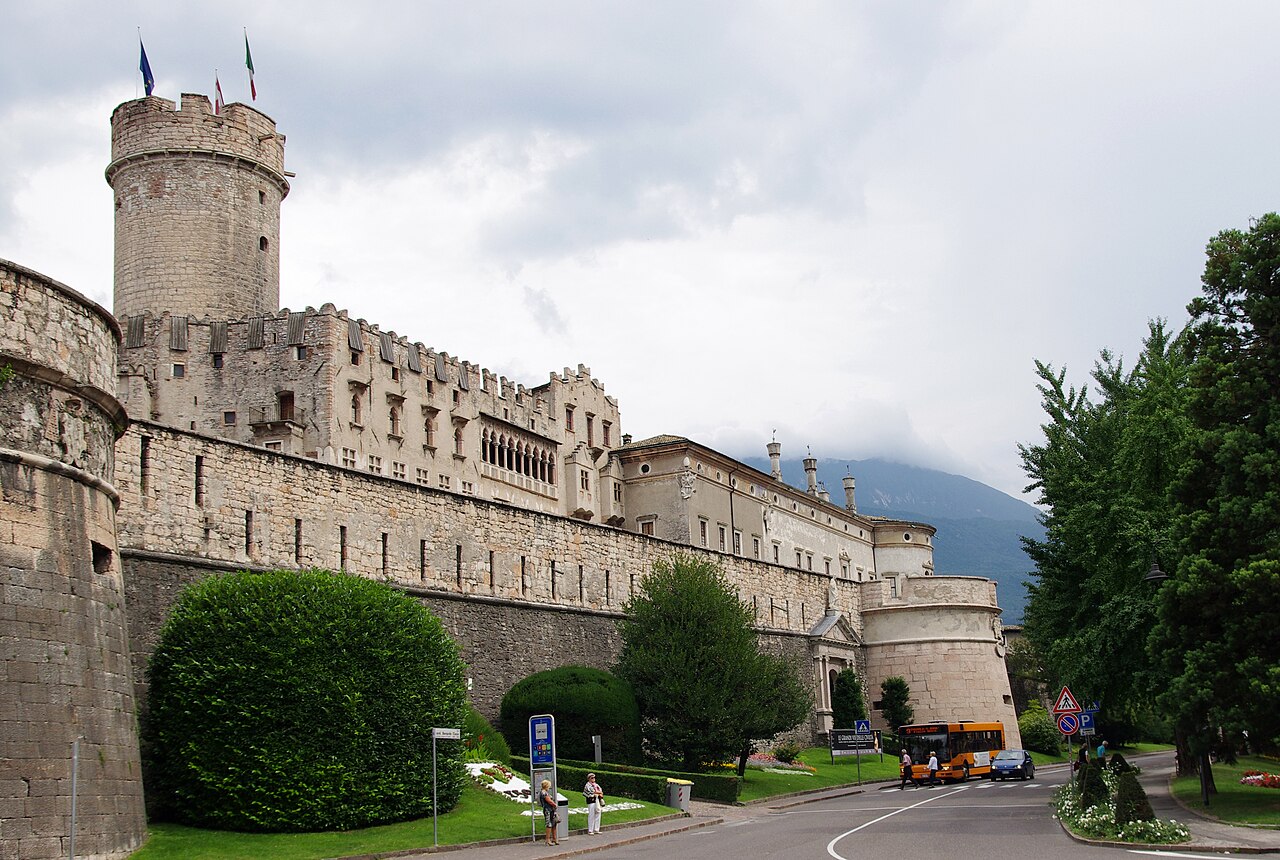
Castel Giovo
Castel Giovo, located in the municipality of Ville di Giovo in northern Italy, stands as a remarkable example of a medieval hill castle with a rich history dating back to the 13th century. This fortress was strategically positioned to oversee the critical route linking the Adige Valley with Valsugana through the Val di Cembra, granting its owners control over both the lucrative mining activities and the flow of commercial trade in the region.
The earliest documented reference to the site appears in 1305, when it was known as the "domus di Vesino", reflecting its role as a noble residence. The castle initially served as the seat of the lords of Giovo, a family closely linked to the influential counts of Appiano. Over the centuries, ownership transferred among several prominent noble families, including the counts of Tyrol and the Moremberg family from Sarnonico, highlighting its enduring political and social significance.
Medieval origins and strategic importance
Constructed primarily during the high medieval period, Castel Giovo began as a fortified residence designed to assert feudal control over the surrounding territory. Its location on a hill approximately 680 meters above sea level provided commanding views of the landscape, essential for early warning and defense. The castle's position also facilitated the supervision of trade routes and mining operations, which were vital economic drivers in the region.
Architectural evolution and features
Defensive structures and layout
The original castle complex was composed of multiple buildings enclosed within defensive walls, including two or possibly three towers. These towers served as critical defensive strongpoints, with the surviving tower rising to about 24 meters and containing five floors. The tower's thick external walls, measuring approximately 1.40 meters on the side facing the road, underscore its military purpose.
Inside the tower, features such as movable iron stairs and trapdoors between floors were incorporated to control access and enhance security. The staircase leading to the first floor, dating from the early 20th century, reflects later modifications during the castle's decline and restoration phases.
Residential and service buildings
Alongside its defensive elements, Castel Giovo evolved to include a noble palace, gardens, and various service buildings. The palace, particularly on the western side, has partially survived and has been adapted into private rural residences, blending medieval architectural elements with modern usage. The presence of a garden and a well within the complex illustrates the castle's function as a self-sustaining noble residence.
Historical transitions and ownership
Throughout its history, Castel Giovo experienced several changes in ownership and function. Initially a feudal stronghold, it gradually transformed into a noble residence by the 15th century, with expansions including fortified enclosures and service buildings. Notable families such as the A Prato, Spaur, and Prugger held the castle during the 17th century, reflecting the shifting political landscape of the region.
The castle's military role diminished over time, culminating in its use as a military barracks during the Napoleonic Wars. This period inflicted significant damage, leading to its eventual abandonment and decline into ruin.
Names and cultural significance
Castel Giovo is known by several names that reflect its history and local identity. The name "Castel Giovo" relates to its geographical location, while "Castello della Rosa" derives from a distinctive rose emblem once embedded in its masonry. Another historical name, "Castel Vesíno" or "Tor de Vesina," connects the castle to the Villa di Vesín, one of the original quarters of Giovo, emphasizing its integration into the local community.
Restoration and current condition
After centuries of decline, restoration efforts began in the late 20th century, culminating in 1987 with the stabilization and partial rebuilding of the castle. Today, the site is recognized as a partially preserved medieval fortress, with the surviving tower and sections of the noble palace offering valuable insights into its architectural and historical heritage.
The castle remains a prominent landmark overlooking the surrounding landscape, providing a tangible connection to the region's medieval past and its evolution through subsequent centuries of social and political change.
Frequently asked questions (FAQ)
- When was Castel Giovo originally built?
- Castel Giovo was originally constructed in the 13th century during the high medieval period, serving as a fortified noble residence.
- What is the historical significance of Castel Giovo's location?
- The castle overlooks the route connecting the Adige Valley with Valsugana through Val di Cembra, controlling mining activities and trade in the region.
- What remains of Castel Giovo can visitors see today?
- Visitors can see the surviving medieval tower, which is about 24 meters tall with five floors, and parts of the noble palace adapted as rural residences.
- Why is Castel Giovo also known as Castello della Rosa?
- The name Castello della Rosa comes from a rose emblem that was once embedded in the castle's masonry, symbolizing its identity and heritage.
- Has Castel Giovo been restored?
- Yes, restoration efforts in the late 20th century stabilized and partially rebuilt the castle, preserving its historical significance.
Information
Website
Visit websiteSources & official resources
Verify the information above using these authoritative references.
Loading map...
Visitor reviews
No reviews yet. Been here? Write the first review and help other travelers!
Write the first reviewVisited this castle? Share your experience
Your review helps other travelers and adds first-hand knowledge to our encyclopedia.