Penteskoufi Castle
Penteskoufi Castle stands as a testament to the complex medieval history of the Corinth region in Greece. This hill castle, perched atop Kastraki hill at an elevation of 476 meters, played a strategic military role from the early 13th century through the Greek War of Independence in the 19th century. Built by Frankish rulers following their conquest of Corinth, the fortress was integral in controlling the surrounding area and countering Byzantine resistance based in the nearby Acrocorinth fortress.
The origins of Penteskoufi Castle date back to the aftermath of the Fourth Crusade and the establishment of Frankish rule in the Peloponnese. After Otto de la Roche took control of Corinth, the castle was likely constructed under the direction of Jakob II of Avesnes. Its primary purpose was to support military operations against the Byzantine forces, particularly those loyal to Leon Sgouros, a local Byzantine ruler who had fortified himself in Acrocorinth and frequently launched raids from there. The castle is identified with the medieval fortress known as Montesquieue or Mont Escouvé mentioned in the Chronicle of Morea, with its modern name, Penteskoufi, evolving as a local corruption of the original name.
Medieval military significance and the siege of acrocorinth
Penteskoufi Castle was a key player during the protracted siege of Acrocorinth, which lasted approximately two years and culminated in 1208 with the death of Leon Sgouros. The castle's location southwest of Acrocorinth allowed it to serve as an outpost to contain and monitor Byzantine movements. Following the Frankish victory and the fall of Acrocorinth, the strategic importance of Penteskoufi diminished, leading to its gradual abandonment in the subsequent centuries.
Venetian restoration and later military use
During the Venetian period of control over Corinth from 1687 to 1715, Penteskoufi Castle was restored to function as a secondary fortification supporting Acrocorinth. This restoration underscores the enduring military value of the site, even centuries after its initial construction. The Venetians reinforced the castle's defenses, adapting it to contemporary military needs of the time.
In the early 19th century, the castle once again became a site of military activity during the Greek War of Independence. Greek revolutionary forces captured the fortress in March 1821, using it as a base against Ottoman troops. By January 1822, the Ottomans had retreated, marking a significant moment in the castle's long history of conflict and defense.
Archaeological discoveries near the castle
Beyond its military history, the area surrounding Penteskoufi Castle is archaeologically significant. In 1879, a farmer discovered numerous small votive tablets roughly 900 meters northwest of the fortress. These findings prompted archaeological investigations by Arthur Milchhoefer in 1880 and later by the American School of Classical Studies at Athens in 1905. The excavations revealed about 1,500 fragments of the Pinakes of Penteskouphia, a collection of painted wooden tablets depicting mythological scenes and religious iconography, providing deep insights into the cultural and religious practices of the region in antiquity.
Architectural features and construction phases
Penteskoufi Castle occupies a relatively compact area of approximately 500 square meters, with dimensions measuring around 17 meters from west to east and 35 meters from north to south. The fortress is enclosed by a robust outer wall, which varies in thickness between two and 2.5 meters. This wall is punctuated by six narrow vertical arrow slits, which date from a later period, allowing defenders to fire arrows or firearms while remaining protected behind the thick masonry.
A prominent architectural element is the northern tower, measuring nearly 10.5 by 9.5 meters in footprint. Originally, this tower consisted of a single large ground-floor room. Later modifications introduced a dividing wall made of porphyry, a durable purple volcanic stone, splitting the space into two chambers. The tower's entrance was located on its southern side, adjacent to the main gate of the castle, highlighting its role in overseeing and defending access.
The castle's construction reveals two distinct building phases. The initial phase employed roughly shaped limestone blocks, assembled with gaps filled by clay bricks, a technique characteristic of Frankish medieval architecture in the Peloponnese. The subsequent phase, likely during Venetian or possibly Ottoman rule, introduced more precisely cut porphyry stones, particularly in the tower's subdivision wall and other reinforced structures. These adaptations reflect the evolving military technologies and architectural styles over the centuries.
Current condition and preservation
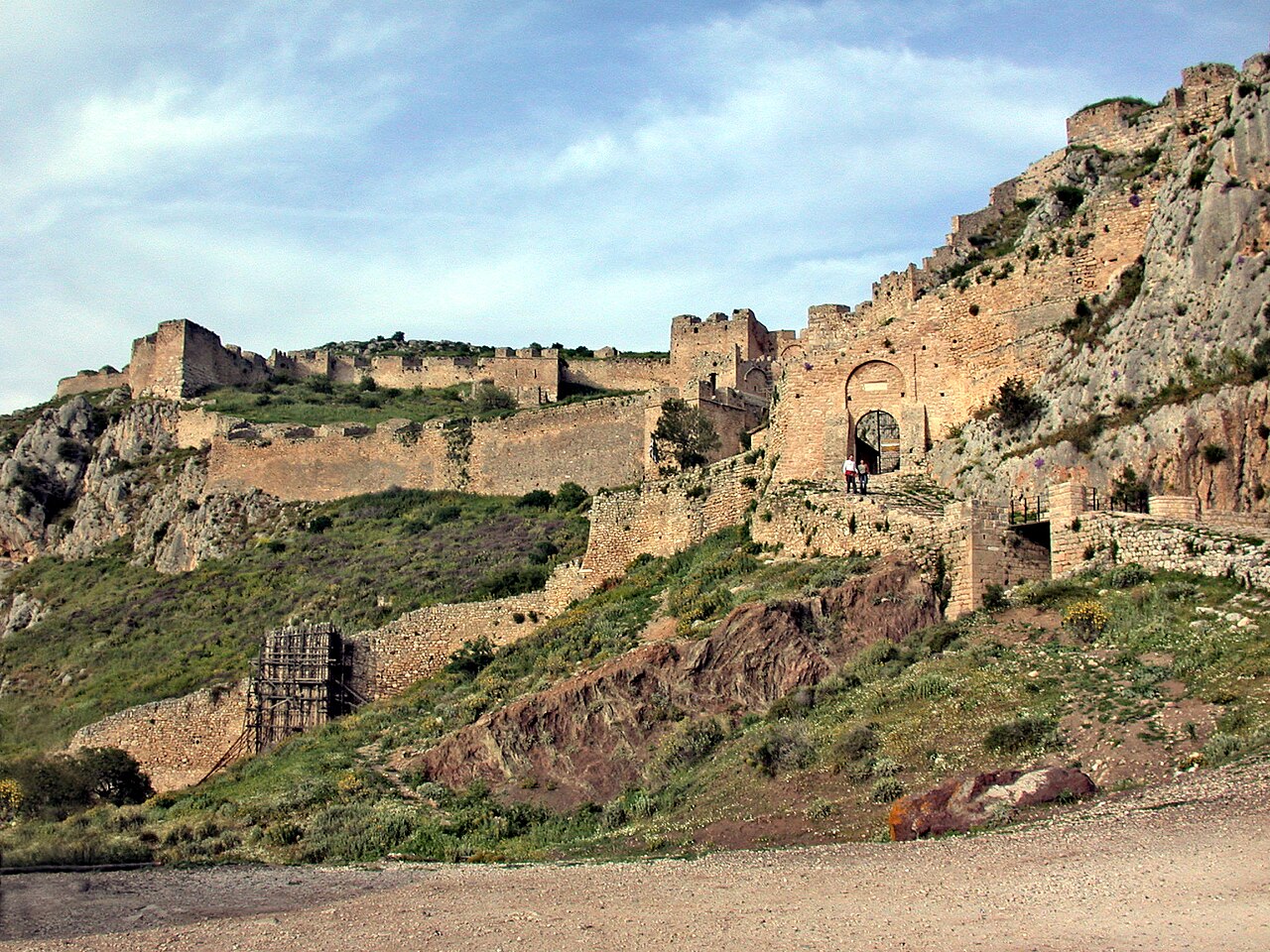
Today, the remains of Penteskoufi Castle are still visible on the summit of Kastraki hill. The thick enclosing walls, the northern tower, and the arrow slits stand as enduring features that illustrate the fortress's defensive purpose and its historical adaptations. While the castle is not fully intact, the partially preserved ruins offer valuable insights into medieval fortification techniques and the region's turbulent history.
Visitors to the site can appreciate the castle's strategic location, commanding views of the surrounding landscape and its proximity to Acrocorinth, one of Greece's most important medieval fortresses. The site remains an important cultural landmark, linking the Frankish, Venetian, and Greek revolutionary periods in a single historic monument.
Frequently asked questions (FAQ)
- How do I get to Penteskoufi Castle from Corinth?
- Penteskoufi Castle is located about 1.25 kilometers southwest of Acrocorinth, near the city of Corinth. Visitors can reach the site by car or on foot via local hiking trails that lead up to Kastraki hill, where the castle ruins are situated.
- What is the historical significance of Penteskoufi Castle?
- Penteskoufi Castle was built by Frankish rulers in the early 13th century to support military operations against Byzantine forces in Acrocorinth. It played a key role during the siege of Acrocorinth and later saw action during the Venetian period and the Greek War of Independence.
- Can I visit the ruins of Penteskoufi Castle year-round?
- Yes, the ruins of Penteskoufi Castle are accessible year-round. However, there are no formal visitor facilities or opening hours, so visitors should plan accordingly and wear appropriate footwear for hiking to the hilltop site.
- Are there any archaeological findings associated with Penteskoufi Castle?
- Yes, near the castle site, numerous votive tablets known as the Pinakes of Penteskouphia were discovered in the late 19th century. These artifacts provide valuable cultural and religious insights into the ancient history of the region.
Information
Loading map...
Visitor reviews
No reviews yet. Been here? Write the first review and help other travelers!
Write the first reviewVisited this castle? Share your experience
Your review helps other travelers and adds first-hand knowledge to our encyclopedia.