Acrocorinth
Acrocorinth stands as a monumental hill castle overlooking the ancient city of Corinth in Greece. This towering fortified rock formation has served as a vital defensive and religious site from ancient Greek times through the Byzantine, Frankish, Venetian, and Ottoman periods. Its strategic location atop a 575-meter high massif commands sweeping views over the Corinthian and Saronic Gulfs, controlling key land and sea routes for over two millennia.
The site's legendary origins are steeped in mythology, with connections to the sun god Helios and the goddess Aphrodite. The mythical king Bellerophon is said to have dedicated the summit to Aphrodite, with a temple traditionally linked to the sorceress Medea. These early religious associations highlight the cultural and spiritual significance of Acrocorinth well before its military role was established.
Ancient origins and classical fortifications
The earliest fortifications at Acrocorinth date back to the 7th and 6th centuries BCE, built by the Corinthian tyrants Cypselus and Periander. These initial defenses were designed to protect the city and oversee the fertile Corinthian plain below. The fortress's natural topography, with steep ravines on three sides, made it a formidable stronghold.
During the 4th century BCE, under Macedonian influence, the fortress was further strengthened to enhance its military capabilities. However, the site suffered destruction in 146 BCE when the Roman general Lucius Mummius sacked Corinth. Later, the fortress was repaired by Julius Caesar in 44 BCE, restoring its strategic importance within the Roman Empire.
Byzantine and medieval transformations
In the 6th century CE, the Byzantine Emperor Justinian undertook significant restoration works, adapting Acrocorinth to withstand the evolving military threats of the era. The fortress's walls and gates were reinforced, and new defensive structures were added.
Following the Fourth Crusade, the fortress came under Frankish control by 1210 CE. The local lord Leon Sgouros famously resisted the Frankish siege before his tragic suicide, marking a dramatic episode in the castle's history. Over subsequent centuries, Acrocorinth passed among various rulers, including the Byzantine Palaiologos dynasty and the Knights Hospitaller.
The Ottoman Turks conquered the fortress in 1458, incorporating it into their empire. The Venetians briefly seized Acrocorinth in 1687, making substantial repairs before the Ottomans recaptured it in 1715. During the Greek War of Independence (1821–1823), the fortress was a focal point of sieges and negotiations, eventually falling under Greek control in 1823.
Architectural features and layout
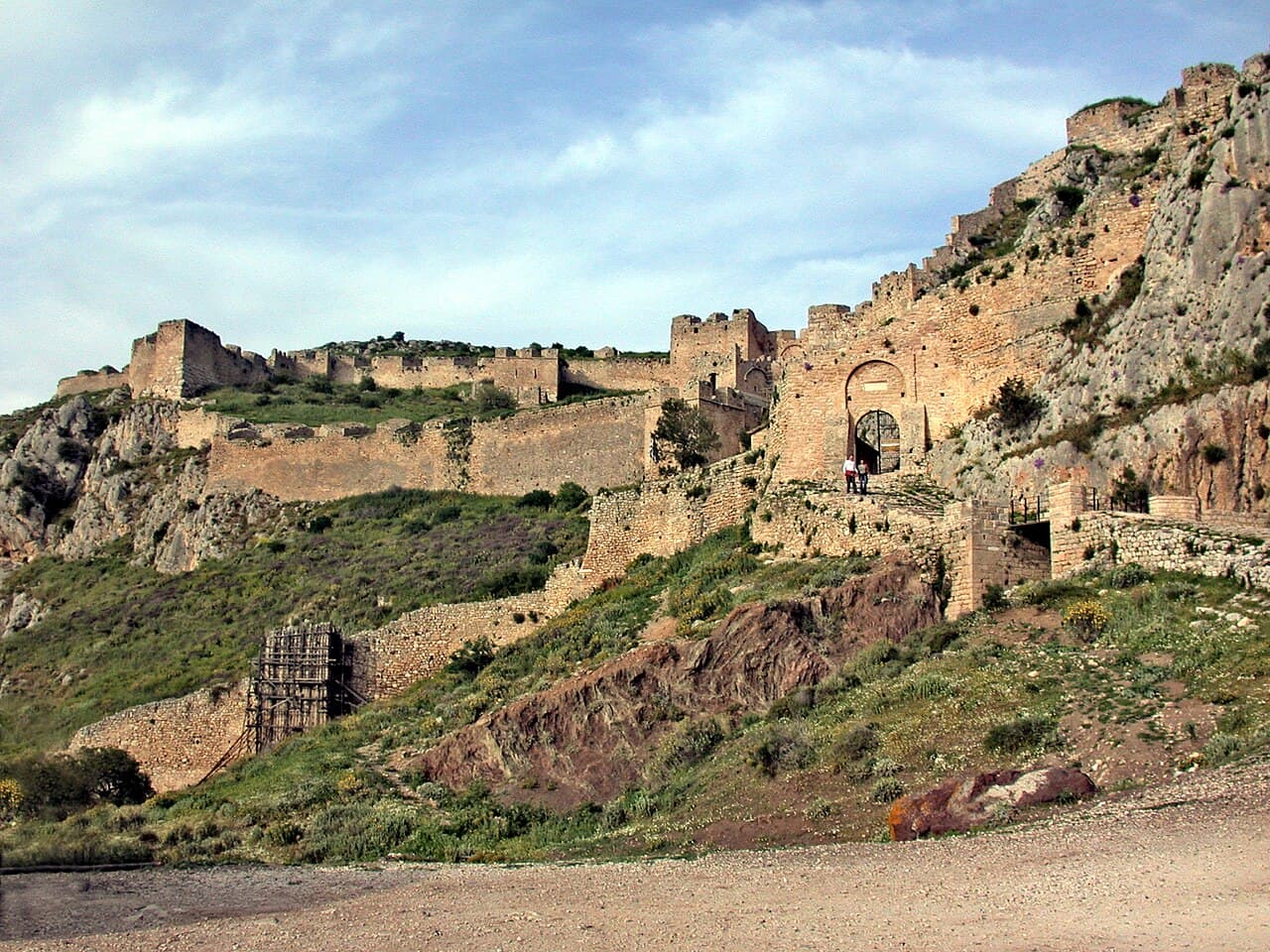
The fortress complex extends across two main summits of the rock, connected by nearly two kilometers of defensive walls that follow the natural contours. The northern, eastern, and southern sides are protected by steep ravines, while the western approach is fortified by a sophisticated triple wall system with three vaulted gates.
The main entrance was historically defended by a deep moat, a medieval drawbridge, and defensive ditches, though some elements have deteriorated. The fortress is arranged in three vertical enclosures: lower, middle, and upper. The highest summit contains the main castle with continuous walls and towers enclosing a plateau divided into eastern and western sections.
Religious structures
On the eastern summit lies the site of the ancient temple of Aphrodite. While the original temple no longer stands, a Byzantine chapel was built on its foundations, reflecting the site's enduring religious significance. The fortress also contains a chapel dedicated to the Prophet Elias and several other religious buildings from Venetian and Ottoman periods, including at least two small mosques. One mosque features a distinctive cylindrical minaret with a spiral staircase, exemplifying Islamic architectural influence.
Military and support structures
The western summit hosts the ruins of a Frankish tower, later expanded by Venetian and Ottoman occupants. The fortress includes numerous underground passageways, wells, storerooms, and cisterns designed to sustain defenders during prolonged sieges.
The Peirene fountain, located between the summits, is an ancient reservoir mentioned by the traveler Pausanias. Restored in 1930, it historically provided a vital fresh water supply.
Preservation and archaeological significance
Archaeological excavations began in 1896 under the American School of Classical Studies at Athens, revealing the fortress's complex history and multi-layered occupation. Conservation efforts throughout the 20th century have stabilized and restored key defensive features, including the bridge over the moat and the guardhouse at the first gate.
Restorations in the 1960s, 1970s, and 1990s have preserved the fortress's walls and gates, with the wooden entrance bridge replaced to maintain accessibility. Remnants of Venetian artillery, including a cannon dated 1670, remain on site, attesting to the fortress's military importance during that era.
Today, Acrocorinth is recognized not only for its historical and architectural significance but also for its natural environment. It is protected as a Natura 2000 site, supporting diverse flora and fauna that thrive on the rock's slopes.
Strategic importance and views
From its commanding vantage points, Acrocorinth offers expansive views over the Patraic and Corinthian Gulfs, southern mainland Greece, and islands such as Salamis and Aegina in the Saronic Gulf. These sightlines underscore the fortress's enduring role as a sentinel overseeing key maritime and land routes throughout its long and varied history.
Frequently asked questions (FAQ)
- How do I get to Acrocorinth from the city of Corinth?
- Acrocorinth is located just a few kilometers south of Corinth city center. Visitors can reach the site by car or taxi, with a short drive uphill to the fortress entrance. There is also a hiking trail for those who prefer a scenic walk.
- What is the best time of year to visit Acrocorinth?
- The best time to visit Acrocorinth is during spring and autumn when the weather is mild and the natural surroundings are lush. Summers can be hot and dry, while winters are cooler but less crowded.
- Can I explore the entire fortress on foot?
- Yes, visitors can explore most of the fortress on foot, including the walls, towers, and various ruins. Some areas may be steep or uneven, so comfortable footwear is recommended.
- Is Acrocorinth accessible for people with mobility issues?
- Due to the steep terrain and rugged paths, Acrocorinth is not fully accessible for visitors with significant mobility challenges. Assistance or guided tours may help, but some parts require careful navigation.
- Are there guided tours available at Acrocorinth?
- Guided tours are available through local operators and the Greek Ministry of Culture. These tours provide in-depth historical and architectural insights, enhancing the visitor experience.
- What historical periods are represented in Acrocorinth's architecture?
- Acrocorinth showcases architectural elements from ancient Greek, Byzantine, Frankish, Venetian, and Ottoman periods, reflecting its long history of occupation and adaptation.
Photo gallery

Photo by MM•Public domain
Information
Opening hours
8:00-19:00 daily
Ticket prices
€6 adult, €3 child
Current owner
Greek Ministry of Culture
Loading map...
Visitor reviews
No reviews yet. Been here? Write the first review and help other travelers!
Write the first reviewVisited this castle? Share your experience
Your review helps other travelers and adds first-hand knowledge to our encyclopedia.