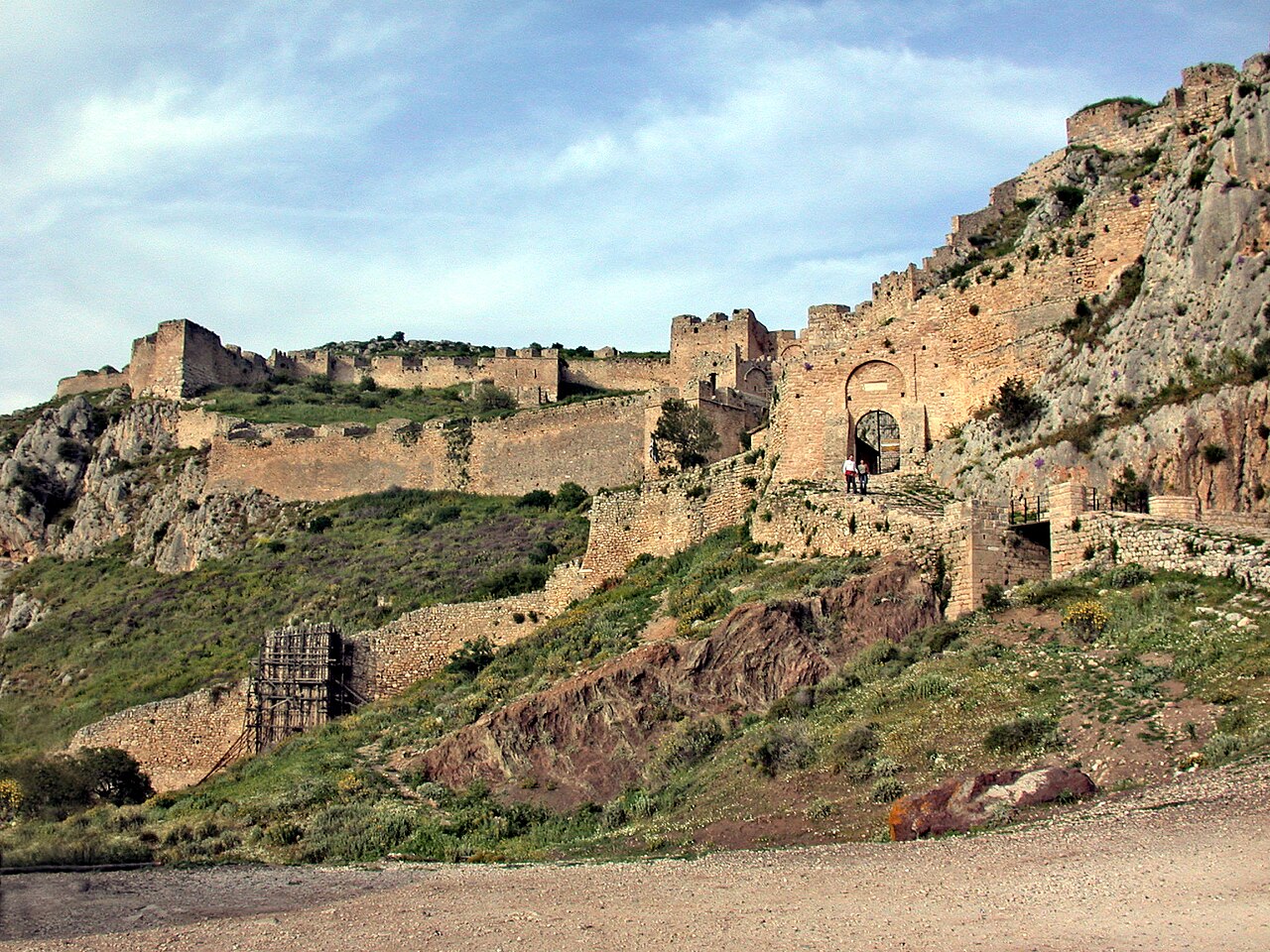
Castle of Fokas stands on Mount Fokas, a prominent 862-meter high hill near Corinth, Greece. This strategic location offered commanding views over the plains of Nemea and the vital route leading to the heart of the Peloponnese peninsula. The castle's position allowed it to maintain visual contact with other significant Frankish fortifications such as Acrocorinth and Agios Vasilios, as well as with castles across the Gulf of Corinth in Central Greece, highlighting its importance in regional defense and communication networks during the medieval period.
Historical background and construction
The origins of the castle of Fokas are somewhat debated, with evidence suggesting it was constructed in the 13th century during the high medieval period. While the castle is traditionally attributed to the Frankish Crusaders who controlled much of the Peloponnese after the Fourth Crusade, some historians propose that the Byzantines may have initially established a fortification on the site slightly earlier. The trapezoid-shaped summit of Mount Fokas hosted a medieval settlement before the castle's construction, indicating the area's longstanding strategic and residential significance.
The castle was primarily built to control the surrounding plains and the main inland route, serving both as a military stronghold and a lookout point. Its elevated position allowed defenders to monitor movements and potential threats across a wide area, especially from the north and east approaches to the Peloponnese.
Architectural features and layout
Today, only limited ruins remain of the castle of Fokas, primarily fragments of its defensive walls and remnants of the lower settlement structures. The castle's original design likely included typical medieval fortification elements such as curtain walls following the natural contours of the trapezoidal summit, battlements for archers, and possibly towers for enhanced defense and observation.
The castle's location on a rocky hilltop classifies it as a hill castle, utilizing the natural elevation as a defensive advantage. The steep slopes surrounding the summit would have made direct assaults difficult, while the limited flat space on top necessitated a compact and efficient layout.
Defensive role and regional significance
The castle's strategic function extended beyond local defense. Its ability to communicate visually with other fortresses such as Acrocorinth and Agios Vasilios allowed for coordinated military responses and early warning systems across the region. This network of castles was vital for controlling the Peloponnese during the turbulent years following the Crusader conquest and during the ongoing conflicts between the Frankish states and the Byzantine Empire.
Control of the castle meant dominance over the fertile plains of Nemea, a region known for its agricultural productivity and as a key transit area. The castle thus played a role in securing resources and trade routes essential for sustaining medieval polities in the Peloponnese.
Current condition and archaeological remains
Presently, the castle of Fokas exists mainly as ruins, with only fragments of the original walls and settlement structures visible. The lower part of the rock hill contains remains of the medieval settlement that once supported the castle's garrison and inhabitants.
Due to its elevated and somewhat remote location, the site has not undergone extensive restoration, preserving its authentic medieval ruin state. The ruins provide valuable insights for archaeologists and historians studying Frankish and Byzantine military architecture and settlement patterns in the Peloponnese.
Visiting the castle of fokas
The castle's location on Mount Fokas offers visitors panoramic views of the surrounding landscape, including the plains of Nemea and the Gulf of Corinth. While the ruins are sparse, the site is of interest to those fascinated by medieval history, military architecture, and the complex history of Frankish and Byzantine rule in Greece.
Access to the castle requires a hike up the hill, which may be challenging due to the terrain. Visitors should prepare accordingly and respect the fragile archaeological remains. The site is an evocative reminder of the medieval struggles for control in the Peloponnese and the enduring legacy of its fortifications.
Frequently asked questions (FAQ)
- How do I get to the castle of Fokas?
- The castle of Fokas is located on Mount Fokas near Corinth, Greece. Visitors can reach the site by hiking up the hill from nearby roads or trails. It is advisable to wear suitable footwear and be prepared for a moderate climb.
- What is the historical significance of the castle of Fokas?
- The castle of Fokas played a strategic role in controlling the plains of Nemea and the main route to the Peloponnese during the 13th century. It was part of a network of Frankish fortresses that helped secure the region after the Fourth Crusade.
- Can I see remains of the original castle structures?
- Yes, visitors can observe fragments of the castle's defensive walls and remains of the medieval settlement on the lower parts of Mount Fokas. However, the ruins are limited and the site is largely in a ruined state.
- Is the castle of Fokas accessible year-round?
- The site is generally accessible year-round, but visitors should consider weather conditions and the physical demands of hiking. Spring and autumn offer the most comfortable conditions for visiting.
- Are there guided tours available at the castle of Fokas?
- Currently, there are no official guided tours at the castle of Fokas. Visitors interested in detailed historical information are advised to research beforehand or hire local guides familiar with the region's medieval history.
Information
Loading map...
Visitor reviews
No reviews yet. Been here? Write the first review and help other travelers!
Write the first reviewVisited this castle? Share your experience
Your review helps other travelers and adds first-hand knowledge to our encyclopedia.