Penrice Castle
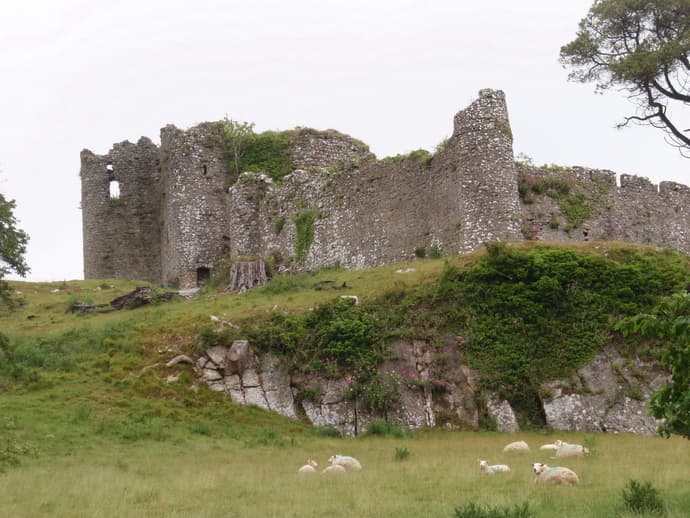
Penrice Castle is a significant 13th-century medieval fortress located near Penrice, Swansea on the Gower Peninsula in Wales. It stands as the successor to an earlier strong ringwork fortification and was constructed by the de Penrice family, who were granted the land following their role in the Norman conquest of Gower. The castle's strategic position atop steeply sloping ground provided natural defensive advantages, particularly on the north, east, south, and southwest sides where the terrain drops sharply.
Architectural features and layout
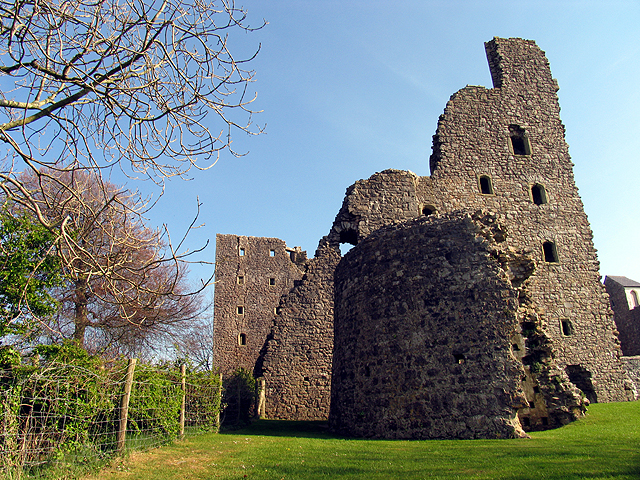
The castle is built primarily of stone and is characterized by its large, irregular hexagonal curtain wall enclosing the inner ward. On the west side stands a prominent round keep, which served as the stronghold and last line of defense. Attached to the keep were two additional towers and a partial mantlet or chemise wall, designed to provide extra protection to the keep by surrounding it with a low defensive wall.
At the north-west corner of the castle is a distinctive twin square-towered gatehouse, which controlled access to the interior. Within the gatehouse is an additional tower, likely used for surveillance and defense. Various other turrets are positioned around the castle perimeter, though their arrangement does not follow a strictly scientific or symmetrical plan, reflecting adaptations to the natural topography and evolving defensive needs.
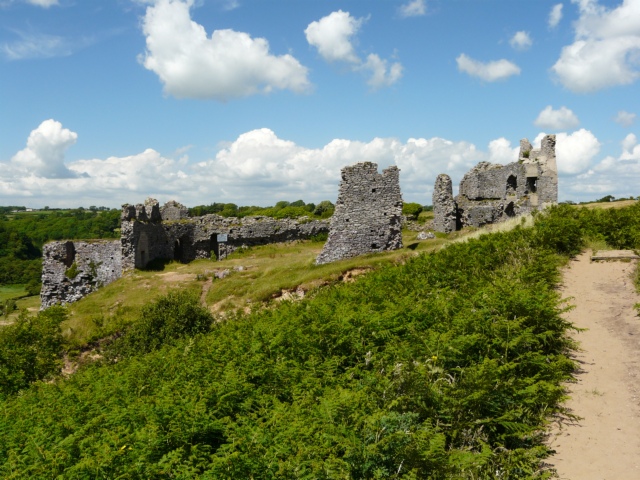
Today, the castle remains in a ruined condition and is considered dangerous due to structural instability. However, the southern wall remains visible from a nearby footpath that passes the adjacent 18th-century mansion on the estate.
Historical context and ownership
The de Penrice family, original builders of the castle, held the estate following the Norman conquest. In 1410, the last de Penrice heiress married into the Mansel family, transferring ownership of the castle and lands. The Mansels later acquired Margam Abbey and established it as their principal seat, though they retained possession of their Gower lands including Penrice.
The castle sustained damage during the 17th-century English Civil War, reflecting its continued military relevance into the early modern period. After this period, the castle fell into disuse and gradual decay as the Mansel family shifted their focus and resources to other estates.
Penrice mansion and estate development
Adjacent to the castle ruins stands a fine neo-classical mansion built in the 1770s by architect Anthony Keck for Thomas Mansel Talbot (1747–1813), a prominent member of the Mansel family. The mansion is a Grade I listed building and is recognized as one of the finest country houses in Wales.
The surrounding parkland, also Grade I listed, was laid out between 1773 and 1776 by William Emes, a landscape designer influenced by Capability Brown. The park complements the mansion's classical elegance with carefully planned naturalistic landscaping.
Thomas Mansel Talbot's art collection
The mansion was originally constructed to house Talbot's extensive collection of antiquities and artworks. During his travels in Italy between 1769 and 1773, Talbot acquired numerous classical artifacts from notable dealers such as Thomas Jenkins, Gavin Hamilton, and Giambattista Piranesi. Among the prized pieces were a Minerva statue with a bronze helmet and a funerary monument, now housed in the Courtauld Institute, London.
Talbot also collected modern furniture crafted by artisans like Albacini and Valadier, as well as contemporary sculptures by Johan Tobias Sergel. He commissioned busts of himself and Pope Clement XIV from the sculptor Christopher Hewetson, with the latter now displayed at the Victoria and Albert Museum in London.
His art acquisitions extended to paintings by Rembrandt and Hackert, as well as drawings by Nicolas Poussin. These collections were shipped to Wales in stages during 1772 and 1775 and were exhibited in the mansion following Talbot's marriage in 1792. Much of this collection was later moved to Margam Castle and eventually sold at auction in 1941.
Penrice household and legacy
Detailed insights into the Penrice household during the late 18th and early 19th centuries come from the diaries and correspondence of Agnes Porter, a Scottish-born governess employed there between 1799 and 1806. These documents, discovered in the castle attic in the 1970s and compiled by historian Joanna Martin, shed light on daily life, family relations, and social customs of the period.
Today, the neo-classical mansion remains inhabited by the Methuen-Campbell family, direct descendants of the de Penrice lineage, maintaining a continuous connection to the estate's medieval origins.
Significance and preservation
Penrice Castle represents a valuable example of high medieval military architecture adapted to the natural landscape of the Gower Peninsula. Its combination of a round keep, gatehouse, and irregular curtain walls illustrate the defensive strategies of the period. Although in ruins, the castle's remains contribute important archaeological and historical information about Norman and later medieval fortifications in Wales.
The adjacent neo-classical mansion and landscaped park add cultural depth to the site, reflecting the 18th-century aristocratic lifestyle and the Mansel family's role as patrons of the arts and collectors of antiquities. Both the castle ruins and the mansion estate are protected as listed heritage sites, ensuring their conservation for future generations.
Frequently asked questions (FAQ)
- How do I get to Penrice Castle?
- Penrice Castle is located in the picturesque village of Penrice in the United Kingdom. It is accessible by car, with parking available nearby. Public transport options include local buses that connect to nearby towns, making it easy for visitors to reach the castle.
- What is the historical significance of Penrice Castle?
- Penrice Castle dates back to the 12th century and is known for its impressive architecture and rich history. It has been a key landmark in the region, serving various roles throughout the centuries, including as a defensive stronghold and a noble residence. Its historical importance is highlighted by its connection to notable figures in Welsh history.
- When was Penrice Castle built?
- Penrice Castle was originally constructed in the early 12th century, with significant renovations occurring in the 14th century. The castle's design reflects the architectural styles of the time, showcasing a blend of defensive and residential features. Over the years, it has been adapted to meet the needs of its inhabitants while preserving its historical essence.
- Can I visit Penrice Castle?
- Yes, Penrice Castle is open to the public for visits. Guests can explore the grounds and enjoy the stunning views of the surrounding landscape. It is advisable to check the castle's official website for the latest visiting hours and any special events that may be taking place.
- Why is Penrice Castle a popular tourist attraction?
- Penrice Castle attracts visitors due to its unique blend of history, architecture, and natural beauty. The stunning grounds and scenic views provide a perfect backdrop for photography and leisurely walks. Additionally, the castle's rich history and connection to Welsh heritage make it an intriguing site for history enthusiasts.
- Is it possible to host events at Penrice Castle?
- Yes, Penrice Castle offers facilities for hosting various events such as weddings, corporate gatherings, and private functions. The picturesque setting and historical ambiance provide a memorable backdrop for special occasions. Interested parties should contact the castle management for details on availability and booking procedures.
- What are the opening hours for Penrice Castle?
- Penrice Castle typically opens to visitors from March to October, with varying hours depending on the day of the week. It is advisable to check the castle’s official website for the most current information regarding opening hours, as they may change seasonally or for special events.
- Are there any nearby attractions to Penrice Castle?
- Yes, there are several nearby attractions including beautiful beaches, scenic walking trails, and charming villages. Visitors can explore the Gower Peninsula, which is renowned for its stunning coastlines and outdoor activities. Additionally, local pubs and shops offer a taste of the region’s culture and hospitality.
- What are the ticket prices for visiting Penrice Castle?
- Ticket prices for Penrice Castle vary depending on age and the type of visit, such as guided tours or special events. Generally, discounts may be available for children, students, and seniors. It is recommended to check the official website for the most accurate pricing and any ongoing promotions.
Photo gallery

Information
Loading map...
Visitor reviews
No reviews yet. Been here? Write the first review and help other travelers!
Write the first reviewVisited this castle? Share your experience
Your review helps other travelers and adds first-hand knowledge to our encyclopedia.