Pembroke Castle
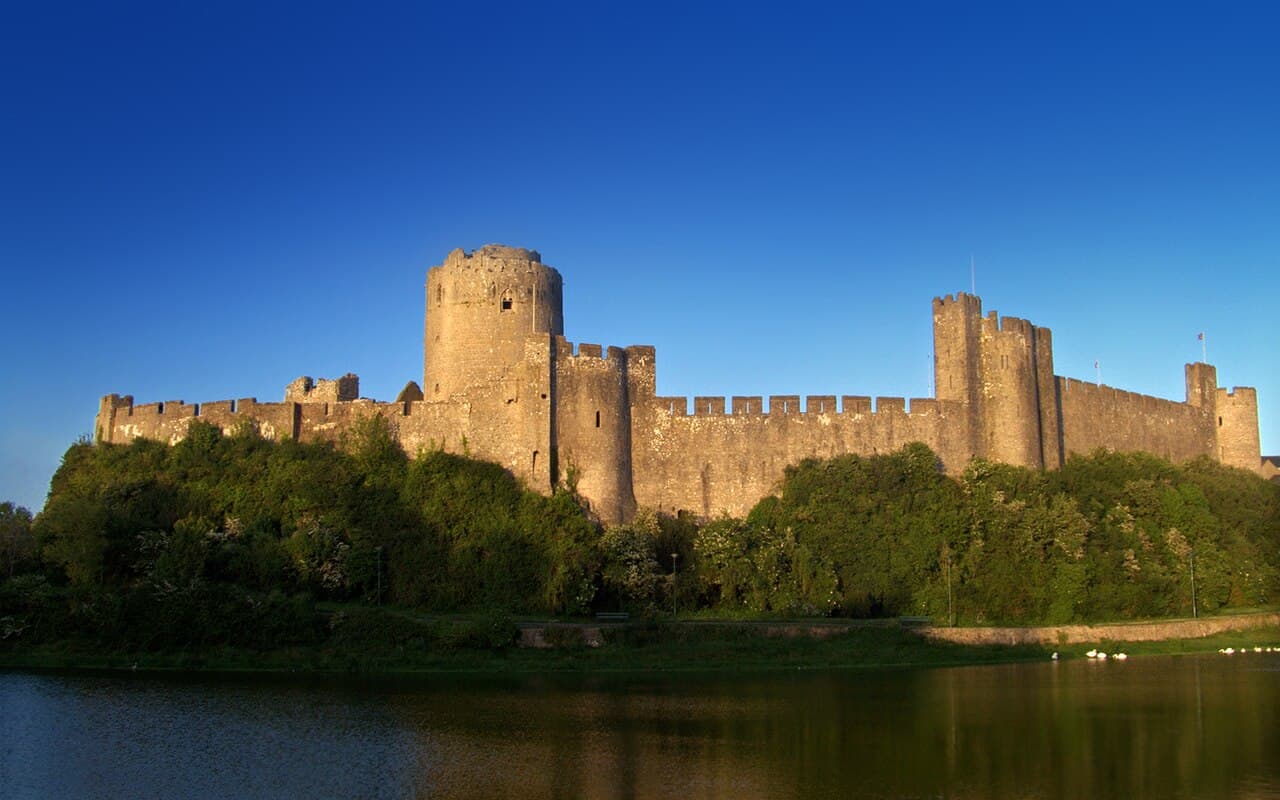
Pembroke Castle stands as one of the most significant Norman fortresses in Wales, located in the historic town of Pembroke, Pembrokeshire. Founded in the 12th century, this castle occupies a strategically important rocky promontory overlooking the Pembroke River estuary, which provided natural defense on three sides. The site itself has a rich history of human occupation dating back to prehistoric times, with evidence of Paleolithic and Mesolithic activity found in the natural limestone cave beneath the castle, known today as Wogan Cavern.
The first fortification on the site was established in 1093 by Arnulf of Montgomery, a Norman lord involved in the Norman invasion of Wales. His initial structure was a timber motte-and-bailey castle, which utilized the natural steep slopes and river defenses. This early castle withstood several Welsh attacks and sieges during the turbulent early Norman period in southwest Wales.
William Marshal and the transformation into a stone fortress
In 1189, King Richard I granted Pembroke Castle to William Marshal, one of the most powerful men in 12th-century Britain. Marshal undertook a comprehensive rebuilding of the castle in stone, transforming it from a wooden fortification into an imposing Norman stone stronghold. He constructed the castle's iconic large round keep, which is notable for its rare stone domed roof and thick walls up to six meters at the base. The keep features an original first-floor entrance accessed by an external stairway and a spiral staircase connecting four stories inside.
The keep's domed roof contains putlog holes that once supported a wooden fighting platform, or hoarding, allowing defenders to project beyond the massive walls during an attack. This architectural feature highlights the castle's advanced military design for its time.
Inner ward and domestic buildings
The castle's inner ward was the first area to be constructed in stone and contains the keep, a large horseshoe-shaped gateway, and domestic buildings such as William Marshal's original Great Hall and private apartments. The inner ward's curtain wall was thin along the promontory side, relying on natural cliffs for defense, but heavily fortified on the landward side facing the town.
Additional buildings were added in the late 13th century, including a new Great Hall and a chapel, reflecting the castle's role not only as a military fortress but also as a noble residence and administrative center.
Expansion under the de Valence family and later medieval developments
After passing through the hands of the Marshal family, Pembroke Castle came under the control of the de Valence family for approximately 70 years. During this period, the castle was further expanded and fortified to serve as a military base during Edward I's conquest of North Wales between 1277 and 1295.
The outer ward was developed with a thick curtain wall up to five meters thick, multiple round towers, and a large twin-towered gatehouse with an attached barbican, constructed in the early 14th century by Aymer de Valence. The outer defenses focused on the landward side, where the castle was vulnerable to attack, while the natural river defenses protected the other sides.
One of the towers near the gatehouse is known as the Henry VII Tower, reputedly the birthplace of King Henry VII in 1457, linking the castle to the Tudor dynasty.
Wogan Cavern: natural cave and fortified sallyport
Beneath the castle lies Wogan Cavern, a large natural limestone cave measuring approximately 21 by 15 meters. This cavern was fortified with a stone wall, barred gateway, and arrow slits, and accessible via a 55-step spiral staircase descending from the inner ward. It may have functioned as a sallyport, a secret exit, or a boathouse, allowing covert access to the river for supplies or escape during sieges.
Role during the English Civil War and subsequent decline
In the 17th century, during the English Civil War, Pembroke Castle declared for Parliament despite most of South Wales siding with the Royalists. It withstood a Royalist siege in 1644, aided by reinforcements arriving by sea from Milford Haven. However, in 1648, during the Second Civil War, the castle was captured by Oliver Cromwell after a seven-week siege.
Following its capture, Cromwell ordered the castle to be deliberately damaged to prevent its future military use. Local townspeople were encouraged to dismantle the fortress and repurpose its stone for building materials, leading to significant ruin and abandonment.
Restoration and modern significance
After centuries of neglect, restoration efforts began in 1880 with a three-year project to stabilize and repair parts of the castle. A more extensive restoration was initiated in 1928 by Major-General Sir Ivor Philipps, who focused on rebuilding the walls, gatehouses, and towers. Since then, the castle has been managed by a trust involving the Philipps family and Pembroke Town Council.
Today, Pembroke Castle remains the largest privately owned castle in Wales, attracting visitors interested in its rich history, impressive Norman architecture, and connection to the Tudor dynasty.
Architectural significance and layout
Pembroke Castle is an excellent example of a Norman hill castle adapted to its natural topography. Its layout is essentially a linear fortification due to the rocky promontory surrounded on three sides by steep slopes and the Pembroke River. This natural defense allowed the castle's builders to concentrate the strongest fortifications on the landward side facing the town.
The castle's walls and towers are constructed primarily from siltstone ashlar masonry, a finely cut stone technique that provided both strength and aesthetic appeal. The curtain walls are up to five meters thick, with multiple round towers strategically placed for defense.
The massive cylindrical keep, standing approximately 23 meters tall, is one of the castle's most distinctive features. Its thick walls, spiral staircases, and domed roof represent advanced medieval military architecture. The keep's original entrance on the first floor, accessed by an external stairway, is typical of Norman defensive design to hinder attackers.
The castle's gatehouses, curtain walls, and towers illustrate the evolution of medieval fortification techniques from the 12th to the 14th centuries, reflecting changes in military technology and the castle's shifting role from a military fortress to a noble residence and administrative center.
Frequently asked questions (FAQ)
- What is the historical significance of Pembroke Castle?
- Pembroke Castle is one of the most impressive medieval castles in Wales, originally built in the 11th century. It played a vital role in the history of the region, being a key stronghold during various conflicts, including the Wars of the Roses. The castle is also the birthplace of Henry VII, the first monarch of the Tudor dynasty, adding to its historical importance.
- When was Pembroke Castle built?
- Pembroke Castle was built in 1093 by Roger of Montgomery, a Norman lord. Over the centuries, it underwent several modifications and expansions, showcasing various architectural styles from different periods, making it a fascinating site for history enthusiasts.
- What are the opening hours for Pembroke Castle?
- Pembroke Castle is typically open to visitors daily from 10:00 AM to 5:00 PM, although hours may vary seasonally. It is advisable to check the official website before your visit for the most accurate and up-to-date information on opening times.
- Can I purchase tickets online for Pembroke Castle?
- Yes, tickets for Pembroke Castle can be purchased online through their official website. Buying tickets in advance is recommended to avoid queues and ensure you have your preferred visit date secured.
- Is Pembroke Castle accessible for visitors with disabilities?
- Pembroke Castle strives to be accessible for all visitors, with designated pathways and ramps for wheelchair users. However, some areas may have limited access due to the castle's historical architecture, so it's best to inquire in advance for specific accessibility needs.
- What is the best time to visit Pembroke Castle?
- The best time to visit Pembroke Castle is during the spring and summer months, from April to September, when the weather is generally mild and the gardens are in full bloom. Additionally, these months often feature special events and guided tours, enhancing the visitor experience.
- Are there any nearby attractions to Pembroke Castle?
- Yes, there are several attractions near Pembroke Castle, including the stunning beaches of Pembrokeshire Coast National Park and the quaint town of Tenby. Visitors can also explore other historical sites like Carew Castle and the picturesque Pembroke town center.
- What are the ticket prices for Pembroke Castle?
- Ticket prices for Pembroke Castle vary based on age and group discounts, with adult tickets typically priced around £7.50, and concessions available for children, seniors, and families. It's a good idea to check the official website for current pricing and any special offers.
Photo gallery

Photo by Monkeyrustler at English Wikipedia•Public domain
Information
Website
Visit websiteSources & official resources
Verify the information above using these authoritative references.
Loading map...
Visitor reviews
No reviews yet. Been here? Write the first review and help other travelers!
Write the first reviewVisited this castle? Share your experience
Your review helps other travelers and adds first-hand knowledge to our encyclopedia.