Paso Alto Castle
Paso Alto Castle is a historically significant hill castle located along the coast of Santa Cruz de Tenerife in Spain. Constructed in the early 17th century, this fortress was a critical element in the island’s coastal defense system, designed to protect against naval threats during a period of intense maritime conflict. Its strategic position capitalized on local winds and currents that forced enemy ships close to shore, enabling effective control and defense of maritime access points.
Early construction and strategic importance
The construction of Paso Alto Castle began shortly after 1625 under the direction of Commander General Francisco de Andía. This period marked heightened concerns over naval incursions, prompting the Spanish military to bolster defenses around the Canary Islands. The castle’s design and location reflect typical 17th-century military architecture focused on coastal fortification, blending natural landscape advantages with man-made defenses.
During the 1640s, amid the conflict with Portugal, the fortress underwent significant reinforcement to withstand ongoing warfare pressures. Its importance was further underscored in 1657 when it sustained a severe attack led by the English admiral Robert Blake. This assault inflicted the greatest damage on the city's fortifications, highlighting the castle’s frontline role in defending Santa Cruz.
Rebuilt resilience and military engagements
Plans to demolish the castle in 1683 were halted by Captain General Félix Nieto de Silva, known as the Count of Guaro, who recognized its ongoing strategic value. The fortress suffered major damage from a violent storm in 1774, necessitating a comprehensive rebuilding completed in 1782. An inscription commemorating this reconstruction remains visible on the site, serving as a testament to the castle’s resilience.
In 1797, Paso Alto Castle played a pivotal role in repelling the British assault on Santa Cruz commanded by Admiral Horatio Nelson. The castle’s artillery and defensive capabilities contributed significantly to the successful resistance against one of the era’s most formidable naval powers.
Multifunctional military use and cultural heritage
Beyond its defensive function, the castle served as a prison during various periods. Notably, it incarcerated the local pirate known as Cabeza de Perro before his execution. In the 20th century, during the Spanish Civil War, it detained José Carlos Schwartz, the last republican mayor of Santa Cruz, prior to his execution, underscoring its continued use as a place of confinement and political significance.
The castle is also linked to a significant religious and cultural artifact: the Baroque painting of Cristo de Paso Alto. This artwork, once housed in the castle’s chapel, remarkably survived the intense British bombardment in 1797 unharmed. This survival was considered miraculous by local residents and inspired an annual pilgrimage tradition that, after waning, has seen recent efforts at revival.
Architectural layout and features
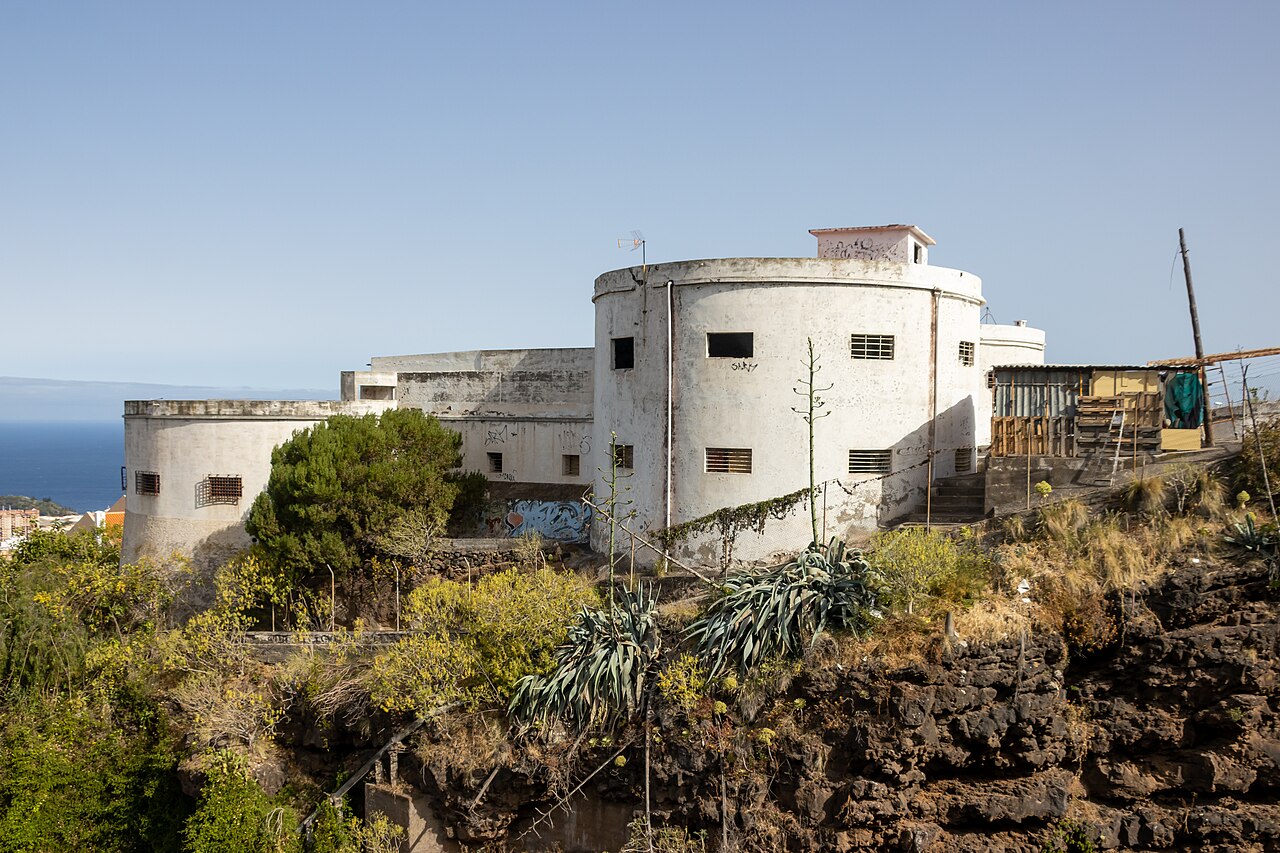
Paso Alto Castle is constructed on a semicircular plan covering approximately 1,428 square meters and built over two levels. The rear section contains two stories with distinct functions. The lower floor housed a chapel, living quarters for troops, dungeons, storage rooms, and stables, reflecting the castle’s dual role as a military fortress and prison. The upper level accommodated the governor’s and officers’ quarters alongside essential service areas such as the kitchen, pantry, and a guardroom.
The materials used in construction are not extensively documented, but the presence of an 18th-century commemorative inscription confirms major rebuilding after the 1774 storm. The chapel's significance is heightened by its housing of the Baroque Cristo de Paso Alto painting, a symbol of local faith and resilience.
Later developments and current status
In the late 19th century, concerns over a potential American invasion led to the construction of a nearby artillery battery. This addition was removed in the 1960s to make way for the Paso Alto Military Sports Club. Over time, ownership transferred from military to civilian authorities, with official registry records dating back to 1900 and administrative changes continuing until 1957.
Today, Paso Alto Castle remains in state hands but is currently unused. The fortress has suffered considerable decay and is classified as a ruin. Despite this, its historical significance is preserved through its registration in official property records, including the Property Registry of Santa Cruz de Tenerife and the Cadastre, ensuring ongoing recognition and protection.
Historical legacy and cultural impact
The castle’s role in key historical events, such as the 1657 English attack and the 1797 British assault led by Admiral Nelson, underscores its importance in Spanish military history. Its use as a prison through various eras adds layers to its historical narrative, linking it to notable figures and political turmoil.
The survival of the Baroque Cristo de Paso Alto painting during bombardment has cemented the castle’s place in local cultural memory, inspiring religious traditions and community identity. Efforts to revive the associated pilgrimage reflect a renewed interest in the castle’s heritage and its role in the spiritual life of the region.
Architectural significance
As a 17th-century hill castle designed for coastal defense, Paso Alto represents a fusion of natural topography and military engineering. Its semicircular plan and multi-level layout demonstrate an adaptation to both the landscape and the functional demands of artillery warfare and garrison life. The integration of living quarters, prison facilities, and a chapel within the fortress illustrates the multifunctional nature of such military installations.
Preservation challenges
Despite its historical and cultural importance, the castle faces challenges common to many coastal fortifications, including weathering from sea air, storm damage, and neglect following military decommissioning. Preservation efforts are complicated by its current unused status and the need for sustainable management strategies to protect the site for future generations.
Frequently asked questions (FAQ)
- When was Paso Alto Castle built and for what purpose?
- Paso Alto Castle was built in the early 17th century to strengthen coastal defenses of Santa Cruz de Tenerife against naval threats.
- What significant battles did Paso Alto Castle participate in?
- The castle was notably involved in the 1657 attack by English admiral Robert Blake and the 1797 British assault led by Admiral Horatio Nelson.
- Is Paso Alto Castle accessible to visitors today?
- Currently, Paso Alto Castle is unused and in a state of ruin, with no regular public access or visitor facilities.
- What is the significance of the Cristo de Paso Alto painting?
- The Baroque Cristo de Paso Alto painting survived the 1797 British bombardment unharmed and inspired a local pilgrimage tradition.
- What are the main architectural features of Paso Alto Castle?
- The castle features a semicircular plan over two levels, including a chapel, living quarters, dungeons, storage rooms, stables, and officers' accommodations.
Information
Current owner
State
Loading map...
Visitor reviews
No reviews yet. Been here? Write the first review and help other travelers!
Write the first reviewVisited this castle? Share your experience
Your review helps other travelers and adds first-hand knowledge to our encyclopedia.