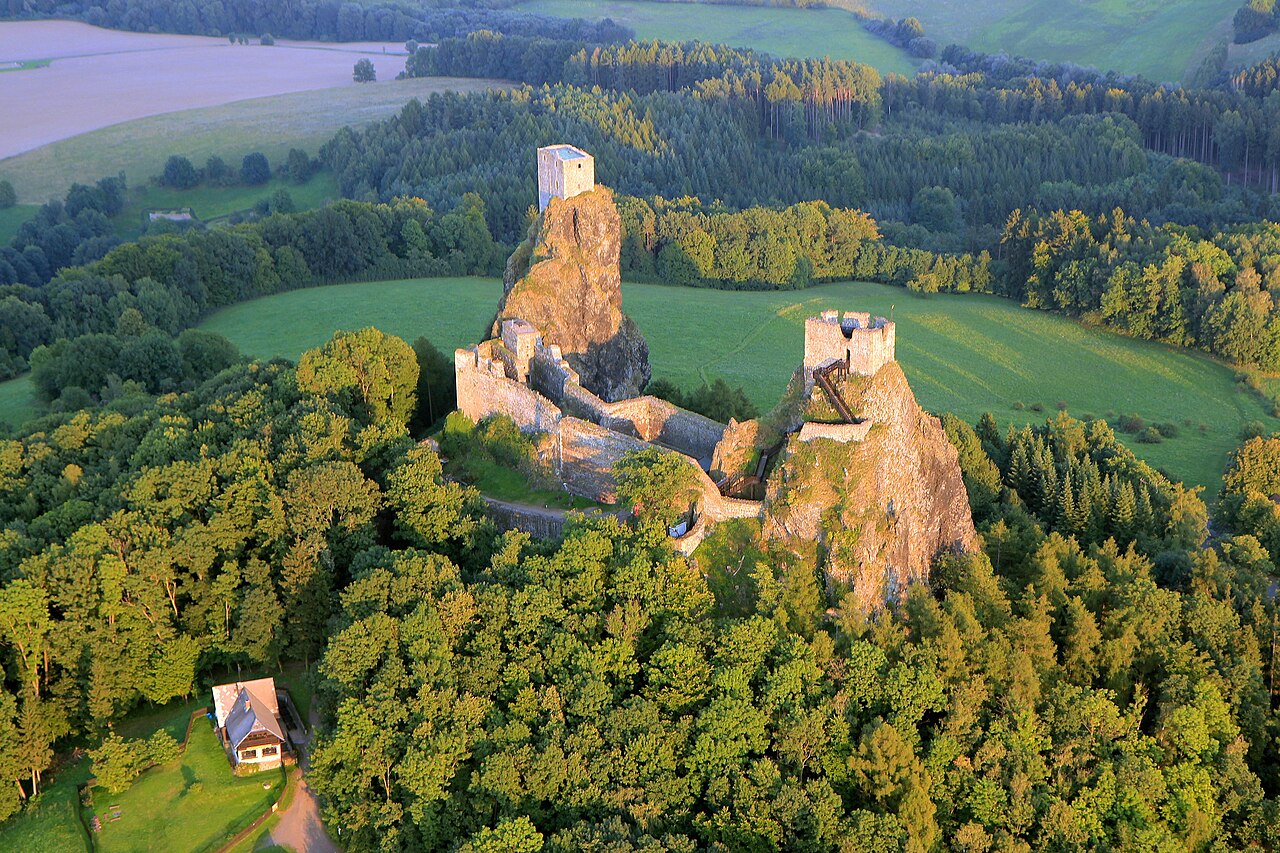
Veliš Castle

Veliš castle: medieval hill fortress in czechia
Podhradí, Czech Republic
High Medieval (11th–13th c.)
Ruins

Veliš Castle stands as a remarkable example of a medieval hill castle in the Czech Republic, located within the municipality of Podhradí. Its origins trace back to the early 14th century, with the first written mention dating to 1316. The castle was likely constructed under the auspices of King Václav II, reflecting the strategic and political importance of the site during the High Medieval period.

Historical significance and ownership

Throughout its history, veliš castle played a pivotal role in the region's power dynamics. It was owned by several prominent figures, including John of Luxembourg, a key ruler during the medieval era, and influential noble families such as the Vartemberks and Šliks. The fortress also came under the control of Albrecht of Wallenstein, a renowned military leader of the Thirty Years' War, and George of Poděbrady, a notable Czech king. These associations underscore the castle’s significance as both a military stronghold and a noble residence.

From around 1500, the castle acquired a unique religious importance as the repository for the Basel Compacts, critical agreements from the Hussite movement seeking church reform. These documents were safeguarded within the castle for nearly a century, highlighting its role beyond mere military functions.

In the late 16th century, the castle underwent significant architectural modifications under Vilém Trčka of Lípa, who expanded and adapted the structure to meet contemporary needs. Despite these enhancements, the castle's military relevance declined over time.

During the Thirty Years' War in the 17th century, veliš castle withstood an unsuccessful siege by Swedish forces, demonstrating its defensive resilience even as its strategic value waned. By 1658, the castle was reportedly abandoned and neglected. An imperial decree ordered its demolition to prevent its use by enemy forces, marking the beginning of its decline.

The surrounding area saw further deterioration in the 19th century due to the expansion of a nearby basalt quarry, which caused damage to the castle remains. Since 1964, the site has been protected as a cultural monument, preserving its historical and archaeological significance.

Architectural features and layout

The original castle complex was strategically constructed on a basalt hill, utilizing the natural volcanic rock as a sturdy foundation. The layout centered around a large, rectangular main tower featuring a steeply pitched, gabled roof and battlements designed for defense. This tower formed the heart of the fortress and symbolized its military strength.

Flanking the main tower were two palatial buildings on the west and east sides, each terminating in smaller towers. These structures served both residential and defensive purposes. Notably, the eastern palace contained a chapel, indicating the integration of religious functions within the castle walls.

To the north of the main buildings, a fortified structure with a gallery and narrow vertical arrow slits provided additional defense. This elevated corridor allowed defenders to launch projectiles while remaining protected, enhancing the castle’s defensive capabilities.

The primary access point was the western gate, secured by palisades—rows of wooden stakes that impeded attackers and controlled entry. This defensive arrangement underscored the importance of safeguarding the castle’s entrances.

Today, only fragments of the original masonry remain. Surviving elements include parts of the bastion walls, the main tower, and the western palace, all anchored on the basalt foundation. The layout of access paths is faintly visible, and the southern summit of the hill has been terraced, reflecting later landscape modifications.

Veliš castle in the context of czech medieval fortifications

Veliš Castle exemplifies the typical characteristics of High Medieval hill castles in the Czech lands, combining natural topography with man-made fortifications. Its use of basalt rock as a foundation is a distinctive feature, integrating the fortress seamlessly with its rugged terrain.

The castle’s architectural elements, such as the rectangular tower, palatial residences, chapel, and defensive galleries, reflect the multifunctional nature of medieval castles as both military strongholds and noble homes. The presence of the Basel Compacts within the castle further highlights its role in the religious and political history of the region.

Despite its ruinous state, veliš castle remains a valuable cultural monument, offering insights into medieval construction techniques, defensive strategies, and the historical narratives of Czech nobility and rulers.

Visiting veliš castle today

The castle ruins are accessible to visitors interested in medieval history and architecture. While much of the structure is in a ruined condition, the remaining walls and foundations provide a tangible connection to the past. The site’s elevated position offers scenic views of the surrounding landscape, enhancing the visitor experience.

Exploration of the site allows for appreciation of the castle’s original layout, including the location of the main tower, palaces, and defensive works. Interpretive signage and local guides often provide historical context, enriching the understanding of the castle’s significance.

Preservation efforts continue to maintain the ruins as a protected cultural monument, ensuring that veliš castle remains a noteworthy destination for heritage tourism in Czechia.

Frequently asked questions (FAQ)

What is the historical significance of Veliš Castle?
Veliš Castle, located in Podhradí, Czechia, dates back to the 13th century and played a crucial role in the region's defense against invasions. Its strategic position allowed it to serve as a royal residence and a military stronghold, showcasing the architectural evolution of castles in the Czech lands.
When was Veliš Castle built?
Veliš Castle was constructed in the early 13th century, with its foundation attributed to the noble family of Vítkovci. Over the centuries, it underwent several renovations and expansions, reflecting the changing styles and needs of its occupants.
Can I visit Veliš Castle?
Yes, Veliš Castle is open to visitors, allowing them to explore its rich history and stunning architecture. Guided tours are often available, providing insights into the castle's past and its significance in Czech heritage.
What are the opening hours for Veliš Castle?
Veliš Castle typically opens its doors to visitors from April to October, with specific hours varying by season. It is recommended to check the official website or local tourist information for the most current opening times before planning your visit.
Is it possible to access Veliš Castle with a wheelchair?
While efforts have been made to improve accessibility at Veliš Castle, some areas may still pose challenges for wheelchair users due to the castle's historic structure and natural terrain. It's advisable to contact the castle administration ahead of your visit to inquire about specific accessibility options.
What is the best time to visit Veliš Castle?
The best time to visit Veliš Castle is during the late spring and early autumn months when the weather is mild, and the surrounding landscapes are particularly beautiful. These seasons also offer various events and activities that enhance the visitor experience.
Are there any nearby attractions to visit along with Veliš Castle?
Yes, visitors to Veliš Castle can explore several nearby attractions, including the picturesque town of Jičín, known for its historical sites and charming streets. Additionally, the surrounding natural parks offer opportunities for hiking and enjoying the scenic beauty of the Czech countryside.
What are the ticket prices for Veliš Castle?
Ticket prices for Veliš Castle are generally reasonable, with discounts available for children, students, and seniors. It’s best to check the official website for the latest pricing information and any special offers that may be available during your visit.

Information

Hill Castle

Sources & official resources

Verify the information above using these authoritative references.

Loading map...

Visitor reviews

No reviews yet. Been here? Write the first review and help other travelers!

Write the first review

Visited this castle? Share your experience

Your review helps other travelers and adds first-hand knowledge to our encyclopedia.

Write a review

(5/5)

0/2000 characters

Your review will be visible after admin approval

Nearby castles

7.3 km

Pařez Castle

Czechia, Czech Republic

Pařez Castle stands as a compelling example of a medieval hill castle constructed in the late 14th century in the region of Bohemia, now part of the Czech Republic. Situated near the village of Pařezská Lhota, the castle was strategically built atop a solitary sandstone rock formation close to the Prachov Rocks, leveraging the natural steepness and elevation to enhance its defensive capabilities. This choice of location reflects the medieval trend of fortifying sites on naturally defensible terrain, a common practice among Bohemian nobility seeking to assert control and security in a turbulent era. The earliest recorded mention of Pařez Castle dates to 1403, identifying Jan of Pařez as its owner. Historical evidence suggests that the castle’s founder may have been Petr of Pařez, documented in records from 1372, indicating the noble lineage associated with the site. The Lords of Pařez maintained the castle as a residence and local power center until the early 15th century. The castle’s architecture and layout were adapted to the sandstone rock, with extensive carving to create chambers and vaulted ceilings directly within the stone, showcasing a unique integration of natural and man-made defensive features. Historical context and destruction The castle’s history is closely tied to the Hussite Wars, a series of religious and civil conflicts that engulfed Bohemia in the early 15th century. By approximately 1424, Pařez Castle was violently destroyed during these wars, a conclusion supported by archaeological finds such as a stone cannonball discovered at the site, indicating military assault. By 1430, contemporary accounts already described the castle as a ruin. Following its destruction, the remaining structures served variously as a refuge for robbers and later as shelter for impoverished populations, reflecting the shifting social landscape of the region after the castle’s fall. Architectural features and layout Integration with sandstone rock The castle’s core was essentially the sandstone rock itself, which was extensively carved to create functional spaces including small chambers and vaulted ceilings imitated in stone. This technique not only maximized the defensive advantage of the natural formation but also provided sheltered living and storage areas. The top plateau of the rock supported a palace structure, once enclosed by a stone wall. Archaeological evidence reveals foundation grooves with remnants of masonry and mortar, suggesting that the palace featured half-timbered walls typical of the period, though no wooden elements have survived. Defensive structures and water defenses Enhancing the natural defenses, the castle planners constructed dams to flood the area surrounding the rock, effectively creating a moat-like barrier that would have impeded attackers. Adjacent to the rock on the west side stands a partially preserved square tower, designed to be accessed by a pedestrian drawbridge. However, the tower’s entrance required complex earthworks or construction solutions, suggesting it may never have been fully operational as intended. This tower would have served as a key defensive and lookout point. Siege camp and outer defenses To the east, across a nearby valley, lies an area believed to be associated with a siege camp. This site is bordered by a ditch and an outer rampart, though its connection to the castle remains uncertain due to disturbances from later recreational activities. If related, this area would have played a role during the castle’s siege and eventual destruction. Archaeological discoveries and artifacts Excavations conducted in 1972 uncovered a variety of artifacts illuminating the castle’s active period and earlier cultural layers. Ceramic shards include fragments of vessels, an ornamental rattle, and a uniquely shaped ceramic lid with four lobes. Metal finds such as an iron chain link and a lead disc—possibly a gaming piece—suggest daily life and leisure activities within the castle. Additionally, a bone disc decorated with a swirling rosette motif likely served as decorative inlay for wooden furniture, while a stone weight may have been part of a door locking mechanism. Notably, archaeological layers also revealed artifacts from the La Tène cultural period, indicating the site’s long-term significance before the castle’s construction. Local legend speaks of a lost hoard of Prague groschen, silver coins minted during the reign of King Wenceslaus IV, purportedly hidden in the castle’s tower, adding a layer of cultural mystique to the site. Current condition and cultural significance Today, Pařez Castle remains a ruin, with only partial preservation of its stone structures and carved chambers. The site offers valuable insights into medieval castle construction adapted to challenging natural terrain and the turbulent history of Bohemia during the late Middle Ages. Its integration with the sandstone rock and use of water defenses highlight innovative medieval military architecture. The castle’s ruins continue to attract historians, archaeologists, and visitors interested in medieval fortifications and Bohemian history. Pařez Castle exemplifies the transitional period of castle building in the late 14th century, combining natural geological features with human ingenuity to create a defensible residence. Its destruction during the Hussite Wars marks it as a witness to one of the most significant conflicts in Czech history. The archaeological findings enrich our understanding of daily life, warfare, and craftsmanship during this era.

Late Medieval (14th–15th c.)
Details
12.5 km

Kumburk Castle

Syřenov, Czech Republic

Kumburk Castle stands as a remarkable example of Gothic hill castle architecture in the Czech Republic, perched at an elevation of 639 meters above sea level near the village of Syřenov. Founded in the 14th century by the noble family of Vartemberk, originally named Goldenberk or Kolmburk, this fortress has witnessed centuries of history, warfare, and cultural significance. Its strategic location atop a steep hill provided commanding views over the surrounding Bohemian landscape, including the towns of Nová Paka, Úbislavice, and the renowned Bohemian Paradise region, as well as the distant Krkonoše mountains. The castle’s origins trace back to 1325, when Markvart of Vartenberk (also known as Markwart von Goldenburg) ordered its construction. Over the centuries, Kumburk evolved from a medieval stronghold into a fortified residence and later a prison, reflecting the changing political and military landscape of Bohemia. The castle’s architecture and fortifications were significantly enhanced during the late medieval period, particularly under the ownership of Hynek Krušina of Lichtenburk, a prominent Hussite commander in the early 15th century. His contributions included strengthening the defenses and adding a palace section, adapting the castle to the demands of the Hussite Wars. Historical significance and ownership Kumburk Castle has a rich history intertwined with notable Bohemian noble families. After the Vartemberks, the castle passed to the Berka of Dubá, Trčka of Lípa, and Smiřický families. Following the Battle of White Mountain in 1620, ownership shifted multiple times, including possession by the influential Albrecht of Valdštejn (Wallenstein) and Rudolf von Tiefenbach. Later, the Sternberg family and the counts of Trautmannsdorff maintained the property until the mid-20th century. The castle’s military importance is underscored by its role during the Hussite Wars and the Thirty Years’ War. It was heavily damaged by Swedish forces during the latter conflict, after which Emperor Leopold I ordered its demolition in 1658 due to its status as a hostile stronghold. Despite this, the ruins remain a testament to the turbulent history of Bohemia and the evolution of medieval fortifications. Architectural features and fortifications Castle layout and construction The castle’s design adapts naturally to the steep hilltop, with a spiral formation of walls and buildings climbing the terrain. Constructed primarily from stone, the remains showcase typical Gothic fortress architecture with thick masonry walls designed for defense. The lower parts of the palace, still visible today, reveal the residential and administrative heart of the castle during its peak. Defensive structures Towers and walls form the core defensive elements, with several towers partially preserved. These towers originally served as lookout points and strongholds guarding key approaches. The northeastern side features remnants of a walled fortification, which may have extended around the entire core structure. This fortification was notably enhanced in the mid-15th century to withstand cannon fire, making it an important example of evolving military architecture in response to gunpowder weaponry. Outer defenses and strategic position In addition to the inner fortifications, Kumburk’s outer defenses were expanded under Hynek Krušina of Lichtenburk, including reinforced walls and strengthened gates. The castle’s elevated position provided a strategic vantage point for monitoring surrounding settlements and controlling regional routes, crucial for both defense and administration. Archaeological and cultural importance The site of Kumburk Castle has been significant for human activity since the Neolithic era, with archaeological finds indicating continuous settlement through the Bronze Age Lusatian culture, the Hallstatt period, and early medieval times. Although many earlier traces were erased by the castle’s construction, these findings highlight the hill’s long-standing strategic and cultural value. Local legends add a layer of mystique to the ruins. Tales of imprisoned noblewomen, hidden treasures guarded by a fiery-eyed rooster, and ghostly apparitions contribute to the castle’s allure. The Romantic poet Karel Hynek Mácha visited Kumburk, and a memorial plaque in the upper tower commemorates his connection, linking the castle to Czech literary heritage. Preservation and visitor experience Despite suffering near destruction in the 17th century, Kumburk Castle’s ruins are among the most interesting and well-preserved in the region. Restoration efforts in the 20th century, particularly between 1939 and 1941, focused on stabilizing walls and towers to preserve the site’s historical integrity. Today, the castle is a protected cultural monument accessible via multiple hiking trails. The shortest route is from the Syřenov railway station, following a yellow trail approximately 3 km to the site. Other approaches include paths from Nová Paka and Stará Paka (4 km) and a popular red tourist trail from Ploužnice (7 km). Visitors can explore the ruins, enjoy panoramic views, and learn about the castle’s rich history through onsite information. Compared to nearby ruins like Bradlec, Kumburk retains a larger portion of its original structure, especially in the palace foundations and towers, making it a valuable destination for those interested in medieval architecture and Bohemian history.

Late Medieval (14th–15th c.)
Details
12.6 km
Trosky Castle — Czech Republic castle

Trosky Castle

Troskovice, Czech Republic

Trosky Castle is an extraordinary medieval fortress uniquely perched atop two prominent basalt volcanic plugs in the Bohemian Paradise region of Czechia. Constructed in the 14th century, this hill castle is renowned for its striking silhouette formed by twin towers named Baba (Crone) and Panna (Maiden), which rise dramatically from the rugged volcanic rock formations. The castle’s dramatic location and distinctive architecture have made it a symbol of the region and a popular destination for visitors interested in medieval history and castle architecture. The castle was founded by Čeněk of Wartenberg in the latter half of the 14th century. Its construction capitalized on the natural defensive advantages of the volcanic plugs, with two major towers built atop separate peaks—Baba on the lower 47-meter outcrop and Panna on the higher 57-meter peak. Between these towers, a complex of residential buildings, palaces, and defensive structures was erected, all enclosed within three concentric rings of fortified walls. This strategic design provided formidable defense and residential functionality, making Trosky a stronghold of significant military and noble importance during the Late Medieval period. Historical significance and ownership through the centuries After its establishment, Trosky Castle passed through various hands, reflecting the turbulent political landscape of medieval Bohemia. Initially owned by Čeněk of Wartenberg, the castle became royal property under King Wenceslaus IV in the early 1390s. It was then acquired by Otto III of Bergau and later passed to his son Otto IV of Bergau, who is infamous for raiding the nearby Opatovice monastery and hiding its treasures within the castle’s underground chambers. During the Hussite Wars in the 15th century, Trosky served as a staunch pro-Catholic fortress and resisted multiple sieges, including attacks in 1424, 1428, and 1469. Despite its resilience, the castle was eventually captured in 1469 by forces loyal to King George of Poděbrady. Following this period, the castle’s role as a noble residence diminished, and it was managed more as an administrative estate. The Thirty Years’ War brought further destruction when the castle was burned down by the Imperial Army in 1648. This event marked the beginning of its decline into ruin. Ownership passed through notable noble families, including the Wallenstein family, before being sold in the early 19th century to Jan Lexa of Aehrenthal, who initiated romantic-era restoration efforts, such as the unfinished staircase to the Panna tower. Today, Trosky Castle is a protected national cultural monument of the Czech Republic, reflecting its importance as a historical, architectural, and geological landmark. It also features in popular culture, notably in the video game Kingdom Come: Deliverance II, set during the early 15th century. Architectural features and layout The twin towers: baba and panna The castle’s most distinctive features are its two towers, each perched on separate volcanic plugs. The Baba tower is a hexagonal, two-storey structure standing 47 meters above the surrounding terrain. Inside, it is divided into four chambers with large windows that maximize natural light. The entrance on the northern side leads into an antechamber, connecting the internal rooms. The Panna tower, located on the higher 57-meter peak, is a roughly square, four-sided tower. It originally featured a pointed arch entrance on the western side at the first-floor level. The tower was extended eastward over time, with residential quarters on the first floor. Many of the current window shapes are results of 20th-century restoration efforts aimed at stabilizing the structure. Castle core and fortifications Between the two towers lies the castle core, which housed two palaces and various residential buildings. The eastern entrance led into this core area, which included a large two-room palace with living quarters on the upper floors. The central courtyard was the highest point of the core, while on the western side, a smaller wooden palace contained rooms including a smithy that remained operational until the 17th century. The entire complex was protected by three rings of curtain walls, measuring 1.5 to 2 meters thick and up to 15 meters high. The northern forecourt contained economic buildings and a furnace, indicating metallurgical activities close to the main gate. Notably, the castle’s gatehouses were not supplemented by moats or ditches, relying instead on the natural defensive advantage of the volcanic rock formations. Geological and preservation aspects The castle’s foundation on two volcanic plugs is a rare geological feature that contributes to its dramatic appearance and defensive strength. The basalt rocks exhibit characteristic columnar jointing, a pattern of vertical cracks formed by cooling lava, and have endured centuries of weathering, including frost damage and erosion. Restoration efforts in the 20th and 21st centuries have focused on stabilizing the volcanic rock bases and the masonry remains. These efforts have included the installation of staircases and observation platforms, improving visitor access to the Baba and Panna towers. The preservation work ensures that the castle’s ruins remain safe and accessible while maintaining their historical and geological integrity. Cultural importance and tourism Trosky Castle is a symbol of the Bohemian Paradise and features prominently in Czech cultural heritage. Its distinctive silhouette is often used in regional branding and tourism promotion. The castle attracts visitors interested in medieval architecture, history, and natural landscapes. Visitors can explore the ruins, climb the towers, and enjoy panoramic views of the surrounding countryside. The site is equipped with interpretive signage and pathways to enhance the visitor experience. Seasonal events and guided tours further enrich understanding of the castle’s historical context and architectural features. As a national cultural monument, Trosky Castle is protected under Czech law, ensuring ongoing conservation and responsible tourism management. Its combination of historical significance, unique geology, and scenic beauty make it a must-visit destination for castle enthusiasts and travelers to Czechia.

Late Medieval (14th–15th c.)
Details