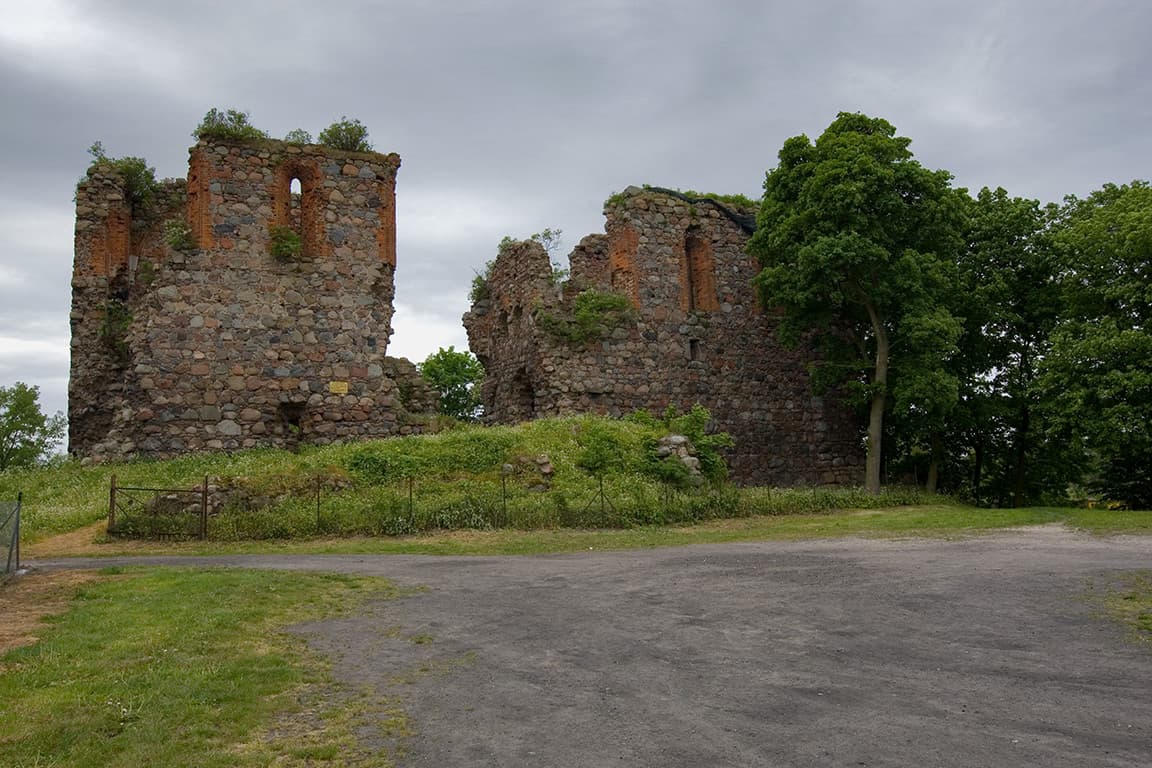
Papowo Biskupie
Papowo Biskupie Castle stands as a significant relic of medieval military architecture in Poland, located on a small artificially elevated hill at the edge of the village of Papowo Biskupie. This hill castle was originally constructed by the Teutonic Order in the late 13th century and played a pivotal role in the turbulent history of the region, especially during the conflicts between Poland and the Teutonic Knights in the 15th century. Today, only ruins remain, offering valuable insights into the castle's original structure and historical importance.
Early history and foundation
The site of Papowo Biskupie was initially under the control of the bishops of Płock and later, from 1222, the missionary Bishop Christian of Prussia. In 1231, the village and its lands passed into the hands of the Teutonic Order, marking the beginning of the castle's association with this military-religious organization. By the second half of the 13th century, as the Order consolidated its authority in the newly acquired territories, Papowo became the seat of a komturei (commandery). The first documented reference to this komturei dates to 1287.
Construction of the castle began around 1280 and was completed by 1300, making it one of the earliest convent-type castles within the Teutonic state. The castle was designed as a quadrangular four-winged structure approximately 40 meters on each side, enclosing a small internal courtyard surrounded by two-story wooden cloisters. This layout reflected the dual military and monastic functions typical of Teutonic convent castles.
Architectural features and construction
The castle was primarily built from fieldstones and granite boulders, materials that were abundant locally. Only the vaults and window openings were constructed using bricks, a common practice in the region to combine robustness with architectural detail. The surviving foundations and walls suggest that the castle had defensive corner towers on each angle, enhancing its fortification.
The main entrance was located in the northern wing, accessed via a bridge over a moat and fortified gatehouse. This northern wing also housed the chapel and the chapter house, key elements of the castle's religious function. The eastern wing contained the refectory where communal meals were held, while the western wing was designated as the dormitory for the knights. The southern wing was the most prominent, serving as the residence of the komturei commander.
Surrounding the main castle was a low defensive wall and moat separating it from a larger outer bailey, which was itself protected by walls and wide moats. The bailey's entrance was on the western side, completing the castle's layered defensive system.
Historical significance and military events
Papowo Biskupie Castle played a notable role during the Polish-Teutonic wars of the 15th century. Despite its fortifications, it was briefly captured by the forces of King Władysław Jagiełło in 1410 during the conflict culminating in the Battle of Grunwald. After the battle, the castle was occupied by Polish knights for a short time before returning to Teutonic control, serving thereafter as a seat for a local vogt or governor.
The castle suffered damage during various military engagements, including a raid led by Janusz Brzozogłowy in 1411 which targeted the outer bailey. During the Thirteen Years’ War (1454–1466), the fortress was a refuge for the Teutonic leadership but changed hands multiple times. In 1454, it was seized by forces allied with the Prussian Confederation and Polish supporters. King Casimir IV Jagiellon ordered its destruction to prevent further military use.
Despite this, in early 1458, Teutonic mercenaries briefly recaptured the castle. However, on 20 July 1458, Polish forces under Piotr of Szamotuły stormed and reclaimed the stronghold, subsequently burning it on royal orders. The castle's military importance effectively ended after this event.
Following the Second Peace of Thorn in 1466, Papowo Biskupie and the surrounding region were incorporated into the Kingdom of Poland. The castle became a royal estate, with Gabriel Bażyński appointed as the first royal administrator.
Later history and decline
In 1505, King Alexander Jagiellon granted the castle and village to the Bishops of Chełmno. Under their ownership, the castle was partially dismantled before 1639, with stones repurposed for building a seminary in Chełmno. Despite this, the robust stone construction allowed substantial ruins to survive through the centuries.
The bishops retained control until the First Partition of Poland in 1772, after which the castle was seized by the Kingdom of Prussia under King Frederick the Great. The castle rapidly fell into ruin, with local inhabitants removing building materials during the 19th century. Today, the site is officially registered as a historic monument since 1937.
Architectural remains and current condition
Today, the remnants of Papowo Biskupie Castle primarily consist of the ruins of the main castle. The northern wing, which once contained the chapel and chapter house, is the best preserved. The eastern and western wings survive only as thick external walls, while fragments of the southern wing's ground floor walls remain.
The castle's modest size and convent-style layout are evident from the surviving structures. Unlike many other Teutonic castles built predominantly of brick, Papowo Biskupie is notable for its extensive use of fieldstones, giving it a distinctive appearance. The lack of a central tower (donjon) and the presence of corner towers reflect a defensive strategy suited to its role as a local commandery rather than a major fortress.
Visitors to the site can explore the ruins, which provide a tangible connection to the high medieval period and the complex history of the Teutonic Order in the Chełmno region. The castle's ruins stand as a testament to the region's medieval heritage and the shifting tides of political and military power in Central Europe.
Archaeological and historical research
Extensive archaeological studies have documented the castle's layout, construction techniques, and phases of use. Findings confirm the presence of vaulted ceilings and pointed arch windows in the chapel and refectory, indicating the incorporation of Gothic architectural elements within the primarily stone-built fortress. These features highlight the blend of functional military design with ecclesiastical architectural influences characteristic of Teutonic convent castles.
The castle's history, from its foundation to its decline, mirrors the broader historical narrative of the Teutonic Order's rise and fall in the Baltic region, making it a subject of interest for historians and castle enthusiasts alike.
Visitor information and cultural significance
Papowo Biskupie Castle is accessible to visitors interested in medieval history and architecture. While the site consists mainly of ruins, it offers a compelling glimpse into the Teutonic Order's architectural and military heritage. The castle is an important cultural landmark within the Kuyavian-Pomeranian Voivodeship and contributes to the understanding of medieval fortifications in Poland.
Efforts to preserve and study the ruins continue, emphasizing the castle's value as a historical monument and educational resource. Visitors are encouraged to explore the site respectfully, appreciating the enduring legacy of this high medieval hill castle.
Frequently asked questions (FAQ)
- When was Papowo Biskupie Castle built?
- Construction of Papowo Biskupie Castle began around 1280 and was completed by 1300, making it a high medieval fortress built by the Teutonic Order.
- What architectural style characterizes Papowo Biskupie Castle?
- The castle exhibits Gothic architectural elements, especially in its vaulted ceilings and pointed arch windows, typical of Teutonic convent castles.
- What remains of Papowo Biskupie Castle today?
- Today, only ruins remain, with the northern wing best preserved, including parts of the chapel and chapter house, while other wings survive as thick walls or fragments.
- Can visitors explore Papowo Biskupie Castle?
- Yes, visitors can explore the ruins of Papowo Biskupie Castle, which are accessible and provide insight into the medieval history and architecture of the Teutonic Order.
- What historical events affected Papowo Biskupie Castle?
- The castle was involved in the Polish-Teutonic wars, briefly captured in 1410, and changed hands multiple times during the Thirteen Years’ War, before being burned in 1458.
Photo gallery

Information
Website
Visit websiteSources & official resources
Verify the information above using these authoritative references.
Loading map...
Visitor reviews
No reviews yet. Been here? Write the first review and help other travelers!
Write the first reviewVisited this castle? Share your experience
Your review helps other travelers and adds first-hand knowledge to our encyclopedia.



