Pambre Castle
Pambre Castle stands as a remarkable example of a late 14th-century medieval fortress situated in the municipality of Palas de Rei, Galicia, Spain. Built by the nobleman Gonzalo Ozores de Ulloa, a loyal supporter of King Pedro I of Castile (Pedro O Cruel), the castle embodies the turbulent political and military history of the region during the Late Medieval period. Its strategic location atop a rocky outcrop overlooking the Pambre River provided both defensive advantages and control over vital passageways, making it a key stronghold in local power struggles.
The castle’s origins are deeply intertwined with the civil conflicts of Castile in the 14th century, particularly the rivalry between King Pedro I and his half-brother Henry II of Castile. The surrounding area witnessed several military engagements, including the notable Battle of Porto de Bois, where Fernando Ruiz de Castro, an ally of Pedro I, faced defeat and exile. This historical backdrop contextualizes the castle’s construction as a statement of power and resilience by the Ulloa family, who sought to reclaim and secure their ancestral lands from rival factions such as the Seixas family.
Architectural features and defensive design
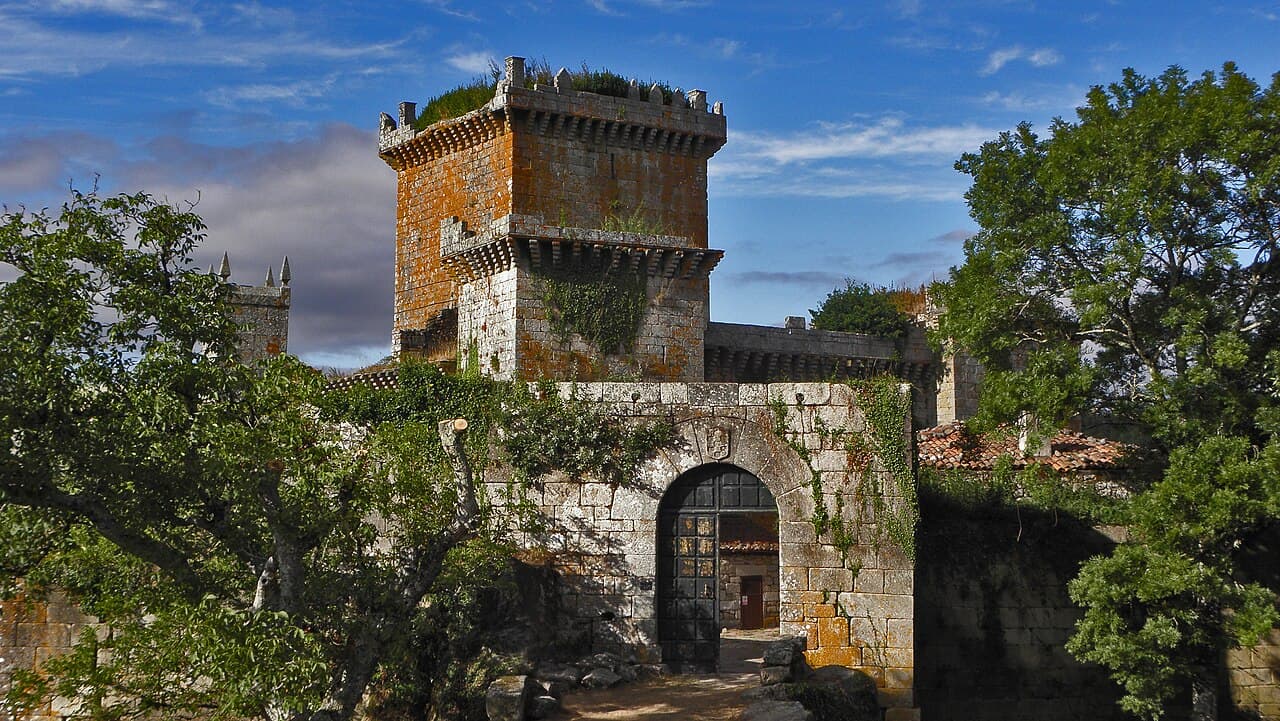
Pambre Castle is a hill castle built on a rocky prominence approximately 44 meters above the Pambre River. Its layout is roughly square, enclosed by a robust curtain wall that incorporates four crenellated corner towers and a prominent central keep or tower of homage. This keep rises three stories high, measuring about 11 meters on each side, and is designed with security in mind. The ground floor has no windows, and access was originally via a Romanesque-style door positioned about five meters above ground level, reachable only by ladders or wooden bridges.
The upper floors of the keep reveal a blend of defensive and stylistic elements. The second floor likely connected internally to the curtain wall, facilitating movement for defenders. The top floor features a distinctive twin pointed-arch window with lobed arches, an elegant detail reflecting the Gothic architectural influence prevalent in the castle’s design. Surrounding the keep, the outer walls form an irregular rectangular plan approximately 21 by 17 meters, oriented northeast to southwest. The northern walls are solid and imposing, while the southern façade is pierced by nine vertical and circular arrow slits designed for archers to repel attackers.
The thickness of the walls varies between two and two and a half meters, with the main entrance area reinforced to about five meters for added defense. The principal gate combines functional strength with heraldic symbolism, featuring a semicircular arch framed internally by a lancet ogival arch typical of Gothic architecture. The keystone prominently displays the Ulloa family coat of arms carved in relief with fifteen checkered fields, asserting the family’s dominance.
Additional defensive features include machicolations supported by corbels atop the walls, allowing defenders to drop projectiles or boiling substances on attackers below. The castle also contains a smaller postern gate for discreet movement. The four corner towers are topped with battlements (crenellations) characterized by pointed merlons, enhancing both defense and aesthetic coherence with the Gothic style. Their interiors are illuminated by small funnel-shaped windows with splayed embrasures and lowered arches, designed to optimize visibility and protection for archers.
Historical significance and ownership
The castle’s history reflects the complex socio-political dynamics of medieval Galicia. After its construction by Gonzalo Ozores de Ulloa, the fortress became a focal point in the ongoing conflicts between noble families and ecclesiastical authorities, notably involving Alonso III de Fonseca, the Archbishop of Santiago de Compostela. Remarkably, Pambre Castle survived the widespread destruction of noble fortresses during the Irmandiño revolts in the mid-15th century, largely due to the strategic withdrawal of its lord, Sancho Sánchez de Ulloa, during negotiations with the rebels.
Throughout the 15th century, the castle served dual roles as a military stronghold and a toll collection point, controlling an important regional road. In 1484, ownership transferred from the Ulloa family to the Counts of Monterrei, and later passed to the Dukes of Alba. A controversial sale occurred in 1895 when the Duke of Alba illegally sold the property to a local resident, but the Moreiras family reclaimed it in 1912.
In the 20th century, preservation efforts were championed by Manuel García Blanco, a scholar related to the Moreiras family, who conducted early studies and safeguarded the castle’s remains. He notably donated artifacts such as a 1620 sepulchral stone belonging to Captain Payo Varela, the fortress’s governor, to the Provincial Museum of Lugo. Later, ownership changed to Manuel Taboada Fernández in 1974, who unfortunately allowed the castle to decline. Public concern led to the acquisition of the property by the Xunta de Galicia in 2011, initiating official restoration and public access programs.
The chapel of san pedro and archaeological findings
Adjacent to the main castle entrance lies the Romanesque Chapel of San Pedro, which predates the fortress and likely dates back to the late 12th century. This small chapel, measuring approximately 42 square meters, features a rectangular apse and a main portal adorned with a tympanum resting on corbels carved with pyramids and four-leaf rosettes. The southern door has a semicircular arch supported by plain corbels, while other corbels display minimal decoration with occasional floral and animal motifs.
Historical tradition suggests the chapel may have been built atop earlier megalithic structures, including a tumulus, indicating the site’s long-standing spiritual and cultural significance. The chapel was originally covered with granite slabs, a feature restored in the 1980s to preserve its historical integrity and prevent alterations that might hinder archaeological research.
Excavations at the castle site have uncovered a variety of artifacts, including Roman-era millstones, donated by Manuel García Blanco, which point to earlier occupation of the area before the medieval fortress. The 1620 sepulchral stone of Captain Payo Varela and his wife Xoana de Novoa is a significant funerary monument displaying a detailed heraldic shield with an eagle and symbolic motifs, now housed in the Provincial Museum of Lugo.
Construction techniques and masonry details
The masonry of Pambre Castle reveals a high level of craftsmanship, with numerous stonemason’s marks etched into the ashlar blocks. These marks indicate a well-organized and rapid construction process carried out by skilled workers familiar with advanced Gothic building techniques of the late medieval period. The use of thick walls, machicolations, and crenellated towers demonstrates a sophisticated understanding of defensive architecture designed to withstand sieges and assaults.
The combination of Romanesque elements, such as the chapel’s portal, with the castle’s predominantly Gothic features, illustrates the architectural transition occurring during the period of its construction. The presence of religious inscriptions like the "Ave María" window on the southern façade highlights the integration of spiritual symbolism within military architecture, reflecting the cultural values of the time.
Current status and preservation efforts
Today, Pambre Castle is recognized as one of the best-preserved medieval fortresses in Galicia. Its well-preserved condition results from ongoing restoration and conservation efforts led by the Xunta de Galicia since 2011. The castle is accessible to the public and serves as an important cultural and historical landmark, attracting visitors interested in medieval history, architecture, and Galician heritage.
Efforts continue to maintain the castle’s structural integrity and to enhance visitor experience through educational programs and archaeological research. The castle’s combination of military, religious, and residential features offers a comprehensive glimpse into the complexities of medieval fortress life in northwestern Spain.
Frequently asked questions (FAQ)
- How do I get to Pambre Castle?
- Pambre Castle is located near the town of Palas de Rei in Galicia, Spain. It is accessible by car via local roads, with parking available nearby. Visitors can also reach the castle by regional bus services connecting Palas de Rei to larger cities in Galicia.
- What are the opening hours of Pambre Castle?
- The castle is generally open to visitors during daylight hours, typically from 10:00 to 18:00, but it is advisable to check the official Xunta de Galicia website for seasonal variations and special closures.
- Is there an entrance fee to visit Pambre Castle?
- Entrance to Pambre Castle is usually free or involves a nominal fee to support maintenance and preservation. Visitors should verify current ticket prices on official tourism platforms before planning their visit.
- What architectural styles are represented at Pambre Castle?
- Pambre Castle primarily showcases Gothic military architecture, with Romanesque elements evident in the adjacent Chapel of San Pedro. This blend reflects the architectural transition in Galicia during the late medieval period.
- Can I explore the interior of the keep at Pambre Castle?
- Visitors can explore several parts of the castle, including the curtain walls and towers. Access to the interior of the keep may be restricted for safety reasons, but guided tours often provide insights into its historical function and design.
- Why is Pambre Castle historically significant?
- Pambre Castle played a crucial role in the civil conflicts of 14th-century Castile and later regional power struggles in Galicia. Its survival through the Irmandiño revolts and association with notable noble families highlight its importance in medieval Spanish history.
- Are there any nearby attractions to visit along with Pambre Castle?
- Nearby attractions include the historic town of Palas de Rei, the Cathedral of Santiago de Compostela, and various natural parks in Galicia. These sites complement a visit to Pambre Castle by offering cultural and scenic experiences.
Photo gallery

Information
Sources & official resources
Verify the information above using these authoritative references.
Loading map...
Visitor reviews
No reviews yet. Been here? Write the first review and help other travelers!
Write the first reviewVisited this castle? Share your experience
Your review helps other travelers and adds first-hand knowledge to our encyclopedia.