Palmanova Fortress
Palmanova fortress is a remarkable example of Renaissance military architecture located in northeastern Italy. Constructed in the 16th century, it is renowned for its distinctive star-shaped layout, designed to maximize defensive capabilities against artillery attacks. This bastioned fortress represents one of the most sophisticated and well-preserved examples of Renaissance fortification principles applied in urban planning and military defense.
Historical context and construction
The fortress was built under the direction of the Venetian Republic, which sought to protect its mainland territories from the expanding Ottoman Empire and other European powers. Construction began in 1593, reflecting the strategic military thinking of the Renaissance period when fortresses evolved beyond medieval castles to withstand cannon fire and siege warfare.
The design of Palmanova was the work of the Italian architect Vittorio Veneto and other military engineers who applied the principles of the trace italienne or Italian style of fortification. This style featured angled bastions and low, thick walls to deflect cannonballs and provide overlapping fields of fire.
Architectural design and features
Star-shaped layout and bastions
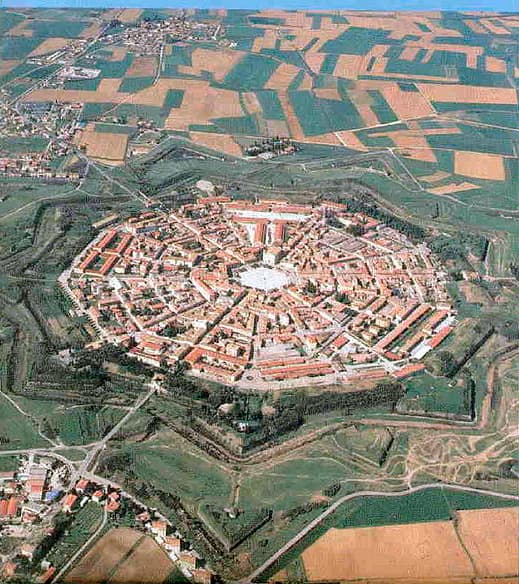
Palmanova is famously built in a perfect nine-pointed star shape, with nine bastions projecting outward from the central fortress walls. This design allowed defenders to cover all approaches with crossfire, eliminating blind spots. The bastions are connected by curved curtain walls which are lower and thicker than traditional medieval walls, optimized to absorb artillery impacts.
Moats and gates
The fortress is surrounded by a wide, deep moat that further enhanced its defensive capabilities. The moat was designed to prevent enemy forces from reaching the walls easily and to channel attackers into kill zones covered by the bastions.
Access to the fortress was controlled through three main gates, each fortified with additional defensive structures such as ravelins and drawbridges. These gates served both military and civilian purposes, controlling entry to the fortified town within.
Internal urban planning
Inside the fortress walls, Palmanova was planned as a fortified town with a radial street layout converging on a central square. This layout was intended to facilitate efficient movement of troops and supplies, as well as to serve the needs of a civilian population living within the fortress.
Military significance and historical use
Palmanova was never successfully besieged, demonstrating the effectiveness of its design. It served as a military stronghold for the Venetian Republic and later changed hands through various European powers, including the Austrians and Italians.
Over the centuries, Palmanova's military importance declined with advances in warfare technology, but it remains a symbol of Renaissance military engineering and urban design.
Preservation and current status
Today, Palmanova fortress is well preserved and is recognized as a cultural heritage site. Its unique star shape and intact fortifications attract historians, architects, and tourists interested in military history and Renaissance architecture.
The fortress is accessible to visitors who can explore its bastions, walls, gates, and the historic town within. It remains a vivid example of how military needs shaped urban development during the Renaissance.

Information
Loading map...
Visitor reviews
No reviews yet. Been here? Write the first review and help other travelers!
Write the first reviewVisited this castle? Share your experience
Your review helps other travelers and adds first-hand knowledge to our encyclopedia.