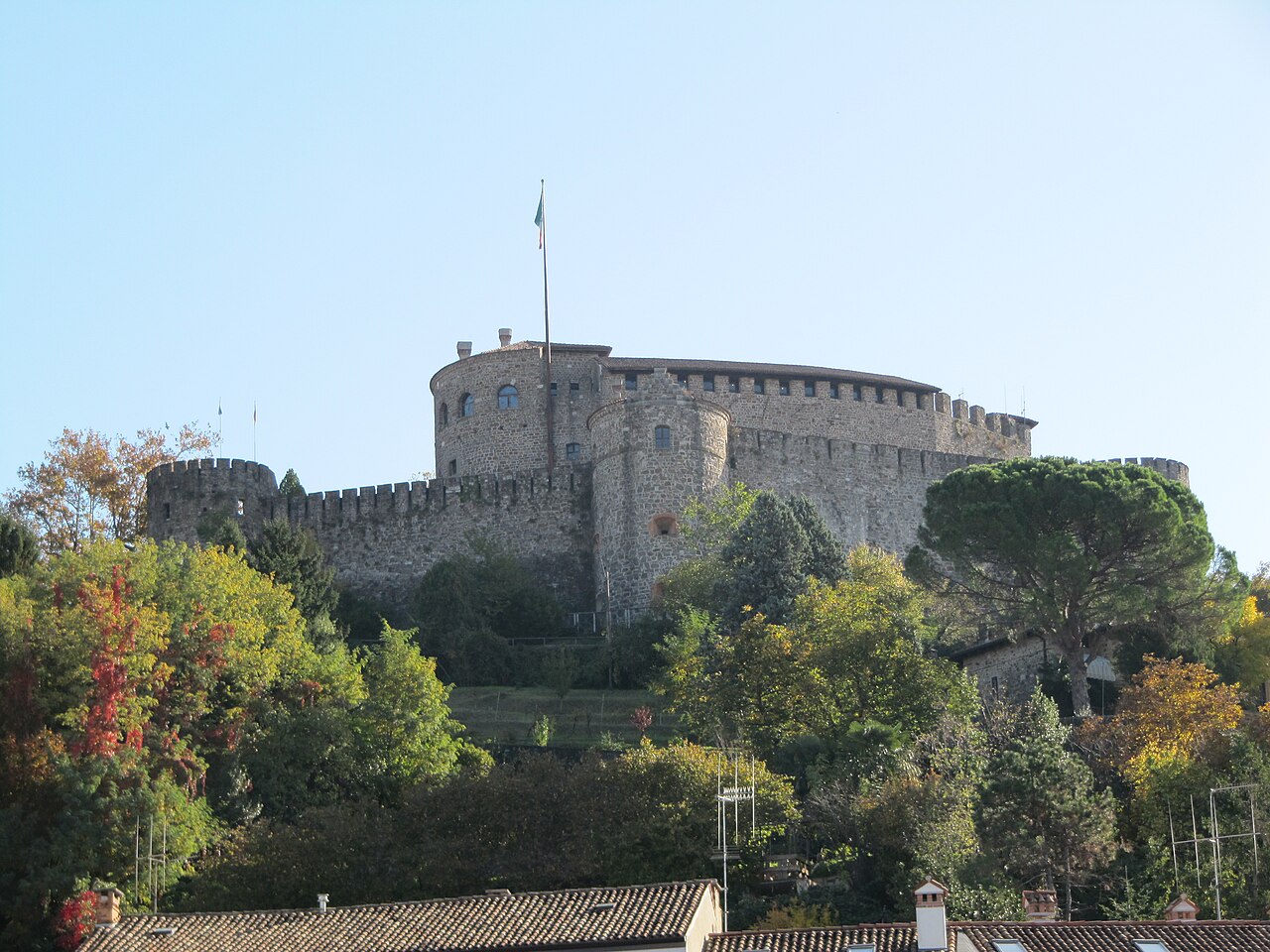
Cormons Castle
Cormons Castle, locally known as Castello di Cormons, is a significant early medieval hill castle perched atop Monte Quarin, just north of the town of Cormons in the Gorizia province of the Friuli-Venezia Giulia region in Italy. This strategic location has been fortified since prehistoric times, evolving through Roman, Lombard, medieval, and early modern periods, reflecting a rich tapestry of military and regional history.
The site originally served as a Roman castrum, known as Cormontium, which underscores its long-standing military importance. The first true castle fortifications were established by the Lombards in the 6th or 7th century as part of their defensive frontier against invasions, notably from the Avars around 610 AD. This early fortress functioned as a critical lookout and signaling post within the Lombard limes system.
Following the Lombard period, the castle came under the control of the Patriarchate of Aquileia in the 8th century, serving as a residence until their seat moved to Cividale. The castle likely provided refuge during the turbulent Magyar raids of the 9th and 10th centuries. Around the 10th century, a larger lower castle was constructed at the base of Monte Quarin, probably by the Counts of Gorizia, marking the beginning of a protracted territorial dispute with the Patriarchate.
Medieval expansions and ownership disputes
During the 12th century, the lower castle and its surrounding village were fortified with two concentric town walls, remnants of which still exist today. These fortifications enhanced the defensive capabilities of the settlement, which was strategically significant in the regional power struggles between the Patriarchs of Aquileia and the Counts of Gorizia.
By 1277, the Counts of Gorizia secured official possession of the castle and village. Ownership later transferred to the Habsburg dynasty in 1497 after Emperor Maximilian I inherited the territories following the death of Count Leonhard of Gorizia. The castle was then granted as a fiefdom to the Vogrski knights, who served as castellans.
Venetian occupation and decline
In the early 16th century, the castle became a contested site during the conflicts between the Habsburgs and the Venetian Republic. Venetian forces briefly occupied the castle in 1508 and again in 1511, during which time they destroyed parts of the fortress. Reconstruction efforts were initiated by the Venetians but were incomplete. The Treaty of Worms (1521) reaffirmed Habsburg control over the castle.
Following these conflicts, the castle's military importance waned, and it gradually fell into disuse and decay. By the 17th century, it was largely abandoned, leading to the deterioration of its structures. The site experienced a brief period of French occupation in 1813 before reverting to the County of Gorizia and Gradisca. It remained under this jurisdiction until the Italian occupation during World War I in 1915.
Architectural features and current remains
The castle complex spans the entire flat summit of Monte Quarin, featuring an upper fortress separated from the lower bailey by a dry moat cut across the mountain top. The upper castle's centerpiece is a large circular structure approximately 18 meters in diameter, with walls up to five meters thick. This robust masonry structure underwent multiple construction phases, indicating adaptations to evolving defensive needs over centuries.
The lower castle area was once protected by two concentric town walls built in the 12th century, which enclosed the developing village at the mountain's base. Today, only fragments of these walls remain, alongside small remnants within the bailey. The castle's overall condition is classified as ruins, with significant portions of walls and buildings reduced to weathered stone.
Despite its ruined state, the site offers spectacular panoramic views of the surrounding Friuli-Venezia Giulia countryside, making it a popular destination for hikers and history enthusiasts. The castle is freely accessible on foot, though it cannot be reached by car, preserving its remote and historic atmosphere.
Historical significance and cultural heritage
Cormons Castle stands as a testament to the region's complex history, reflecting the shifting political and military landscape from the early medieval Lombard period through the medieval and early modern eras. It illustrates the strategic importance of Monte Quarin as a military lookout and defensive site controlling key routes in northeastern Italy.
The castle's layered construction phases and ownership history provide valuable insights into the feudal dynamics between the Patriarchate of Aquileia, the Counts of Gorizia, the Habsburgs, and the Venetian Republic. Its ruins contribute to the cultural heritage of the Friuli-Venezia Giulia region and are an important archaeological and historical site.
Visitors to Cormons Castle can explore the remnants of its formidable walls and towers while enjoying the natural beauty and historical ambiance of Monte Quarin. The site remains a poignant reminder of the region's medieval military architecture and the enduring legacy of its past rulers.
Frequently asked questions (FAQ)
- How do I reach Cormons Castle?
- Cormons Castle is located on Monte Quarin and can only be accessed by foot via hiking trails from the town of Cormons. There is no vehicle access to the castle.
- What is the historical significance of Cormons Castle?
- Cormons Castle was a key Lombard and medieval fortress that controlled strategic routes in northeastern Italy and witnessed conflicts between the Patriarchate of Aquileia, Counts of Gorizia, and Habsburgs.
- When was Cormons Castle built?
- The initial fortifications at the site date back to the 6th or 7th century Lombard period, with significant expansions in the 10th and 12th centuries.
- Can I visit Cormons Castle freely?
- Yes, the castle ruins are freely accessible to the public at any time, as there are no gates or ticket requirements.
- What can I see at Cormons Castle today?
- Visitors can explore the ruins of the upper fortress, including a large circular tower with thick walls, remnants of town walls, and enjoy panoramic views of the Friuli-Venezia Giulia countryside.
Information
Website
Visit websiteSources & official resources
Verify the information above using these authoritative references.
Loading map...
Visitor reviews
No reviews yet. Been here? Write the first review and help other travelers!
Write the first reviewVisited this castle? Share your experience
Your review helps other travelers and adds first-hand knowledge to our encyclopedia.