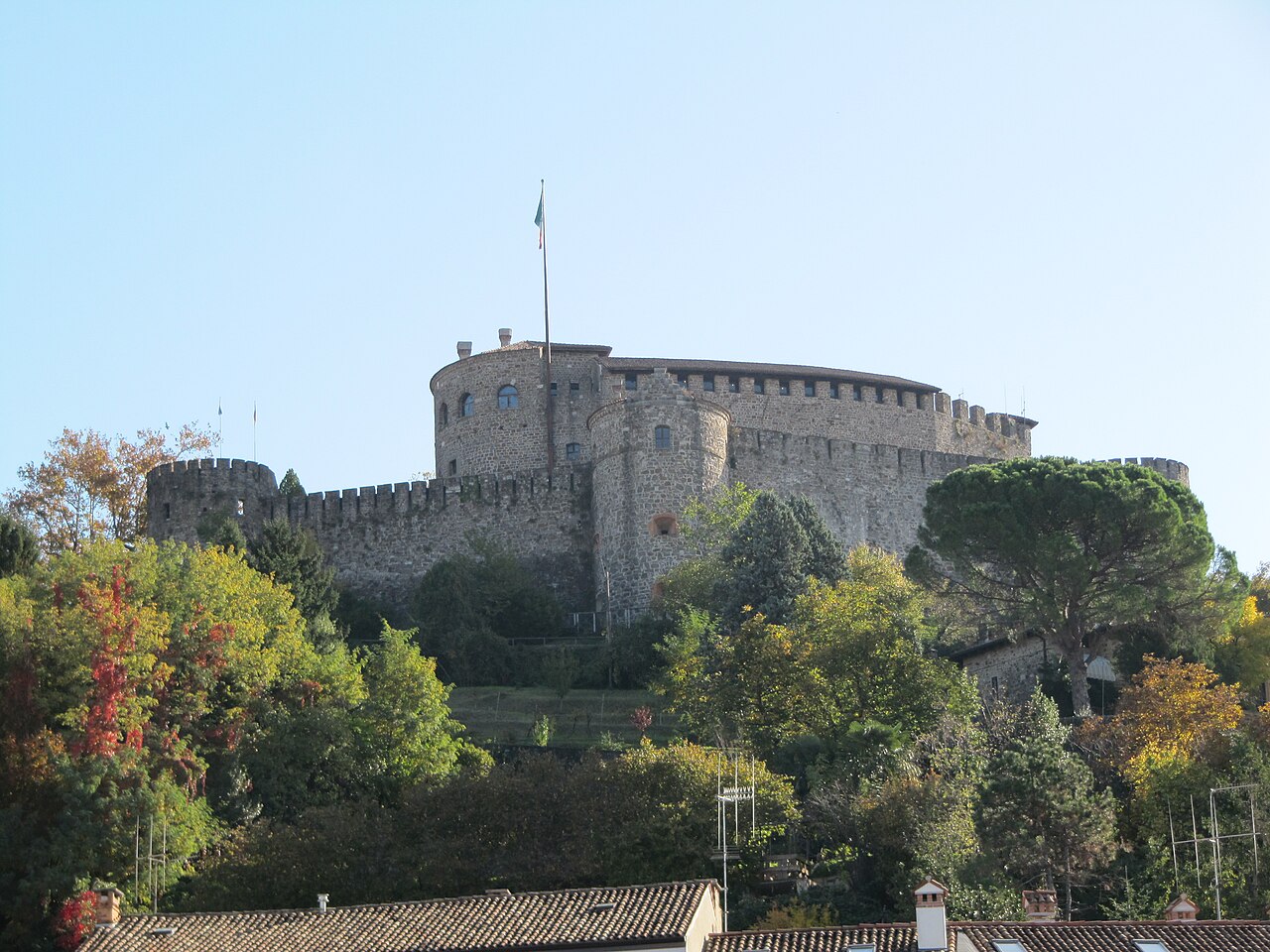
Gredič

Gredič castle in goriška brda, slovenia
Brda, Slovenia

Gredič Castle stands as a modest yet elegant fortress overlooking the verdant vineyards of Goriška Brda, a renowned wine-producing region in western Slovenia. This castle plays a significant role in the history and development of the region, which transformed from an impoverished area into one of the world's most prized centers for viticulture. Its strategic location on a gentle hill provides commanding views of the surrounding landscape, including the patchwork of vineyards that define the area's identity.

The historical context of Gredič and Goriška Brda

Goriška Brda is composed of approximately 45 villages spread over 72 square kilometers (28 square miles). Historically, this area was part of a larger, unified region that extended across what is now the border between Slovenia and Italy, known in Italian as Collio. This border division occurred after the Second World War, yet the cultural and viticultural ties between the two regions remain strong. The two areas cooperate closely, notably through a cross-border designation of origin (DOC) for their wines, a pioneering initiative within the European Union.

The region's unique terroir, known locally as opoka (or flysch in English), is a geological formation resulting from sedimentary rock layers deposited beneath a prehistoric ocean. This soil is characterized by a high mineral content, which imparts distinctive qualities to the grapes grown here. The terrain is marked by small hills, which contribute to the area's microclimates and affect the distribution of organic material and nutrients.

Geological and climatic factors influencing viticulture

The soils of Goriška Brda are notably poor in fertility due to the erosion of organic material down the hillsides. This scarcity of nutrients limits vine growth, causing the vines to develop slowly and produce fewer grapes. However, this stress on the vines enhances the concentration of flavors and complexity in the fruit, resulting in wines of exceptional quality and sophistication. This phenomenon aligns with the principle that the best wine terroirs are often those with spartan soils rather than rich, fertile ground.

Climatically, Goriška Brda benefits from an ideal combination of factors. The region enjoys abundant sunshine, which is crucial for grape ripening. It also receives cool, fresh air from the nearby Alps, which moderates temperatures and preserves acidity in the grapes. Additionally, the Adriatic Sea lies approximately 40 kilometers away, providing a maritime influence that brings freshness without the harsh effects of salt-laden winds. This unique climate-soil interaction is fundamental to the region's reputation for producing high-quality wines.

Architectural features and historical significance of Gredič Castle

While Gredič Castle itself is relatively modest in scale compared to larger fortifications, its architectural elegance is notable. The castle's construction reflects the styles and building techniques typical of smaller noble residences in the region. Its position on a hillside not only provided defensive advantages historically but also symbolized the authority and presence of its owners within the local community.

The castle's history is intertwined with the social and economic development of Goriška Brda, particularly its rise as a center of viticulture. The castle likely served as a local administrative and economic hub, overseeing vineyard management and trade. Although detailed records of its construction date and architectural modifications are limited, the castle remains a cultural landmark that embodies the region's heritage.

Preservation and cultural importance today

Today, Gredič Castle stands as a testament to the enduring legacy of the Goriška Brda region. It attracts visitors interested in the intersection of history, architecture, and viticulture. The castle's surroundings continue to be dominated by vineyards, reinforcing its connection to the land and its agricultural traditions.

The castle and the broader Goriška Brda area have become important for cultural tourism, drawing wine enthusiasts and history lovers alike. Efforts to preserve the castle and promote its heritage contribute to the sustainable development of the region, ensuring that its historical and architectural significance is appreciated alongside its natural beauty and agricultural productivity.

Visiting Gredič Castle and the Goriška Brda region

Visitors to Gredič Castle can explore the scenic landscape of Goriška Brda, enjoying wine tastings and tours that highlight the region's unique terroir and winemaking traditions. The castle's location offers picturesque views and a glimpse into the area's historical fabric.

The region's accessibility from nearby towns and the proximity to the Italian border make it a convenient destination for cross-border cultural and gastronomic experiences. The combination of historical architecture, natural beauty, and world-class wines makes Gredič Castle and Goriška Brda a compelling destination for travelers seeking an authentic connection to Slovenian heritage.

Frequently asked questions (FAQ)

How do I get to Castle Gredič?
Castle Gredič is located in the picturesque Brda region of Slovenia, easily accessible by car or local transport. The nearest major city is Nova Gorica, from where you can take a scenic drive through vineyards and hills to reach the castle.
What is the historical significance of Castle Gredič?
Castle Gredič dates back to the 15th century and has played a crucial role in the region's history, serving as a fortress and residence for noble families. Its architecture reflects a blend of Gothic and Renaissance styles, making it an important cultural landmark in Slovenia.
When was Castle Gredič built?
Construction of Castle Gredič began in the late 15th century, with significant modifications and expansions occurring in the following centuries. Its historical layers showcase the evolution of architectural styles and the strategic importance of the site throughout the ages.
Can I visit Castle Gredič year-round?
Yes, Castle Gredič is open to visitors throughout the year, but it is recommended to check specific opening hours based on the season. Guided tours provide an enriching experience, but it's best to book in advance during peak tourist seasons.
Why is Castle Gredič a popular tourist attraction?
Castle Gredič is popular for its stunning views, rich history, and beautifully preserved architecture. Visitors are drawn to its enchanting surroundings, which include vineyards and rolling hills, making it a perfect spot for photography and exploration.
Is it possible to host events at Castle Gredič?
Yes, Castle Gredič offers facilities for special events, including weddings, corporate meetings, and private gatherings. The breathtaking setting and historical ambiance make it a sought-after location for memorable occasions.
What are the ticket prices for visiting Castle Gredič?
Ticket prices for Castle Gredič are reasonable, with discounts available for children, students, and seniors. It's advisable to check the official website for the most current pricing and any special offers that may be available during your visit.
What are the opening hours for Castle Gredič?
Castle Gredič typically opens at 10 AM and closes at 6 PM, but these hours may vary depending on the season. Visitors should verify the opening times ahead of their visit to ensure a smooth experience.
What nearby attractions can I explore while visiting Castle Gredič?
While at Castle Gredič, you can explore nearby attractions such as local wineries, the charming town of Šmartno, and the beautiful landscape of the Brda region. The area is renowned for its wine production, so consider taking a vineyard tour to enhance your visit.

Information

Hill Castle

Sources & official resources

Verify the information above using these authoritative references.

Loading map...

Visitor reviews

No reviews yet. Been here? Write the first review and help other travelers!

Write the first review

Visited this castle? Share your experience

Your review helps other travelers and adds first-hand knowledge to our encyclopedia.

Write a review

(5/5)

0/2000 characters

Your review will be visible after admin approval

Nearby castles

3.6 km

Cormons Castle

Cormons, Italy

Cormons Castle, locally known as Castello di Cormons, is a significant early medieval hill castle perched atop Monte Quarin, just north of the town of Cormons in the Gorizia province of the Friuli-Venezia Giulia region in Italy. This strategic location has been fortified since prehistoric times, evolving through Roman, Lombard, medieval, and early modern periods, reflecting a rich tapestry of military and regional history.The site originally served as a Roman castrum, known as Cormontium, which underscores its long-standing military importance. The first true castle fortifications were established by the Lombards in the 6th or 7th century as part of their defensive frontier against invasions, notably from the Avars around 610 AD. This early fortress functioned as a critical lookout and signaling post within the Lombard limes system.Following the Lombard period, the castle came under the control of the Patriarchate of Aquileia in the 8th century, serving as a residence until their seat moved to Cividale. The castle likely provided refuge during the turbulent Magyar raids of the 9th and 10th centuries. Around the 10th century, a larger lower castle was constructed at the base of Monte Quarin, probably by the Counts of Gorizia, marking the beginning of a protracted territorial dispute with the Patriarchate.Medieval expansions and ownership disputesDuring the 12th century, the lower castle and its surrounding village were fortified with two concentric town walls, remnants of which still exist today. These fortifications enhanced the defensive capabilities of the settlement, which was strategically significant in the regional power struggles between the Patriarchs of Aquileia and the Counts of Gorizia.By 1277, the Counts of Gorizia secured official possession of the castle and village. Ownership later transferred to the Habsburg dynasty in 1497 after Emperor Maximilian I inherited the territories following the death of Count Leonhard of Gorizia. The castle was then granted as a fiefdom to the Vogrski knights, who served as castellans.Venetian occupation and declineIn the early 16th century, the castle became a contested site during the conflicts between the Habsburgs and the Venetian Republic. Venetian forces briefly occupied the castle in 1508 and again in 1511, during which time they destroyed parts of the fortress. Reconstruction efforts were initiated by the Venetians but were incomplete. The Treaty of Worms (1521) reaffirmed Habsburg control over the castle.Following these conflicts, the castle's military importance waned, and it gradually fell into disuse and decay. By the 17th century, it was largely abandoned, leading to the deterioration of its structures. The site experienced a brief period of French occupation in 1813 before reverting to the County of Gorizia and Gradisca. It remained under this jurisdiction until the Italian occupation during World War I in 1915.Architectural features and current remainsThe castle complex spans the entire flat summit of Monte Quarin, featuring an upper fortress separated from the lower bailey by a dry moat cut across the mountain top. The upper castle's centerpiece is a large circular structure approximately 18 meters in diameter, with walls up to five meters thick. This robust masonry structure underwent multiple construction phases, indicating adaptations to evolving defensive needs over centuries.The lower castle area was once protected by two concentric town walls built in the 12th century, which enclosed the developing village at the mountain's base. Today, only fragments of these walls remain, alongside small remnants within the bailey. The castle's overall condition is classified as ruins, with significant portions of walls and buildings reduced to weathered stone.Despite its ruined state, the site offers spectacular panoramic views of the surrounding Friuli-Venezia Giulia countryside, making it a popular destination for hikers and history enthusiasts. The castle is freely accessible on foot, though it cannot be reached by car, preserving its remote and historic atmosphere.Historical significance and cultural heritageCormons Castle stands as a testament to the region's complex history, reflecting the shifting political and military landscape from the early medieval Lombard period through the medieval and early modern eras. It illustrates the strategic importance of Monte Quarin as a military lookout and defensive site controlling key routes in northeastern Italy.The castle's layered construction phases and ownership history provide valuable insights into the feudal dynamics between the Patriarchate of Aquileia, the Counts of Gorizia, the Habsburgs, and the Venetian Republic. Its ruins contribute to the cultural heritage of the Friuli-Venezia Giulia region and are an important archaeological and historical site.Visitors to Cormons Castle can explore the remnants of its formidable walls and towers while enjoying the natural beauty and historical ambiance of Monte Quarin. The site remains a poignant reminder of the region's medieval military architecture and the enduring legacy of its past rulers.

Early Medieval (5th–10th c.)
Details
8.9 km
Gorizia Castle — Italy castle

Gorizia Castle

Gorizia, Italy

Gorizia Castle, locally known as Castello di Gorizia, stands as a prominent medieval fortress overlooking the city of Gorizia in the Friuli-Venezia Giulia region of northeastern Italy. Perched on a strategic hill 155 meters above sea level, the castle has witnessed over a millennium of history, evolving from an early medieval stronghold to a Renaissance fortress, and now serves as a cultural monument housing the Museum of the Middle Ages of Gorizia. The origins of Gorizia Castle trace back to the 11th century, when initial wooden defensive structures typical of the era, such as a motte-and-bailey with a moat and palisade, were replaced by more permanent stone constructions. The earliest stone keep, dating from this period, remains partially visible today within the castle's central courtyard, offering a tangible connection to its medieval roots. The castle's significance grew in the 12th century when it became the seat of the Counts of Gorizia, with Henry IV of Spanheim recorded as the first known count in 1146. This noble lineage expanded their influence across northeastern Italy and parts of present-day Austria and Slovenia, gradually enlarging and fortifying the castle to reflect their growing power. Medieval foundations and expansions Throughout the 13th century, Gorizia Castle underwent substantial expansion. A lordly palace and a two-storey building were added within the castle walls, enhancing its residential and administrative functions. Outside the castle's defensive palisade, a fortified hamlet developed, where residents were required to build masonry homes and assist in the castle's defense, underscoring the fortress's role as a community stronghold. The castle's architectural form during this period is documented by a city seal from 1307, granted by Albert II, which depicts a stylized keep similar to the castle's known structure. By the mid-14th century, the castle's appearance was comparable to that of Bruck Castle near Lienz, reflecting regional architectural influences. Transition to habsburg and venetian control The death of Leonhard, the last Count of Gorizia, in 1500 marked the end of the House of Gorizia's rule. The castle and its county passed to Maximilian I, Holy Roman Emperor and head of the Habsburg dynasty. Despite efforts to reinforce the castle's defenses, it was captured in 1508 by the Republic of Venice, which claimed the territory based on its ties to the Patriarchate of Aquileia. During Venetian occupation, which lasted just over a year until 1509, the castle underwent significant modifications to adapt to Renaissance warfare, particularly the use of firearms. This included the demolition of the original 11th-century stone keep to make way for modern fortifications such as bastions and reinforced walls. The Venetian coat of arms and a 16th-century statue of the Lion of Saint Mark, the symbol of Venice, remain prominent features above the castle's main entrance, commemorating this brief but impactful period. Early modern transformations and military use Following the Venetian retreat, the castle reverted to Habsburg control and gradually lost its medieval character. By the 17th century, it functioned primarily as a prison and military barracks. The 18th century saw further enhancements including the construction of bastions, powder magazines, and thick defensive walls. Notably, some of these fortification works were supervised by the renowned mathematician and astronomer Edmond Halley, reflecting an innovative approach to military architecture. Damage and restoration in the 20th century Gorizia Castle suffered extensive damage during World War I due to aerial bombardments, reducing it to ruins after centuries of use. Between 1934 and 1937, a major restoration led by architect Ferdinando Forlati, assisted by military engineers and the Trieste Belle Arti authority, sought to restore the castle to its medieval appearance. This involved removing Renaissance-era white plaster and reconstructing stone façades, reviving the castle's original medieval aesthetic. During World War II, the castle was occupied by German troops, and its northeast garden was used for executions, adding a somber chapter to its long history. Museum and present-day significance Today, Gorizia Castle houses the Museum of the Middle Ages of Gorizia, featuring original medieval furniture, reproductions of weapons, and siege engines that illustrate the castle's military and domestic history. The central courtyard still reveals the remains of the original 11th-century tower, connecting visitors directly to its medieval origins. The castle is surrounded by a public park, offering scenic views of the city and a tranquil setting for visitors. Its well-preserved medieval stonework and layered architectural elements make it a significant cultural and historical landmark in the Friuli-Venezia Giulia region. Gorizia Castle's enduring presence reflects the complex history of northeastern Italy, shaped by medieval nobility, Renaissance warfare, Habsburg and Venetian influences, and modern restoration efforts. It stands as a testament to the region's strategic importance and rich heritage, inviting exploration and study of its architectural evolution and historical narratives.

High Medieval (11th–13th c.)
Details
9.4 km

Castello di Rubbia

Savogna d’Isonzo, Italy

Castello di Rubbia stands as a remarkable historical monument near the confluence of the Vipava and Soča rivers, within the municipality of Savogna d’Isonzo in Italy. This castle's origins are deeply rooted in antiquity, with archaeological and architectural evidence suggesting a fortification existed on this strategic site since Roman times. The location was pivotal for controlling important routes through the Vipava Valley, serving as a military and administrative post overseeing passage between the Venetian Plain and the Danube Plain. Historical development and ownership The earliest known phase of the castle likely involved a Roman military outpost, whose foundations were later repurposed. The current structure primarily dates from the 15th and 16th centuries, embodying the Renaissance architectural style that replaced earlier medieval fortifications. This manor was constructed atop the remains of previous defensive works, reflecting the layered history of the site. The castle's documented ownership began with Count Egg, followed in the early 1500s by the noble Torre-Valsassina family. Later, the estate passed to Angelo Giacomo Edling before coming into the possession of the Coronini family, specifically Cipriano Coronini Kromberg, who retained it for several centuries. This lineage of ownership highlights the castle's importance as a noble residence and strategic stronghold. Military significance and conflicts The Gradisca Wars and artillery damage In the early 17th century, Castello di Rubbia gained renewed military relevance during the Gradisca Wars (1616-1617). Serving as a headquarters for military operations, the castle endured heavy artillery bombardment led by General Adem Trautmannsdorff. This assault inflicted severe structural damage, particularly to the castle's defensive walls and towers, underscoring its strategic importance in regional conflicts. World War I impact The castle's military role extended into the 20th century, where it again suffered significant destruction during World War I. The proximity to front lines meant the castle was exposed to artillery fire and combat operations, resulting in partial ruin before modern restoration efforts commenced. Religious refuge and cultural heritage A notable episode in the castle’s history occurred in 1563 when Primož Trubar, a prominent Protestant Slovene preacher, sought refuge within its walls. Fleeing the pressures of the Counter-Reformation, Trubar used the castle as a sanctuary to preach and conduct baptisms. This event marks the castle as a site of significant religious and cultural importance during a turbulent period in European history. Architectural features and restoration Structural composition and Roman elements The castle today mainly comprises a Renaissance manor built upon 15th-century foundations, which themselves incorporate remnants from earlier periods. The defensive walls, still visible, reveal the castle’s original military purpose alongside its residential function. A distinctive feature is the presence of Roman quarrying notches on one of the tower’s corner stones, indicating the reuse of Roman materials or the survival of Roman-built foundations beneath the medieval structure. Damage and restoration efforts Following the extensive damage from the Gradisca Wars and World War I, parts of the castle were left in a state of partial ruin. However, restoration work beginning in the early 21st century, guided by historical documentation, has revived the structure and preserved its historical integrity. These efforts have allowed the castle to function once again as a winery, continuing a tradition established in the late 19th century. Modern usage and visitor experience In 1872, the castle entered a new chapter when Leonardo Bianchi di Casalanza purchased and restored it, establishing vineyards and a winery on the estate. This agricultural heritage remains active, with the castle’s winery still operating under private ownership. The property occasionally opens to the public during special events, offering visitors a glimpse into its rich history and architectural splendor. A commemorative bust of Primož Trubar near the entrance honors his historical refuge at the castle, linking visitors directly to its religious and cultural legacy. The preservation of the defensive walls and the Roman-styled corner stones provides tangible connections to the castle’s multifaceted past, making Castello di Rubbia a unique destination for those interested in history, architecture, and viticulture.

Renaissance (15th–17th c.)
Details