Palanok Castle
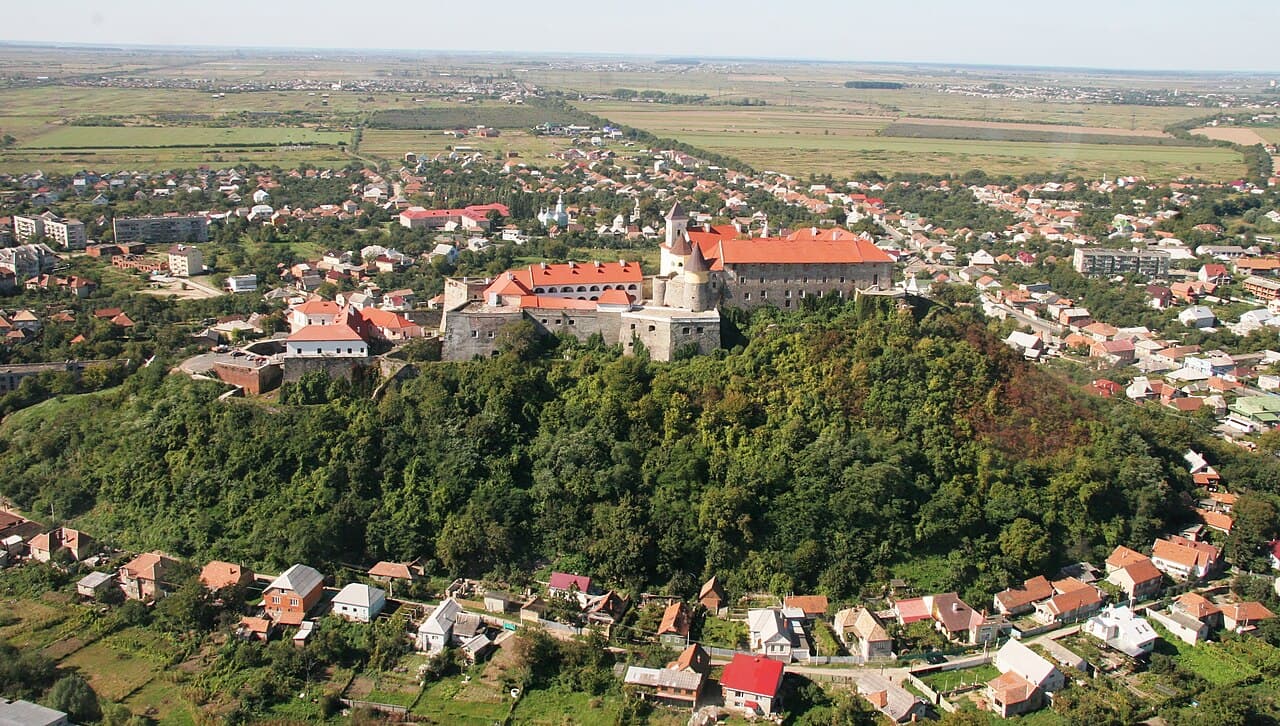
Palanok Castle, also known as Munkács Castle, stands majestically on a volcanic hill in Mukachevo, Ukraine, dominating the surrounding landscape with its formidable presence. This medieval hill castle is one of the most significant and best-preserved defensive complexes in Ukraine, attracting over one hundred thousand visitors annually who come to explore its rich history and architectural grandeur.
The origins of Palanok Castle trace back to the early medieval period, with archaeological evidence indicating the site was inhabited from the Neolithic through the Bronze and Iron Ages. Initially, the fortress was a wooden stronghold established during the Hungarian conquest, first mentioned in written records in the 11th century. It played a crucial role in the defense of the Kingdom of Hungary, successfully withstanding attacks from the Pechenegs in 1086 and the Mongol invasion in 1241, highlighting its strategic frontier position.
In the late 14th century, under the ownership of Prince Theodor Koriatovych, the castle underwent significant transformation from wood to stone. Koriatovych fortified the complex with new walls, deep ditches, and additional towers. He also commissioned the digging of a remarkable 85-meter deep well carved into the rock, which ensured a reliable water supply during sieges. A local legend surrounds the well's construction, involving a pact with the devil, which adds a layer of mystical allure to the castle's history.
Architectural evolution and defensive features
Palanok Castle's architecture reflects a blend of medieval fortification techniques and Renaissance military engineering, adapted over centuries to meet evolving military threats. The fortress is arranged on multiple terraces ascending the hill: the upper terrace houses the oldest part, the citadel, while the middle and lower terraces contain the main castle complex and outer defenses respectively.
The castle's defensive system is notable for its thick walls, measuring up to 3.8 meters wide, and a series of bastions designed in the Italian style, including eight angular and three round bastions. Key bastions such as the German and Hajdú guard the lower castle entrance, while the Hussar and Wheelwright (Wagner) bastions protect the middle castle gate. Within the citadel, the Lorántffy, Rákóczi, and Freedom Tree bastions stand as critical defensive points, with the highest tower adjacent to the Lorántffy bastion linking to other fortifications.
A distinctive architectural feature is the covered well within the citadel, 2.5 meters in diameter and 86 meters deep, with a secret tunnel at 71 meters connecting to the nearby Latorca River. This ingenious design provided a secure water source and potential escape route during sieges.
The castle courtyard, known as Rákóczi Square, is enclosed by two to three-story buildings that historically served as barracks, ammunition storage, a knights' hall, and food supply depots. The palace within the citadel is a multi-story structure with arcaded galleries on three sides, serving as the residence and court for the castle's lords.
Additional defensive measures included a dry moat between the lower and middle castles, approximately 10 to 12 meters deep, and a water-filled moat encircling the hill's base. The surrounding marshy terrain further enhanced the castle's natural defenses by limiting enemy approach routes.
Historical significance and notable figures
Throughout its history, Palanok Castle was a focal point of regional power struggles, especially between Austria and Transylvania from the 16th century onward. In 1633, it came under the rule of the Transylvanian prince György I Rákóczi, who made it the capital of his principality. Under his reign, the fortress saw extensive renovations and expansions, including the construction of the Upper, Middle, and Lower castles.
Following György I, his widow Sophia Báthory took control and fortified the castle further by adding two defensive terraces and an outer defensive ring. Sophia is remembered for her ruthless reputation, with legends attributing to her bizarre practices such as drinking human blood to retain youth.
The castle is also famously associated with Ilona Zrínyi, daughter of Sophia Báthory, who is celebrated for her valiant defense of Palanok during a prolonged siege by Austrian forces from 1685 to 1688. Despite the fortress enduring a grueling two and a half years under siege, it eventually fell due to a deceptive surrender agreement signed by Ilona Zrínyi. Her leadership remains a symbol of courage and resistance in Hungarian and Ukrainian history.
During the early 18th century, Palanok Castle was a strategic stronghold in the anti-Habsburg uprisings, notably serving as the residence and military headquarters of Francis II Rákóczi during his War of Independence (1703–1711). After the defeat of these uprisings, the castle's military importance declined, and it was repurposed as a political prison by the Austrian monarchy until the late 19th century.
Between December 1805 and March 1806, the castle safeguarded the Hungarian Holy Crown during the Napoleonic Wars, underscoring its continued symbolic significance.
Modern usage and cultural heritage
In the 20th century, Palanok Castle served various military functions under Czechoslovak, Hungarian, and Soviet control, including use as barracks and an agricultural machinery school. Restoration efforts commenced in the 1970s to preserve the fortress and transform it into a museum and cultural site.
Today, the castle houses the Mukachevo Historical Museum, featuring exhibits on the region's history, the Lehoczky collection, and restored rooms displaying the castle's architectural and cultural legacy. The museum also includes galleries of Western Ukrainian paintings, ancient icons, and exhibitions dedicated to local wooden churches and art salons showcasing regional artists.
The castle grounds formerly featured the Turul bird monument, a large bronze statue atop a 33-meter obelisk erected in 1896 as a symbol of Hungarian heritage. This monument underwent removal and reinstatement cycles throughout the 20th and early 21st centuries, reflecting shifting political landscapes. In 2022, it was replaced by the Ukrainian trident emblem, symbolizing the castle's integration into Ukrainian national identity.
Visitors to Palanok Castle can enjoy the scenic views from its terraces, explore its extensive fortifications, and relax in the cozy cafés within the fortress, making it a vibrant cultural and historical destination.
Legend of the devil's well
A captivating local legend tells of the castle's deep well, which was initially dug without finding water. The devil allegedly appeared to the castle's owner, offering water in exchange for a bag of gold. The clever prince tricked the devil by giving him a small bag with only two coins. Enraged, the devil jumped into the well, and it is said that his anguished howls can still be heard from its depths, adding a mystical aura to the fortress.
Frequently asked questions (FAQ)
- What is Palanok Castle known for?
- Palanok Castle, located in Mukachevo, Ukraine, is renowned for its stunning medieval architecture and rich history. It has served various purposes throughout the centuries, including as a fortress and a royal residence, and is a symbol of the region’s heritage.
- When was Palanok Castle built?
- Palanok Castle dates back to the 14th century, with its construction beginning in 1376. Over the years, it has undergone numerous renovations and expansions, reflecting the architectural styles of different eras.
- How do I get to Palanok Castle?
- Palanok Castle is easily accessible by car or public transport from Mukachevo city center. Visitors can take a local bus or taxi, and the castle is well-signposted, making it simple to find.
- What are the opening hours for Palanok Castle?
- Palanok Castle is open to visitors year-round, with varying hours depending on the season. Typically, the castle opens at 9 AM and closes at 6 PM, but it’s advisable to check the official website for any seasonal changes.
- Can I take a guided tour of Palanok Castle?
- Yes, guided tours of Palanok Castle are available and highly recommended for a richer experience. Knowledgeable guides provide insights into the castle's history, architecture, and legends, making your visit more engaging.
- Is it possible to visit Palanok Castle with children?
- Absolutely! Palanok Castle is family-friendly and offers a fascinating experience for visitors of all ages. The castle grounds provide plenty of space for exploration, and children can enjoy learning about the castle’s intriguing history.
- What are the ticket prices for Palanok Castle?
- Ticket prices for Palanok Castle are quite reasonable, with discounts available for students and children. As of now, adult tickets are priced around 100 UAH, but it’s best to check the latest prices before your visit.
- When is the best time to visit Palanok Castle?
- The best time to visit Palanok Castle is during the late spring and early autumn months when the weather is pleasant and the surrounding landscapes are beautiful. Additionally, visiting during these times helps avoid the summer tourist crowds.
- What nearby attractions can I visit after Palanok Castle?
- After exploring Palanok Castle, you can visit the nearby Mukachevo Cathedral and the charming historic center of Mukachevo. The region also offers beautiful landscapes and parks, perfect for a scenic walk or picnic.
Photo gallery

Information
Website
Visit websiteSources & official resources
Verify the information above using these authoritative references.
Loading map...
Visitor reviews
No reviews yet. Been here? Write the first review and help other travelers!
Write the first reviewVisited this castle? Share your experience
Your review helps other travelers and adds first-hand knowledge to our encyclopedia.