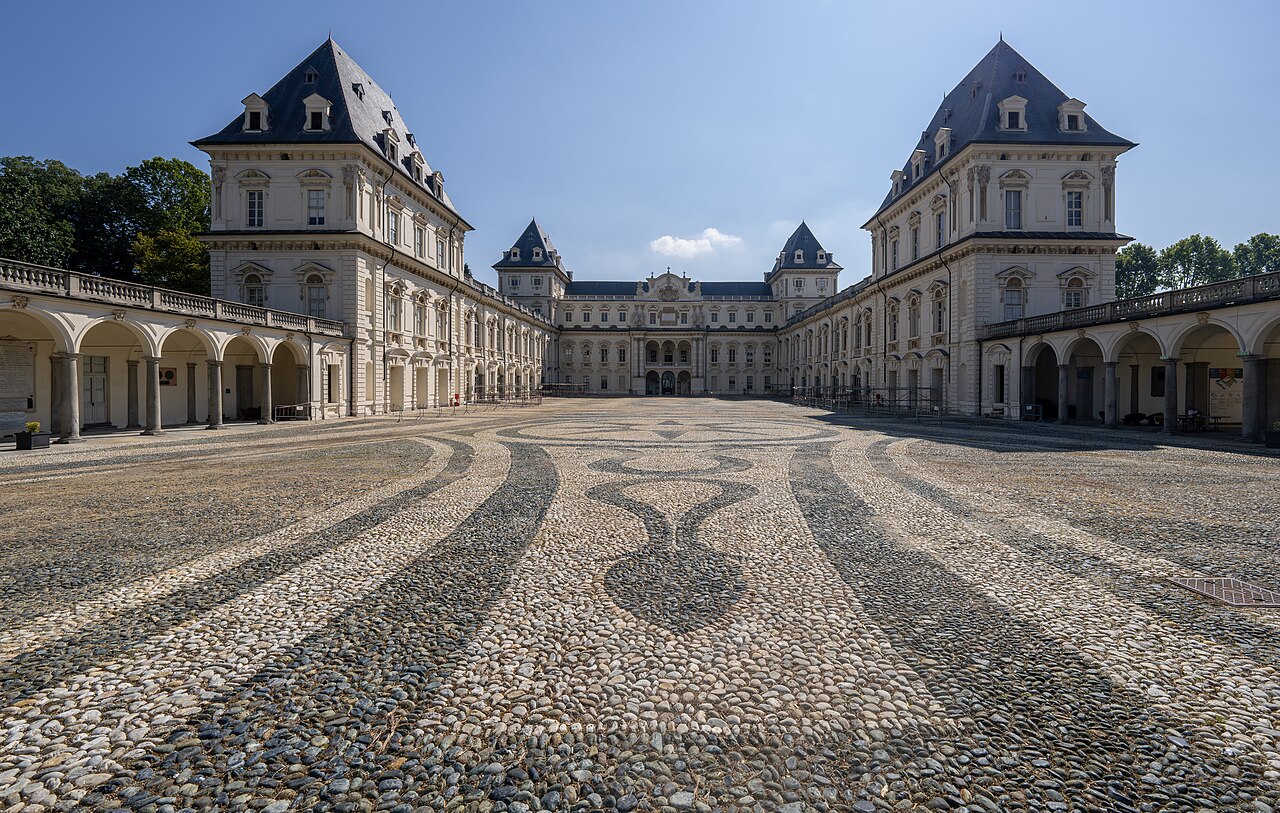
Palace of Venaria
The Palace of Venaria, located in the municipality of Venaria Reale near Turin in northern Italy, stands as one of the most significant examples of Baroque architecture and royal hunting residences in Europe. Originally conceived in the mid-17th century as a grand hunting lodge for the Savoyard rulers of the Duchy of Savoy, the palace evolved into a sprawling complex blending princely residence, town planning, and formal gardens. Its rich history, architectural grandeur, and extensive restoration make it a cultural landmark and a testament to the power and taste of the Savoy dynasty.
The palace’s origins date back to 1658 when Duke Charles Emmanuel II of Savoy commissioned the construction of a hunting base amid the heathlands north of Turin. The site was strategically chosen on lands that previously included two small villages, Altessano Superiore and Inferiore, which were merged and renamed Venaria—a name derived from the Latin Venatio Regia, meaning "Royal Hunt." This naming reflects the palace’s original purpose as a hunting estate, a favored pastime of European nobility and a symbol of aristocratic privilege.
Architectural conception and early construction
The initial design and construction were entrusted to the architect Amedeo di Castellamonte, who began work in 1659. Castellamonte’s vision extended beyond the palace itself; he planned a new town with a symbolic circular layout meant to represent the collar of the Supreme Order of the Most Holy Annunciation, the highest order of chivalry of the House of Savoy. This innovative urban design intertwined the palace, the church, and the town into a unified princely hunting complex and an idealized miniature city embodying both political symbolism and functional elegance.
Between 1658 and 1663, the core residential building known as the Palace of Diana was constructed. This original structure featured white plastered façades and was designed to serve as the heart of the hunting estate. Subsequent decades saw expansions with additional pavilions and courtyards, enhancing the complex’s scale and utility. However, the palace suffered damage during the Nine Years’ War in 1693 when French forces attacked, necessitating repairs and further development.
Grand baroque transformation under victor amadeus ii
After the war, Victor Amadeus II, Duke of Savoy and later King of Sardinia, embarked on an ambitious reconstruction and enlargement program beginning in 1699. He aimed to rival the grandeur of the French royal residence of Versailles by transforming the palace into a monumental Baroque masterpiece. Architect Michelangelo Garove was employed to oversee this phase, which included the addition of new wings, pavilions, and the redesign of formal gardens following French landscaping principles, emphasizing symmetry, perspective, and grandeur.
Despite the palace’s military vulnerability, it endured further conflict during the 1706 Siege of Turin. Following the Savoyard victory, the celebrated architect Filippo Juvarra was commissioned in 1716 to continue the palace’s enhancement. Juvarra’s contributions included the completion of the Great Gallery, the construction of the Church of Sant’Uberto—dedicated to the patron saint of hunters—and the building of the Great Stable. He also renovated façades and interior spaces, solidifying the palace’s status as a Baroque jewel.
The church of sant’uberto
The Church of Sant’Uberto, built between 1716 and 1729, features a Greek-cross floor plan centered on an octagonal core. Although spatial constraints prevented a true dome, Juvarra designed a painted vault that creates the illusion of one. The church’s interior is richly decorated, with a high altar supported by flying angels and topped by a ciborium resembling a small temple. Statues of the four Church doctors flank side altars and chapels adorned with paintings by notable artists such as Francesco Trevisani, Sebastiano Ricci, and Sebastiano Conca. Elevated tribunes were designed for the monarch and court, connected to the palace by a monumental staircase and a tunnel leading to the Citroneria, an orangery within the stable complex.
18th-century additions and decline
The 18th century saw further architectural contributions from Benedetto Alfieri, who added the Belvedere wing, connecting galleries, indoor riding halls, and stables. Alfieri also introduced neoclassical decorative elements around 1788–89, reflecting evolving tastes. Despite these enhancements, the palace’s prominence waned in favor of the Stupinigi hunting lodge during the late 1700s. Monarchs such as Victor Amadeus III and Charles Emmanuel IV continued to use the estate but with diminishing frequency.
Military use and restoration
During the Napoleonic era and beyond, the palace ceased to function as a royal residence. It was repurposed as military barracks, and its extensive gardens were destroyed to create training grounds. The Royal Sardinian Army took ownership, and from 1851 to 1943, the complex housed various military units. Military use gradually declined in the 20th century, and the palace was largely neglected after the military left in 1978.
A major restoration campaign began in 1996, involving around 700 experts and funded by Italian and European bodies. This large-scale project, one of the largest heritage restorations in Europe, lasted from 1999 to 2007. The palace was reopened to the public in October 2007, restored to its former splendor and adapted for cultural and public use.
Architectural features and interior highlights
The Palace of Venaria comprises two principal wings showcasing distinct architectural phases. The older Palace of Diana is notable for its white plastered façades decorated with motifs such as cornucopias, shells, and fruit. The main entrance features a prominent loggia, an open gallery that once flanked twin arches, one of which was removed during 18th-century renovations.
Inside the Palace of Diana, the Sala di Diana or Hall of Diana stands out as a richly decorated rectangular chamber. It features hunting-themed stuccoes and paintings, including a vaulted ceiling fresco depicting Mount Olympus by Jan Miel. The walls display equestrian portraits of Savoyard dukes and courtiers alongside canvases illustrating various hunting scenes, underscoring the palace’s original function as a hunting residence.
The 18th-century wing, designed by Garove and completed by Juvarra, includes two grand pavilions connected by the Galleria Grande (Grand Gallery). This elongated hall is adorned with stucco decorations, 44 arched windows, and a distinctive black-and-white tiled floor. It once housed an extensive collection of artworks by court artists such as Vittorio Amedeo Cignaroli, Pietro Domenico Olivero, and Bernardino Quadri.
The juvarra stables complex
One of the palace’s most remarkable features is the Juvarra Stables, a vast complex comprising a large atrium opening onto the gardens and a vaulted hall subdivided into the Scuderia Grande (Grand Stable) and the Citroneria (orangery). The Citroneria is an impressive vaulted gallery measuring 148 meters long, 14 meters wide, and 16 meters high, originally designed to shelter citrus trees during winter. Its architectural details include niches and trompe-l’œil windows, painted illusions that mimic arches, creating a dynamic interior effect.
The Scuderia Grande, slightly narrower but equally long, once housed about 200 horses. Today, it displays ceremonial carriages, military uniforms, and the Venetian Bucintoro, an elaborate barge commissioned by Victor Amadeus II, symbolizing the palace’s opulent court life.
Gardens and modern park
The palace’s original Italian-style gardens, featuring terraces, stairways, a clock tower, the Fountain of Hercules, a theatre, and decorative parterres, were destroyed during the French occupation and replaced by military training grounds. Recent restoration efforts have recreated a modern-style park that incorporates contemporary artworks, including a striking 12-meter-tall artificial cedar tree by Giuseppe Penone. This sculpture also serves a practical function by housing the palace’s thermal discharges, blending art and utility.
Frequently asked questions (FAQ)
- What is the historical significance of the Palace of Venaria?
- The Palace of Venaria, a UNESCO World Heritage site, is one of the most important examples of Baroque architecture in Italy. Built in the 17th century as a royal hunting lodge for the House of Savoy, it reflects the grandeur of the period and the power of the Savoy dynasty in shaping Italian history.
- When was the Palace of Venaria built?
- Construction of the Palace of Venaria began in 1658 and was completed in 1679. The palace was designed by the architect Amedeo di Castellamonte and has undergone several restorations since its original completion to preserve its historical and architectural integrity.
- What are the opening hours for the Palace of Venaria?
- The Palace of Venaria is typically open from 9:00 AM to 7:00 PM, with the last entry at 6:00 PM. However, it's best to check the official website for any seasonal changes or special holiday hours before your visit.
- Can I buy tickets online for the Palace of Venaria?
- Yes, you can purchase tickets online through the official Palace of Venaria website. Buying tickets in advance is highly recommended to avoid long queues and ensure entry on your desired date.
- Is the Palace of Venaria accessible for visitors with disabilities?
- Yes, the Palace of Venaria is accessible to visitors with disabilities. There are ramps, elevators, and accessible restrooms available to ensure a comfortable experience for all guests.
- What is the best time to visit the Palace of Venaria?
- The best time to visit the Palace of Venaria is during the spring and early fall when the weather is mild and pleasant. Additionally, visiting during weekdays can help avoid larger crowds typically seen on weekends.
- Are there any nearby attractions to the Palace of Venaria?
- Yes, nearby attractions include the Royal Park of La Mandria, which offers beautiful landscapes and outdoor activities, and the historic city of Turin, known for its museums, cafes, and architectural wonders. Both are easily accessible and make for great additions to your visit.
- What are the ticket prices for the Palace of Venaria?
- Ticket prices vary depending on the type of ticket and any ongoing exhibitions. Generally, a standard adult ticket costs around €12, while reduced tickets are available for students and seniors. It's advisable to check the official website for the most current pricing and any special offers.
Information
Website
Visit websiteSources & official resources
Verify the information above using these authoritative references.
Loading map...
Visitor reviews
No reviews yet. Been here? Write the first review and help other travelers!
Write the first reviewVisited this castle? Share your experience
Your review helps other travelers and adds first-hand knowledge to our encyclopedia.