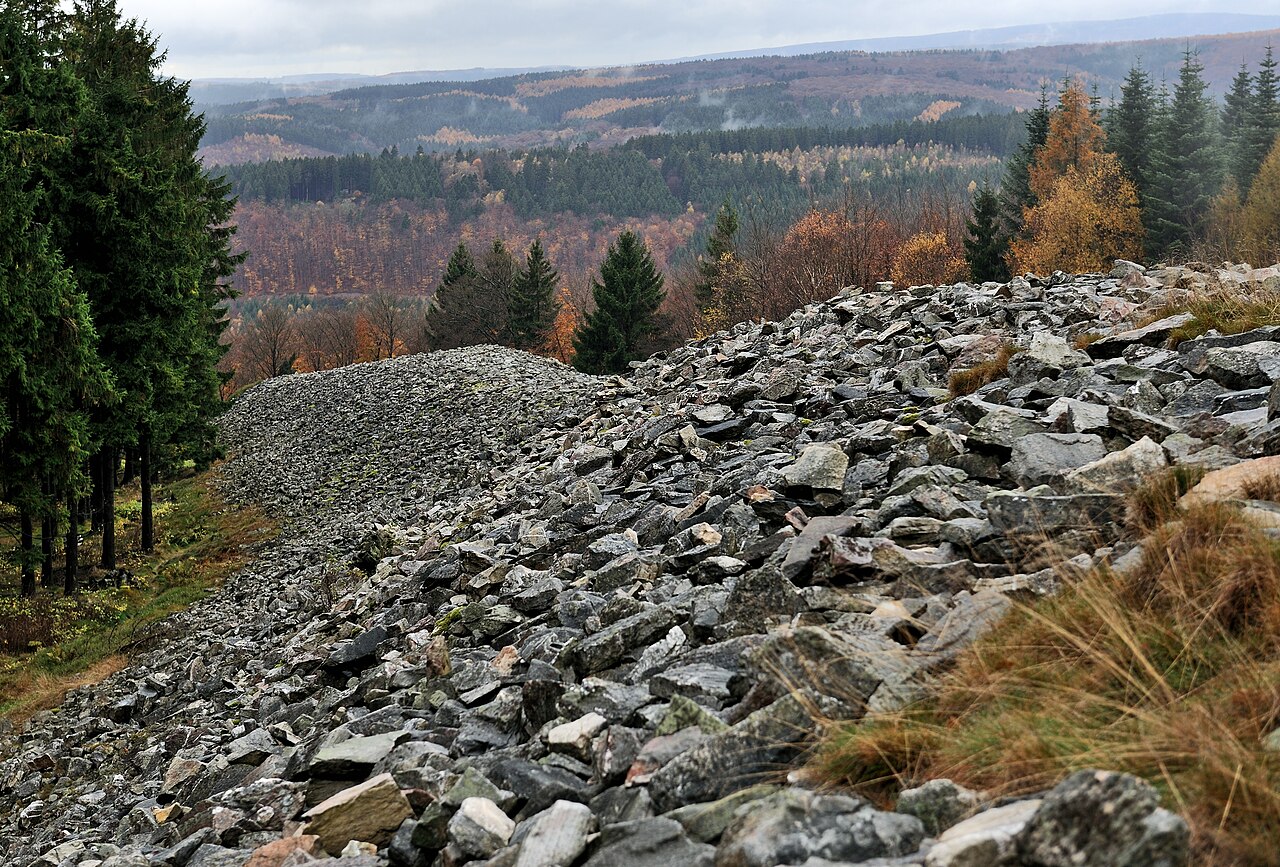
Grimburg Castle
Grimburg Castle, located near the municipality of Grimburg in Germany, stands as a significant example of a high medieval hill castle with a rich history dating back to the late 12th century. Originally constructed around 1190 by the Archbishops of Trier, the castle served as a strategic regional stronghold and administrative center within the territory of the Archbishopric of Trier. Its expansive complex, measuring approximately 300 meters in length and 90 meters in width, makes it one of the most spacious among the former Kurtrier state castles.
The castle's location atop the Kittelaufberg spur at an elevation of about 448 meters above sea level provided natural defensive advantages, overlooking the valleys of the Wadrill and Mühlenbach streams. This positioning was typical of hill castles designed to control surrounding lands and protect important routes.
Early history and strategic importance
The origins of Grimburg Castle trace back to the noble family known as the Edelherren von Saarbrücken, who established the fortress around 1150. However, it was the Archbishopric of Trier that rebuilt and expanded the castle following its destruction during the Trier Schism between 1183 and 1190, a period marked by ecclesiastical power struggles. The castle quickly became an important administrative seat, serving as the center of the Amt Grimburg, a district under Trier's control.
By the 13th century, Grimburg was documented as a hub for local governance and justice, with records from 1328 confirming its status. Ownership was divided among the Archbishop, the cathedral custodian (Domküster), and the St. Paulin monastery, reflecting the complex feudal and ecclesiastical arrangements of the time. The Saarbrücken family played a key role as Burgraves, managing the castle's defense and administration for about a century.
Architectural features and layout
The castle complex is characterized by several principal medieval architectural elements. A prominent feature is the rectangular bergfried (keep), which served as the main defensive tower and refuge during sieges. This tower dominates the castle's silhouette and was partially reconstructed during restoration efforts beginning in 1978.
Adjacent to the bergfried lies the palas, the main residential hall where the lord and his retinue resided. The palas was designed for both comfort and defense, with thick walls and limited access points. Nearby stands the chapel, notable for its unique two-level design: the lower church served the residents of the outer bailey, while the upper gallery was reserved exclusively for the Archbishop and his officials, accessible via a separate entrance. This architectural division highlights the castle's dual role as both a spiritual and administrative center.
The castle also included an outer bailey (Vorburg), which housed auxiliary buildings and served as the first line of defense. Two notable towers in this area, the Hexen- (witch) tower and the Küchenturm (kitchen tower), have been stabilized and partially restored, offering insight into the daily life and functional aspects of the castle.
Originally, a pentagonal residential tower was part of the complex but was later hollowed out and replaced with a new pentagonal tower, demonstrating architectural evolution and adaptation over the centuries.
Historical events and later use
Throughout its history, Grimburg Castle witnessed significant events and changes in ownership. In 1512, Emperor Maximilian I visited the castle, reportedly engaging in falconry, underscoring the site's importance as a noble residence. A decade later, in 1522, the castle was captured without resistance by the imperial knight Franz von Sickingen, reflecting the turbulent political landscape of the early 16th century.
Later in the century, Archbishop Johann von Schönenberg undertook renovations and expansions of the castle chapel in 1585, enhancing its religious significance. However, the castle suffered severe damage during the Thirty Years' War (1618–1648) and was further devastated by French forces during the Reunions Wars in 1683, when it was deliberately set on fire.
Following these conflicts, the administrative functions of the Amt Grimburg were relocated around 1690, leading to the castle's abandonment. Over time, the ruins were quarried for building materials by nearby villages, contributing to its decline.
Modern restoration and cultural significance
Restoration efforts began in 1978, spearheaded by local groups such as the “Friends of Grimburg Castle” in cooperation with municipal authorities. These initiatives focused on excavation, stabilization, and partial reconstruction of key structures including the bergfried, the Hexen- and Küchenturm towers, and the entrance gateway.
Today, the castle is maintained as a cultural monument and is open to visitors year-round with free admission. The restoration work has enabled visitors to gain a tangible understanding of medieval castle architecture and life. The castle's name, likely derived from a term meaning "green castle," reflects its setting amidst the natural greenery of the region rather than any ominous connotations.
Grimburg Castle remains an important heritage site within the Rhineland, illustrating the evolution of medieval fortifications, ecclesiastical power, and regional administration. Its extensive ruins and carefully preserved structures offer valuable insights into the architectural and historical developments of the high medieval period in Germany.
Frequently asked questions (FAQ)
- How do I visit Grimburg Castle?
- Grimburg Castle is open to visitors all year round with free admission. There are no specific opening hours, so visitors can explore the site at their convenience.
- What is the historical significance of Grimburg Castle?
- Grimburg Castle served as a regional administrative center for the Archbishopric of Trier and played a key role in local governance and defense during the high medieval period.
- Can I see the chapel at Grimburg Castle?
- Yes, the castle chapel is a notable feature with two levels: the lower church for the outer bailey residents and an upper gallery reserved for the archbishop and officials. Restoration has preserved these unique architectural elements.
- Is Grimburg Castle accessible for visitors with mobility issues?
- As a hill castle with partially restored ruins, accessibility may be limited for visitors with mobility challenges. The terrain includes uneven paths and some steep areas.
- When was Grimburg Castle built and by whom?
- Grimburg Castle was originally built around 1190, likely by the Archbishops of Trier after rebuilding the earlier structure established by the Edelherren von Saarbrücken.
Information
Website
Visit websiteSources & official resources
Verify the information above using these authoritative references.
Loading map...
Visitor reviews
No reviews yet. Been here? Write the first review and help other travelers!
Write the first reviewVisited this castle? Share your experience
Your review helps other travelers and adds first-hand knowledge to our encyclopedia.