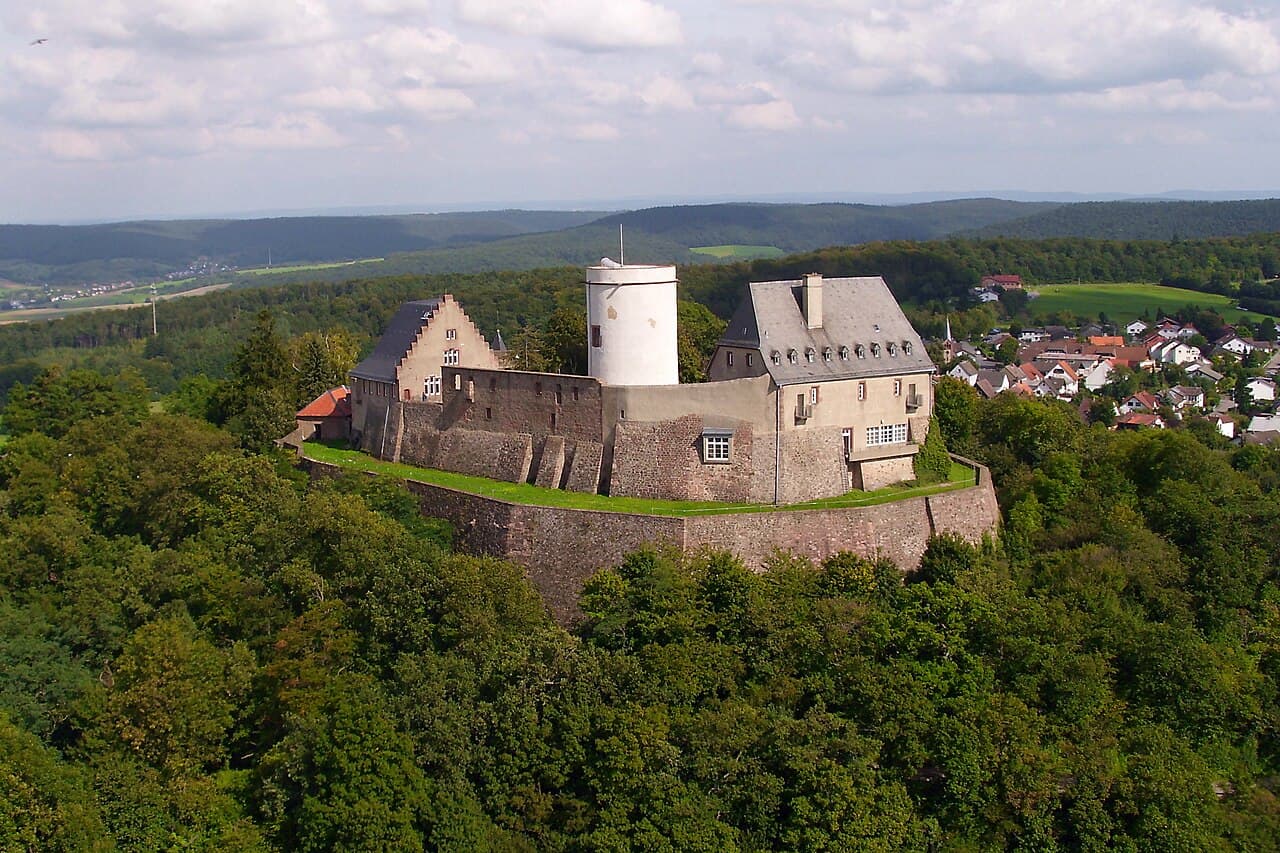
Otzberg Castle
Otzberg Castle stands prominently atop the Otzberg hill in the municipality of Otzberg, located in the state of Hesse, Germany. This hill castle was originally constructed in the late 12th or early 13th century under the auspices of Fulda Abbey, a powerful ecclesiastical institution of the medieval Christian world. The castle's foundation was part of the abbey's strategic efforts to protect its extensive lands and assert its influence in the region during the High Medieval period. The initiative is closely associated with Abbot Marquard I of Fulda, who sought to establish visible and defensible strongholds to secure the abbey's territorial claims.
The earliest documentary mention of the fortress dates to 1231, where it was referred to as "castrum Othesberg". By 1244, records indicate the presence of several castellans or Burgmannen—knights entrusted with the castle's defense and administration. These knights resided with their families in fortified houses within the adjacent settlement that gradually developed beneath the castle. This settlement evolved into the village of Hering, whose growth and protection were closely linked to the castle's presence and military function.
Medieval origins and ecclesiastical ownership
Otzberg Castle's initial construction reflects typical Romanesque architectural features, especially evident in its central keep or bergfried, known locally as the "Weiße Rübe" (White Beet). This tower, approximately 17 meters tall with a substantial rounded base roughly 10 meters in diameter, exemplifies the robust stone masonry characteristic of the period. A projecting stone corbel at around 15.5 meters serves the practical purpose of diverting rainwater away from the walls, aiding in the tower's preservation. The bergfried also offers a vantage point with expansive views over the surrounding Darmstadt-Dieburg district and the distant Taunus hills.
By the 14th century, financial difficulties at Fulda Abbey led to the castle and its lands being pledged repeatedly as collateral to various noble families, including the von Anevelt, von Frankenstein, and the Hanau counts. These noble families contributed to the castle's maintenance and fortification, reflecting the shifting nature of feudal obligations and property rights in the late medieval period. In 1390, the castle transitioned from ecclesiastical to secular control when it was sold to Count Palatine Rupert II.
Early modern military adaptations and conflicts
During the early 16th century, Otzberg Castle was embroiled in regional conflicts such as the Bavarian Feud around 1504. It was briefly occupied by Landgrave William II of Hesse but returned to the Electoral Palatinate after the peace settlement at the Reichstag in Constance in 1507. This period marked a significant transformation for the castle as it adapted to the changing nature of warfare, particularly the introduction of artillery.
Beginning in 1511, the castle underwent extensive fortifications, including the construction of strengthened walls and a defensive outer enclosure known as a zwinger. A new gatehouse was added to enhance the castle's defensive capabilities. Concurrently, the nearby village of Hering was fortified with a stone town wall by the mid-16th century, integrating the settlement into the overall defensive strategy of the castle complex.
Siege during the thirty years' war
The Thirty Years' War (1618–1648) brought significant hardship to Otzberg Castle. It endured a prolonged siege from 1621 to 1622 by allied Bavarian, imperial, and Spanish forces, ultimately surrendering after sustained pressure. The war caused multiple changes in territorial control: Otzberg was transferred to Hesse-Darmstadt as compensation in 1623, occupied by French troops in 1647, and finally returned to the Palatinate following the Peace of Westphalia in 1648.
In the aftermath, the castle served various administrative and military functions, including storing the Palatine archives during times of conflict. By the early 18th century, its role shifted towards housing disabled soldiers and war prisoners, reflecting a decline in its strategic military importance.
19th and 20th century transformations
In 1802, Otzberg Castle became part of the territory of Hesse-Darmstadt permanently. From 1803, it was repurposed as a state prison, a function that lasted until military use ceased around 1818. Recognizing the castle's historical significance, a decree in 1826 preserved key structures such as the tower and the commandant's house, while authorizing the demolition of less essential buildings.
Throughout the 20th century, the castle's buildings were adapted for civilian uses. The former barracks were converted into a youth hostel by 1921, and the commandant's house served various roles including a forestry office and a restaurant until its closure in 2019. From the mid-1980s onward, the castle hosted a museum collection dedicated to regional folk culture. The Korporalshaus, a historic building reconstructed in 1996, now functions as a museum and municipal office, symbolizing the castle's ongoing civic role.
Architectural features and fortifications
The castle complex is notable for its distinctive oval-shaped layout formed by two concentric stone walls dating primarily to the 16th century. This design reflects adaptations for defense against early modern artillery, favoring low, rounded ramparts over the traditional medieval towers. Such fortifications allowed the structure to better absorb and deflect cannon fire, marking a significant evolution in castle architecture.
Central to the fortress is the bergfried, the "Weiße Rübe," a Romanesque tower that remains a dominant feature. Near the castle's center lies a well excavated circa 1320, remarkable for its depth of approximately 50 meters, ranking among the deepest in the Hesse region. Adjacent to the well is a large treadwheel installed in 1788, a mechanical device powered by human labor to facilitate water drawing.
The commandant's house, built in 1574, served as an administrative center and community hub. The palas, or main residential building, housed the Otzberg Museum for many years, preserving local history and culture. Although a notable heated chamber or Kemenate once existed within the castle, it was demolished following an order in 1806, leaving only foundational remains.
The Korporalshaus, reconstructed in 1996, serves as a museum and municipal office, highlighting the castle's ongoing integration into civic life. The village of Hering, originally the castle's lower ward inhabited by Burgmannen, was fortified with its own stone town wall in the mid-1500s, exemplifying the close relationship between the castle and its dependent settlement.
Cultural and heritage significance
Today, Otzberg Castle stands as a well-preserved cultural monument that embodies centuries of architectural evolution and regional history. Its layered fortifications and buildings tell a story of medieval origins, early modern military modernization, and peaceful adaptation to civil uses. The castle remains a tangible record of the Darmstadt-Dieburg district's historical landscape and continues to be a symbol of local identity and heritage.
Frequently asked questions (FAQ)
- When was Otzberg Castle originally built?
- Otzberg Castle was constructed in the late 12th or early 13th century under Fulda Abbey's direction during the High Medieval period.
- What architectural style characterizes Otzberg Castle?
- The castle features Romanesque architectural elements, especially notable in its central bergfried known as the Weiße Rübe.
- Can visitors access the bergfried tower?
- Yes, the bergfried offers a viewing platform near the top, providing expansive views of the surrounding Darmstadt-Dieburg district and the Taunus hills.
- What significant changes occurred at Otzberg Castle in the 16th century?
- In the 16th century, Otzberg Castle was extensively fortified with strengthened walls, a zwinger, and a new gatehouse to adapt to artillery warfare.
- Is Otzberg Castle open to the public?
- The castle is accessible to visitors, with museum exhibits housed in the Korporalshaus and other parts of the complex, though some buildings like the former restaurant have closed.
Photo gallery

Information
Sources & official resources
Verify the information above using these authoritative references.
Loading map...
Visitor reviews
No reviews yet. Been here? Write the first review and help other travelers!
Write the first reviewVisited this castle? Share your experience
Your review helps other travelers and adds first-hand knowledge to our encyclopedia.



