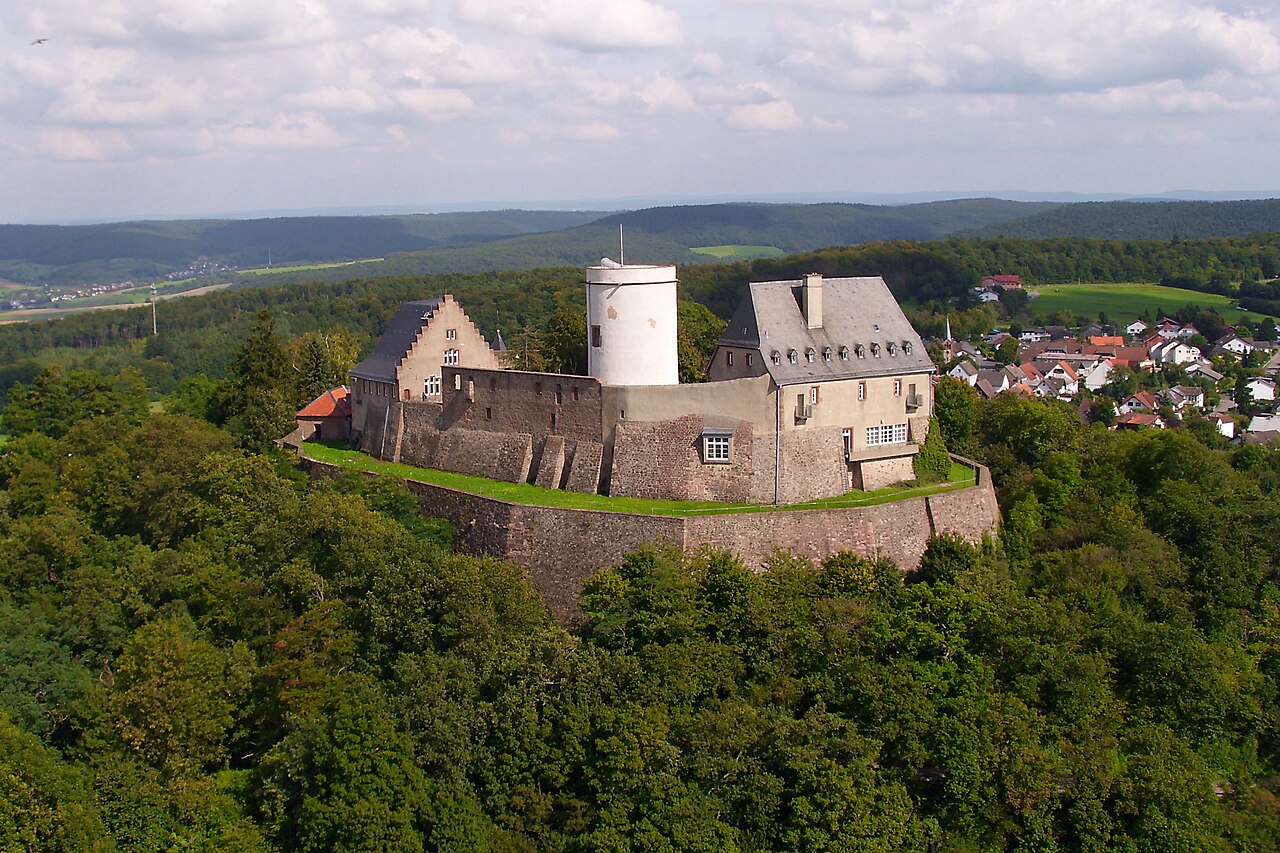
Burg Rodenstein
Burg Rodenstein stands as a significant medieval hill castle ruin nestled in the municipality of Fränkisch-Crumbach in modern-day Germany. Established in the mid-13th century, this fortress was originally constructed by the local noble families known as the Lords of Crumbach and Rodenstein. It served as both a fortified residence and a military stronghold, strategically positioned to defend against rival territories, most notably the nearby Schloss Reichenberg.
The castle's foundation, dating to around 1240, reflects the turbulent political landscape of the High Medieval period, when noble houses sought to consolidate power through fortified structures. The Counts of Katzenelnbogen, a powerful noble family, played a crucial role in supporting the castle's construction and gradually acquired ownership shares throughout the 14th and 15th centuries. After the extinction of the Katzenelnbogen lineage in 1479, their possessions, including Burg Rodenstein, transferred to the Landgraviate of Hesse, marking a shift in political control.
Architectural design and layout
Burg Rodenstein exemplifies the typical layout of a medieval hill castle designed for both defense and habitation. The castle occupies a hillside, utilizing the natural terrain for strategic advantage. Its core is roughly rectangular with rounded corners that enhance structural stability against siege warfare. The southwest side, which faces the slope, is reinforced by a shield wall, a formidable defensive barrier designed to withstand attacks from below.
The primary building materials include robust granite and finely worked sandstone sourced from the local Odenwald region. This combination of materials provided both strength and aesthetic appeal, characteristic of High Medieval fortifications in this part of Germany.
Residential and defensive structures
Within the inner castle, two main palas buildings serve as residential halls. The original palas is situated in the northern corner, while a second palas was added in the 14th century, creating a densely constructed core that reflects the castle's evolving residential needs. Notably, Burg Rodenstein lacks a bergfried, the typical principal defensive tower found in many medieval castles. Instead, the core area is enclosed by a ring wall punctuated by several smaller towers, which provided both defense and observation points.
One of the most well-preserved structures is the mill tower (Mühlturn), located on the outer edge of the castle. This tower combines stone construction on its lower levels with a timber-framed upper floor, capped by a steep, hipped roof. The presence of a chimney suggests it may have served as living quarters for the miller, indicating the castle's self-sufficiency in food production and processing.
Gates and access routes
The castle's original entrance was located on the mountain side but was later moved to the valley side, as evidenced by a bricked-up gate near the mill tower. The newer gate on the northwest became the primary entrance, accessed via a covered wooden bridge. This gate led directly to a substantial 14th-century residential building that housed the lord's apartment on the upper floor. Architectural details such as a timber-framed oriel window supported by wooden braces, multiple dormer windows, a chimney for heating, and a weather vane highlight the building's residential and aesthetic qualities.
Medieval life and castle functions
Adjacent to the lord's residence was a kitchen connected to the older palas, reflecting the daily domestic activities within the castle walls. Two small projecting oriels extending into the zwinger (an outer enclosed area designed to trap attackers) likely functioned as latrines, illustrating the integration of sanitation facilities within the defensive perimeter.
The zwinger itself, along with a palisade fence surrounding the castle grounds, suggests that the site supported agricultural activities. Historical documents from 1624 mention vineyards near the castle, indicating that farming was an integral part of the castle's economy and sustenance strategy.
Historical events and decline
Burg Rodenstein remained a robust fortress into the early 17th century, as depicted in a detailed drawing from 1634 showing a busy and fully functional castle complex. However, the outbreak of plague in 1635 had a devastating impact, claiming the life of Adam von Rodenstein and his family. Following this tragedy, the castle was abandoned and gradually fell into disrepair.
Subsequent years saw the castle's stones quarried for building materials, including for the construction of a noble estate in Fränkisch-Crumbach. Despite legal efforts by the last male heir, Georg Friedrich, to restore the property, these attempts failed to reverse the decline. Ownership later passed to the Freiherren von Gemmingen-Hornberg family before the ruins were sold to the municipality of Fränkisch-Crumbach in 2020, marking a new chapter in the site's custodianship.
Preservation and current state
Today, Burg Rodenstein is classified as a hill castle ruin with several well-preserved and partially restored structures. The castle's remains have undergone stabilization and restoration efforts during the 20th century to preserve its historic presence and architectural integrity.
At the foot of the castle lies the Rodenstein estate (Hofgut Rodenstein), a historic half-timbered building rebuilt after a fire in 1910. This estate incorporates an original sandstone inscribed with the year 1593, taken from the castle itself, symbolizing the enduring connection between the castle ruins and the local community.
Burg Rodenstein remains an important cultural heritage site, offering insights into medieval fortification architecture, noble life, and regional history in the Odenwald area. Its combination of defensive features, residential buildings, and agricultural facilities paints a comprehensive picture of a self-sustaining medieval stronghold adapted to the challenges of its time.
Frequently asked questions (FAQ)
- How do I get to Burg Rodenstein?
- Burg Rodenstein is located in Fränkisch-Crumbach, Hesse, Germany. Visitors can reach the castle by car or local public transport, followed by a short hike uphill to the ruins.
- What is the historical significance of Burg Rodenstein?
- Burg Rodenstein was built in the mid-13th century as a fortified residence and military stronghold. It played a key role in regional defense and was associated with notable noble families such as the Lords of Crumbach, Rodenstein, and the Counts of Katzenelnbogen.
- Can I visit the interior of Burg Rodenstein?
- As a partially restored ruin, Burg Rodenstein offers access to its outer walls, towers, and courtyards. However, some areas may be restricted for safety reasons, so visitors should follow posted guidelines and stay on designated paths.
- When is the best time to visit Burg Rodenstein?
- The best time to visit Burg Rodenstein is during the late spring to early autumn months when the weather is favorable for hiking and exploring the hillside ruins.
- Are there guided tours available at Burg Rodenstein?
- Currently, there are no regular guided tours at Burg Rodenstein. Visitors can explore the site independently, and local tourist information centers may provide historical background and maps.
Information
Current owner
Municipality of Fränkisch-Crumbach
Loading map...
Visitor reviews
No reviews yet. Been here? Write the first review and help other travelers!
Write the first reviewVisited this castle? Share your experience
Your review helps other travelers and adds first-hand knowledge to our encyclopedia.