Osule Castle
Osule Castle is a remarkable example of an unfinished medieval hill castle located near the village of Vitějovice in Czechia. Constructed during the reign of King Přemysl Otakar II in the 13th century, this fortress was part of a broader strategy to consolidate Bohemian territories through fortified sites. Despite its ambitious beginnings, the castle's construction was abruptly halted, leaving behind ruins that reveal much about medieval military architecture and the political turbulence of the era.
Historical context and construction
The castle's origins trace back to the reign of Přemysl Otakar II, one of Bohemia's most powerful rulers who reigned from 1253 to 1278. Known for expanding his realm and strengthening defenses, Otakar II initiated the construction of Osule Castle as a strategic stronghold. The castle was situated on a 640-meter-high hill, providing commanding views and defensive advantages typical of hill castles in medieval Europe.
Construction began in the mid-13th century but was never completed. The death of King Přemysl Otakar II around 1276 (some sources cite 1278) led to political instability, which likely caused the cessation of work. The site may have been partially dismantled deliberately during ensuing conflicts, reflecting the shifting power dynamics of Bohemia at the time.
Ownership changes and decline
Following the king's death, Osule Castle changed hands several times. In 1283, it came under the ownership of Jan of Michalovice. By 1298, a Bruno of Vitějovice was associated with the estate, indicating some continued activity, though limited. Around 1312, the property was held by three brothers—Přibík, Racek, and Vernéř—who exchanged it in 1317 with Bavor of Strakonice for the Pořešín castle.
This exchange marked the beginning of Osule's decline in strategic importance. The nearby settlement of Vitějovice and the castle lost their military relevance, leading to gradual abandonment. By 1344, when the influential Rožmberk family took possession, the castle was deliberately dismantled to prevent its future use as a military fortress.
The name "Osule" appears in historical records only from 1379 onward, by which time the castle had already fallen into ruin. There is some evidence suggesting that local rulers may have resided in a small fortified settlement south of the village church in Vitějovice, though this site has almost entirely vanished.
Architectural features and layout
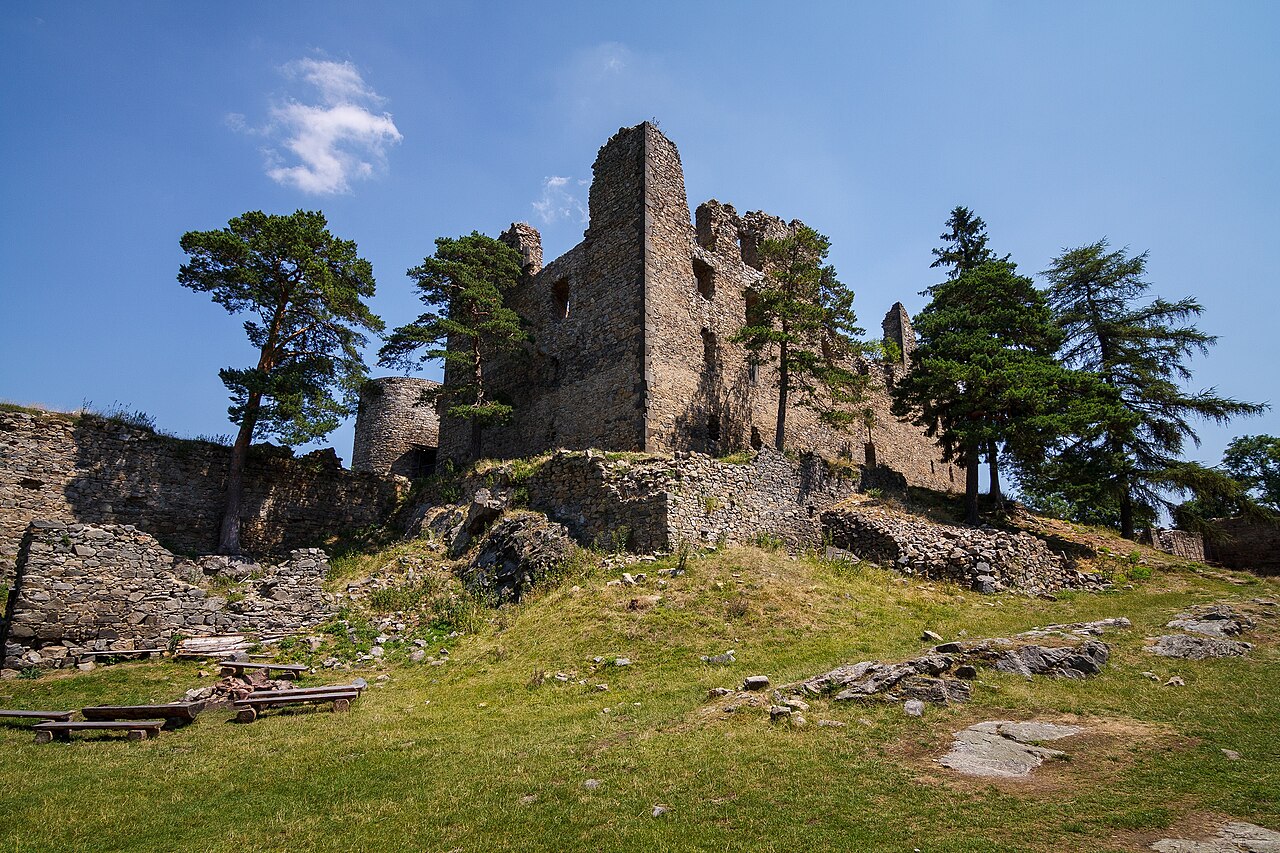
Osule Castle was constructed on a roughly rectangular plateau atop the hill, combining both defensive and residential elements typical of 13th-century Bohemian fortifications. The castle's design prominently featured two large round bergfrieds, which are free-standing stone towers serving as both defensive keeps and strongpoints.
One bergfried guarded the northern entrance, while the other projected beyond the southern outer wall near the southern palace wing. These towers were key defensive structures, designed to provide vantage points for surveillance and defense against attackers.
Behind the northern bergfried lay a smaller courtyard, an open area with no surviving foundations of buildings, suggesting it may have served as a functional space for daily activities or troop assembly. To the south of this was a larger rectangular courtyard, fully enclosed by palace wings, indicating the residential and administrative heart of the castle.
Access to the main courtyard was controlled through a passage centrally located in the northern wing, reflecting a focus on security and controlled movement within the complex. The ruins of palace walls and fragments of the bergfrieds remain visible today, offering insight into the castle's original scale and design.
Defensive structures
The two bergfrieds were the castle's principal defensive features. Their round shape was typical for the period, as it helped deflect projectiles and reduced blind spots. These towers likely contained multiple floors and served as refuges during sieges.
The castle's elevated position on Osule hill provided natural defenses, supplemented by constructed walls and gates. The northern bergfried's placement at the entrance was strategic for monitoring and controlling access, while the southern bergfried's projection beyond the wall allowed for flanking defense.
Residential and functional areas
The palace wings enclosing the southern courtyard suggest that the castle was designed to accommodate both military and residential functions. These wings likely housed living quarters, administrative rooms, and storage spaces. The presence of a sizable courtyard indicates space for gatherings, training, or other communal activities.
Later history and preservation
After its abandonment and dismantling in the mid-14th century, Osule Castle gradually fell into ruin. Unlike many castles that were rebuilt or adapted over centuries, Osule remained largely untouched, preserving its status as an unfinished medieval fortress.
Since 1963, the site has been protected as a cultural monument in the Czech Republic, recognizing its historical and architectural significance. Today, the ruins provide valuable insights into medieval castle construction practices, the political history of Bohemia, and the architectural styles of the High Middle Ages.
Archaeological significance
Archaeological studies at Osule have focused on uncovering the layout and construction techniques of the castle. The remains of the bergfrieds and palace walls are important for understanding the defensive strategies employed during the 13th century. The site also sheds light on the reasons behind the castle's abrupt abandonment and the political shifts in Bohemia following King Přemysl Otakar II's death.
Visiting the ruins
Visitors to Osule Castle can explore the ruins set amidst natural surroundings on Osule hill. The site offers a glimpse into medieval military architecture and the challenges of castle construction during turbulent times. Although the castle is in ruins, the visible remains of the bergfrieds and palace walls provide a tangible connection to Bohemia's medieval past.
Frequently asked questions (FAQ)
- How do I get to Osule Castle near Vitějovice?
- Osule Castle is located on Osule hill near the village of Vitějovice in the South Bohemian Region of Czechia. Visitors can reach the site by local roads and then follow hiking trails to the hilltop ruins.
- What is the historical significance of Osule Castle?
- Osule Castle was an unfinished 13th-century fortress built under King Přemysl Otakar II. Its abrupt abandonment reflects the political turmoil in Bohemia after the king's death and offers insights into medieval castle construction.
- Can I explore the ruins of Osule Castle?
- Yes, visitors can explore the ruins of Osule Castle, including the remains of two bergfrieds and palace walls. The site is protected as a cultural monument and accessible to the public for historical and archaeological interest.
- When was Osule Castle built and why was it never completed?
- Construction began in the 13th century during the reign of King Přemysl Otakar II but was halted after his death around 1276. The political instability that followed likely caused the abandonment and partial dismantling of the castle.
- What architectural features distinguish Osule Castle?
- Osule Castle featured two large round bergfrieds guarding its northern and southern approaches, a rectangular plateau layout, and palace wings enclosing a main courtyard, typical of 13th-century Bohemian fortifications.
Information
Loading map...
Visitor reviews
No reviews yet. Been here? Write the first review and help other travelers!
Write the first reviewVisited this castle? Share your experience
Your review helps other travelers and adds first-hand knowledge to our encyclopedia.