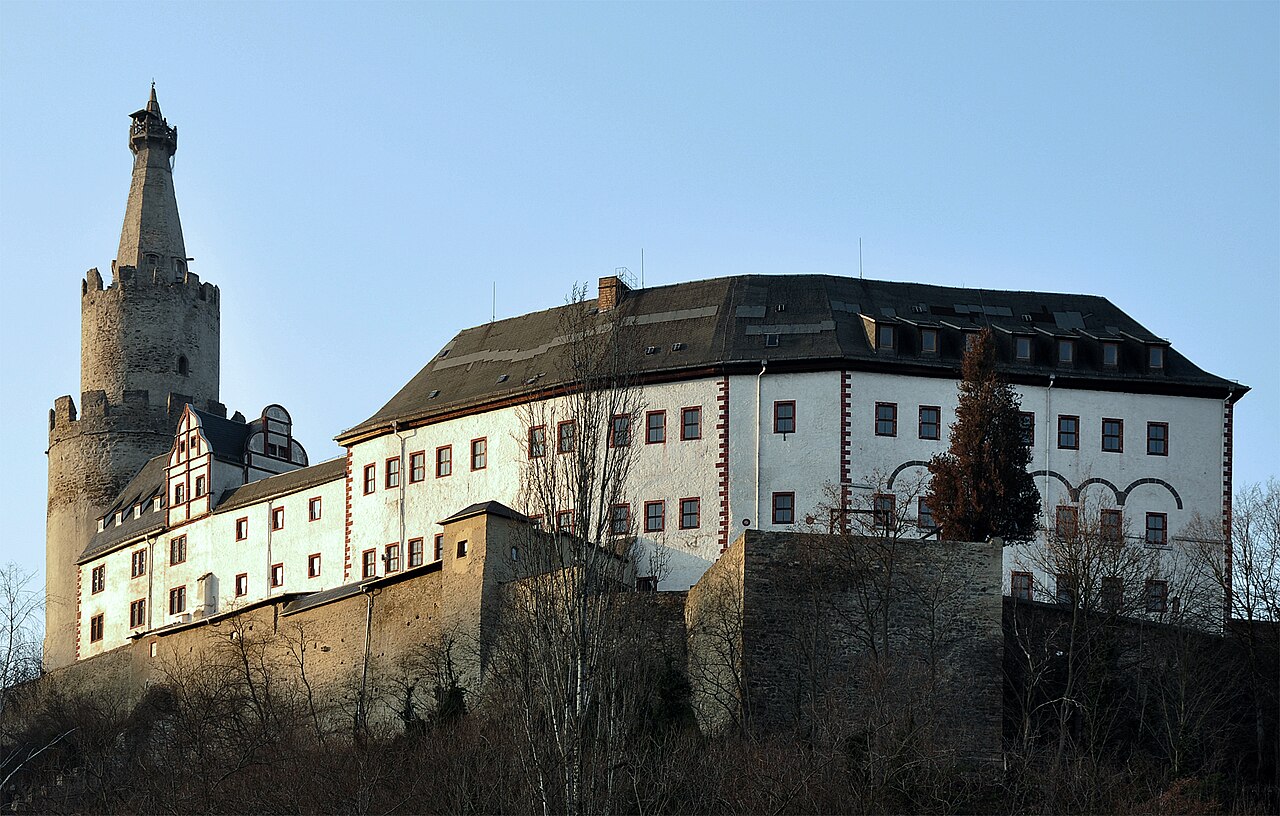
Osterburg Castle
The Osterburg Castle stands as a remarkable example of a medieval hill castle strategically situated near Henfstädt in the German region of Thuringia. Constructed likely in the early 13th century, this castle served as a fortified administrative center for the County of Henneberg. Its primary purpose was to house the seat of a vogt (bailiff) who managed the surrounding Vogteibezirk, an administrative district that evolved into what became known as the Themar district. The castle's first historical mention dates to 1268, appearing in a deed from Elgersburg, underscoring its early significance in regional governance.
Historical significance and ownership transitions
Following the division of the County of Henneberg in 1274, Osterburg came under the control of the Hartenberg branch of the counts. Despite its initial administrative importance, the castle lost its official status when the Amt (district) and the town were separated, resulting in the vogt seat moving to the nearby town of Themar. Over the subsequent two centuries, Osterburg's ownership became complex, involving pledges and sales to several noble families, including the Schwarzburgs and the Bibra family. The Bibra family, in particular, is credited with expansions and modifications to the castle, although these efforts were contested by Count Wilhelm II of Henneberg in 1439. By the mid-15th century, between 1453 and 1468, the castle was gradually reacquired by the Henneberg-Schleusingen line.
Despite these changes in ownership and attempts at maintenance, Osterburg's importance waned in the late 15th century. Records from 1496 mention the last watchman stationed at the castle, and it is believed that the site was abandoned and left open around the year 1500. Since 1977, dedicated local groups have worked to preserve the ruins, aiming to halt further deterioration and maintain the castle's historical presence in the region.
Architectural features and defensive structures
Osterburg is a spur castle positioned on the Hainberg hill at approximately 415 meters above sea level, overlooking the upper Werra valley. Its location afforded natural protection on three sides, which was enhanced by a comprehensive system of curtain walls and a moat, designed to secure the castle against attacks.
The bergfried tower
The most prominent surviving structure is the bergfried, a tall defensive tower rising about 20 meters high. Architectural details such as a round-arched entrance and rusticated ashlar masonry date the tower firmly to the early 13th century. The original entrance was located above the current doorway, a typical defensive feature to hinder attackers. The tower suffered damage from fires in 1743 and 1816 but underwent renovation in 1968, including the installation of a new interior staircase and roof. Further restoration efforts took place in 1994, with the addition of an external stairway and canopy in 1995.
Defensive towers and curtain walls
Three additional defensive towers remain at the site, each with distinct characteristics. The east tower measures 5.80 meters in diameter and stands 6.80 meters tall, featuring multiple arrow slits and evidence of at least three floors. The southeast tower, the largest, measures 5.90 meters in diameter and preserves two floors with remnants of a third. It includes a modern doorway and a small escape hole in the vaulted ceiling. The northwest tower is approximately 12 meters high without its roof and has a base diameter of 5 meters. This tower shows significant structural damage, including a large breach in the wall and near collapse of the vault due to vegetation and decay.
Parts of the eastern curtain wall collapsed in 1950 over a length of 30 meters and were buried under rubble. Near the southeast tower, remnants of the outer ring wall survive up to 8.5 meters in height. Between 2006 and 2011, volunteers cleared debris and stabilized the masonry, restoring much of the castle's original appearance and fortifications.
Inner bailey and well
Within the inner bailey, opposite the bergfried, lies a deep well that was long filled with debris. Excavations confirmed it as a well rather than a cistern, and it was likely housed in a closed structure connected to the bergfried originally. This well would have been crucial for the castle's water supply during sieges and daily life.
Castle layout and medieval inventory
A partial inventory from 1459 provides valuable insight into the castle's layout and function during the late medieval period. It lists several key components, including a chamber (Kemenate), a chapel, multiple towers, a bakehouse, and a zwinger—an outer ward or enclosed defensive area designed to trap attackers. The inventory also mentions various weapons, tools, and provisions, illustrating the castle's role as both a military stronghold and a residence.
Preservation efforts and current status
Since the late 20th century, local enthusiasts and preservation groups have actively worked to conserve the ruins of Osterburg Castle. Their efforts have included clearing debris, stabilizing masonry, and restoring key architectural elements to prevent further decay. These initiatives have helped maintain the castle's historical presence and made it accessible for visitors interested in exploring this significant medieval site in Thuringia.
Frequently asked questions (FAQ)
- How do I get to Osterburg Castle near Henfstädt?
- Osterburg Castle is located near Henfstädt in Thuringia, Germany. Visitors can reach it by car or local transport from nearby towns. It is advisable to check local maps and transportation schedules for the best route.
- What is the historical significance of Osterburg Castle?
- Osterburg Castle was built in the early 13th century as a fortified administrative center for the County of Henneberg. It served as the seat of a vogt who managed the surrounding district, playing an important role in regional governance during the medieval period.
- Can I visit the bergfried tower at Osterburg Castle?
- The bergfried tower is a prominent feature of Osterburg Castle and has undergone restoration. While the exterior is accessible and visible to visitors, access to the interior may be limited due to preservation efforts and safety concerns. Check with local authorities for visitor access details.
- When was Osterburg Castle abandoned?
- Osterburg Castle was likely abandoned around the year 1500 after losing its administrative importance and regular maintenance ceased in the late 15th century.
- Are there guided tours available at Osterburg Castle?
- Currently, there are no regular guided tours at Osterburg Castle. Visitors can explore the ruins independently, but it is recommended to consult local tourist information centers for any special events or guided visits.
Information
Website
Visit websiteSources & official resources
Verify the information above using these authoritative references.
Loading map...
Visitor reviews
No reviews yet. Been here? Write the first review and help other travelers!
Write the first reviewVisited this castle? Share your experience
Your review helps other travelers and adds first-hand knowledge to our encyclopedia.