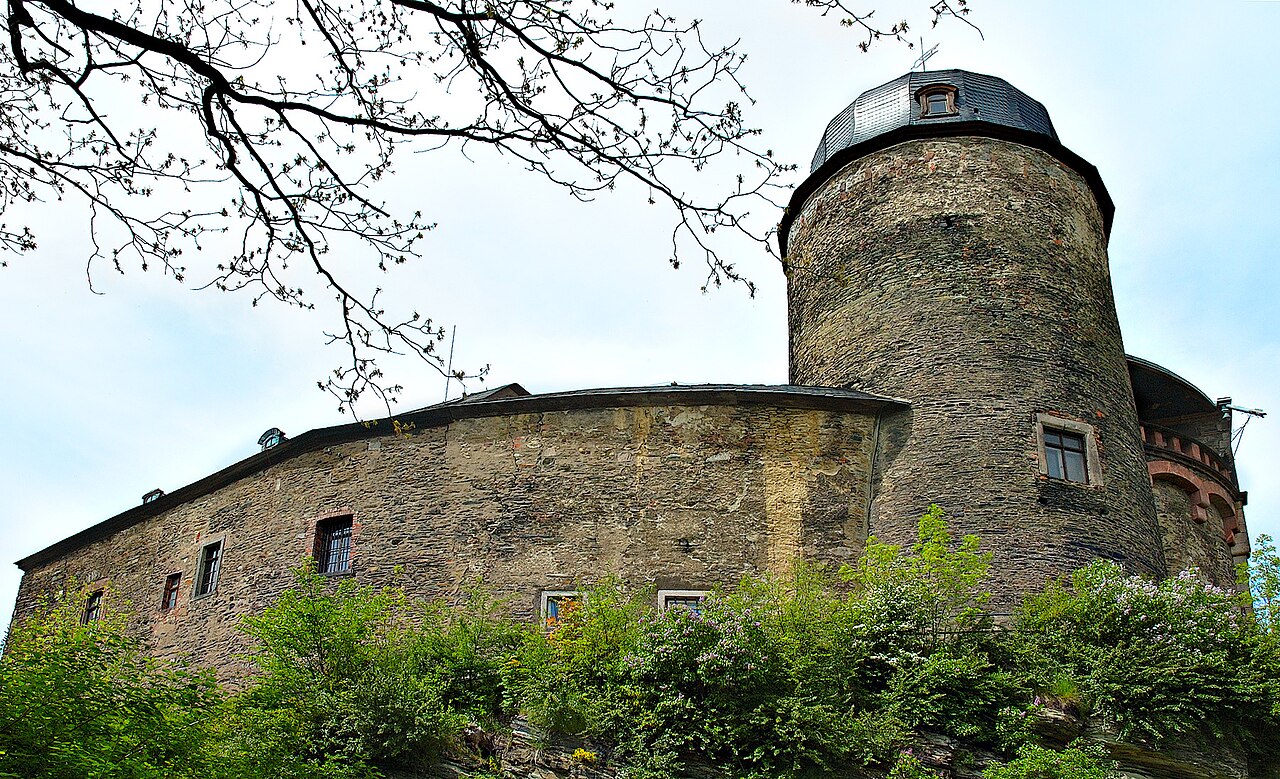
Elsterberg Castle
Elsterberg Castle stands as a prominent example of a high medieval hill castle in Saxony, Germany. Constructed between 1200 and 1225 by the influential Lords of Lobdeburg, it was one of the largest fortresses in the region, covering approximately 1.5 hectares. The castle's strategic location on a bend of the Weiße Elster river near the town of Elsterberg provided natural defenses and control over the surrounding territory.
The castle's origins trace back to an earlier fortress known as "das Alte Haus," situated about 400 meters downstream near the confluence of the Tremnitzbach and the Weiße Elster rivers. This older stronghold served as the initial seat of power for the Lords of Lobdeburg before they commissioned the construction of the new, larger complex. Local legend intriguingly suggests that the two castles were connected by underground passages and a unique leather bridge (Leiterbrücke), highlighting the strategic importance of maintaining communication and movement between the sites.
Architectural features and defensive structures
Elsterberg Castle was fortified with a double ring wall of considerable thickness, designed to withstand sieges and attacks. The walls enclosed the entire complex, which included several watchtowers—originally five in number, with three still standing in good condition today. These towers provided vantage points for surveillance and defense against invaders.
The castle's main building featured a wide vaulted knight's hall, an impressive space characterized by robust stone arches supporting the roof. Access to this hall was via an external staircase, a typical medieval design element allowing controlled entry. This hall would have served as a center for gatherings, feasts, and administrative functions.
A critical feature of the castle was its deep well, uncovered during excavations in 1932. Reportedly about 26 meters deep, this well ensured a reliable water supply, essential for sustaining the castle's inhabitants during prolonged sieges or dry periods.
Historical context and ownership
The castle's history is closely tied to the regional power dynamics of medieval Saxony. The Lords of Lobdeburg are documented as the original builders and lords of the castle, with records from the 1349/1350 fief book of Frederick the Strict confirming their continued possession. During the Vogtland War of 1354, the castle was destroyed but was subsequently rebuilt by 1366, underscoring its strategic and symbolic importance.
In 1395, the castle passed into the hands of the Margraves of Meissen, a powerful noble family in the region. Shortly thereafter, in 1402, it was pledged to the von Wolframsdorf family. By 1437, ownership transferred to the von Bünau family, who maintained control until selling the castle and the adjacent town to Carol Bose in 1636.
After 1698, the castle was abandoned by its owners and fell into gradual disrepair. The municipality of Elsterberg acquired the site in 1909 and has since undertaken efforts to preserve and maintain the ruins.
Current state and cultural significance
Today, Elsterberg Castle exists as a well-preserved ruin that offers visitors a glimpse into medieval fortification architecture. The surviving round towers have been stabilized, with one housing the local history museum known as the Heimatstube. The castle's vaulted cellars have been renovated and are used for community events, maintaining a living connection to the site's historical functions.
The castle grounds remain freely accessible, inviting exploration of the double ring walls, watchtowers, and remnants of the knight's hall. Its location near the old town of Elsterberg and along the Weiße Elster river enhances its picturesque setting and historical ambiance.
Elsterberg Castle's layered history, from its early medieval origins to its role in regional conflicts and noble ownership, coupled with its impressive architectural features, make it a significant cultural landmark in Saxony. The legends of hidden tunnels and bridges add an element of mystery and intrigue, enriching the visitor experience.
Visiting elsterberg castle
The castle is open to the public year-round, with no entrance fee, allowing visitors to freely explore the ruins and enjoy the scenic surroundings. The Heimatstube museum offers insights into the local history and the castle's past, while the renovated cellars host annual festivals and cultural events, fostering community engagement and heritage preservation.
Visitors interested in medieval architecture, Saxon history, or scenic river landscapes will find Elsterberg Castle a rewarding destination. Its well-preserved towers and halls provide tangible connections to the region's high medieval period and the noble families who shaped its history.
Frequently asked questions (FAQ)
- How do I get to Elsterberg Castle?
- Elsterberg Castle is located in the town of Elsterberg, Saxony, Germany. It is accessible by local roads and is near the old town center, making it convenient for visitors traveling by car or public transport.
- What are the opening hours for Elsterberg Castle?
- The castle grounds are freely accessible to the public year-round with no official opening hours, allowing visitors to explore the ruins at their leisure.
- Is there an entrance fee to visit Elsterberg Castle?
- There is no entrance fee to visit Elsterberg Castle. The castle grounds and the Heimatstube museum in one of the towers are open to visitors free of charge.
- What can I see at Elsterberg Castle?
- Visitors can explore the extensive ruins including the double ring walls, three well-preserved watchtowers, the vaulted knight's hall, and the deep castle well. The Heimatstube museum provides historical exhibits about the castle and local area.
- Can I attend events at Elsterberg Castle?
- Yes, the renovated vaulted cellars of the castle are used annually for local festivals and cultural events, offering a unique historical setting for community gatherings.
Information
Loading map...
Visitor reviews
No reviews yet. Been here? Write the first review and help other travelers!
Write the first reviewVisited this castle? Share your experience
Your review helps other travelers and adds first-hand knowledge to our encyclopedia.