Oscarsborg Fortress
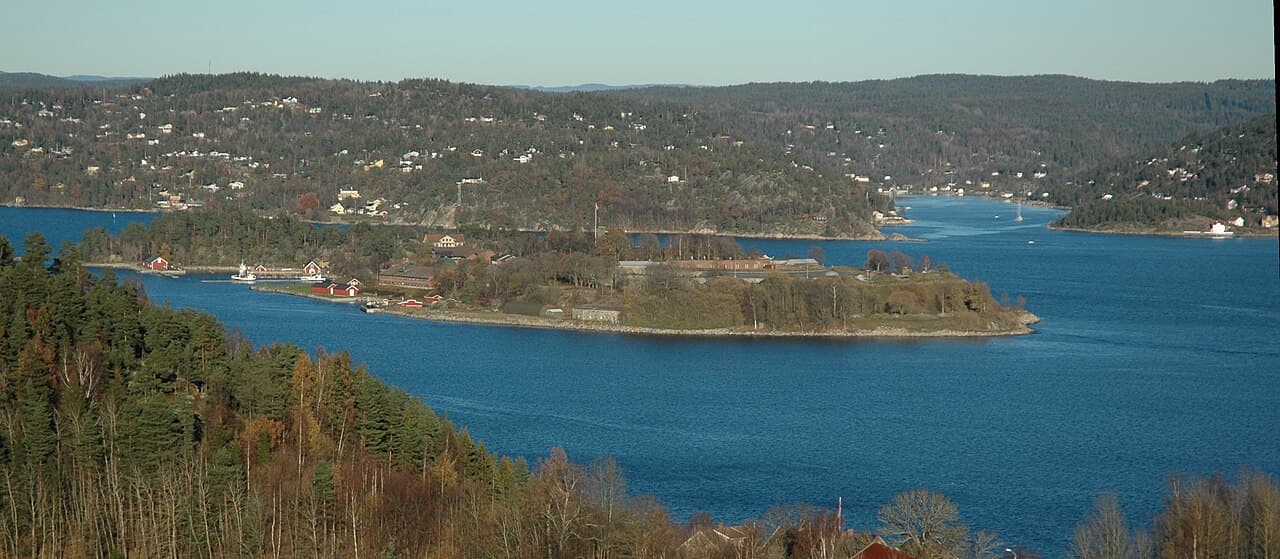
Oscarsborg Fortress, located in the Oslofjord near the town of Drøbak in Akershus County, Norway, is a historically significant bastioned coastal fortress known for its strategic role in the defense of Oslo. The fortress occupies two small islets, Nordre Kaholmen and Søndre Kaholmen, with additional artillery batteries on the nearby island of Håøya and smaller installations on the mainland. Its position at the narrow Drøbaksundet strait made it a critical point for naval defense since the early 17th century.
Early fortifications and construction history
The first fortifications at the Drøbak narrows were commissioned during the reign of Christian IV of Denmark and Norway and completed in 1644. These initial defenses were part of Norway's efforts to control access to the capital, Oslo, but saw no action during the Hannibal War. Following this conflict, the fortifications were dismantled, only to be briefly reactivated during the 1814 war with Sweden.
By the 1830s, the need for a modernized defense system at Drøbaksundet was recognized due to evolving military technology and geopolitical tensions. Construction of a renewed fortress began in 1846 and was completed in stages, with the first phase finished in 1848 and the second in 1853. The fortress was officially named Oscarsborg on 23 August 1855 by royal decree following a visit from King Oscar I of Sweden-Norway.
Architectural features and armaments
Oscarsborg Fortress exemplifies a bastioned fortress design, characterized by angled bastions that provide overlapping fields of fire, enhancing its defensive capabilities. The fortress's main artillery was housed primarily on the islets, with the largest guns located on Nordre Kaholmen.
By the late 19th century, rapid advancements in military technology rendered the original armaments obsolete. In response, the fortress underwent significant upgrades beginning in the 1890s. This included the installation of German-made Krupp 28 cm caliber guns, which became the fortress's main armament. Additionally, an underwater barrier was constructed between 1874 and 1879, stretching from Kaholmen to Hurum on the fjord's western side, effectively preventing large vessels from bypassing the fortress.
One of the fortress's most unique features is its underwater torpedo battery, built between 1898 and 1901. This facility, housed within a concrete structure mined into the rock of North Kaholmen, was designed to launch torpedoes below the waterline, a rare and advanced defensive installation for its time. The torpedo battery remained a secret from German intelligence until the invasion of Norway in 1940.
Role in world war ii and military significance
On 9 April 1940, during the German invasion of Norway, Oscarsborg Fortress played a pivotal role in the defense of Oslo. Despite its armaments being over 40 years old and of German manufacture, the fortress's guns and torpedo battery functioned flawlessly. The fortress successfully sank the German heavy cruiser Blücher, which was part of the naval force aiming to capture Oslo and the Norwegian government. This action delayed the German advance long enough to allow the Norwegian King and government to escape capture.
Following the end of German occupation, Oscarsborg was returned to Norwegian control on 12 May 1945. Captain Thorleif Unneberg took command and raised the Norwegian flag, marking the end of German military presence at the fortress.
Post-war use and preservation
During the Cold War, Oscarsborg Fortress continued to serve as a defensive installation, maintaining its role as a last line of defense for Oslo. The underwater torpedo battery remained operational and was modernized in the 1980s, staying active until 1 January 1993. After the deactivation of its weapons systems, the fortress's military function was limited to hosting the Coastal Artillery officer training program, which was officially closed in 2002.
Since 2003, Oscarsborg Fortress has been open to the public as a museum and resort, offering visitors a chance to explore its historic grounds and enjoy the scenic surroundings. The fortress is accessible by a short motor launch from Drøbak and hosts conferences and excursions. In 2014, it was granted protected status, ensuring its preservation as a cultural heritage site.
Architectural and cultural significance
Oscarsborg Fortress stands as a prime example of 19th-century bastioned fortress architecture adapted to coastal defense. Its combination of traditional artillery batteries, underwater defenses, and innovative torpedo facilities reflects the evolution of military engineering through the 19th and 20th centuries. The fortress's role in the dramatic events of World War II adds to its historical importance, making it a significant site for understanding Norway's military history and coastal defense strategies.
Today, Oscarsborg Fortress is valued not only for its military heritage but also as a cultural landmark and tourist destination, preserving the memory of Norway's resilience and strategic defense efforts.
Frequently asked questions (FAQ)
- How do I get to Oscarsborg Fortress from Drøbak?
- Visitors can reach Oscarsborg Fortress by a short motor launch trip departing regularly from the town of Drøbak, providing convenient access to the islets.
- What is the historical significance of Oscarsborg Fortress in World War II?
- Oscarsborg Fortress played a crucial role during the German invasion of Norway in 1940 by sinking the German heavy cruiser Blücher, delaying the capture of Oslo and allowing the Norwegian government to escape.
- Can I visit the underwater torpedo battery at Oscarsborg Fortress?
- Yes, the underwater torpedo battery is part of the fortress museum and can be toured by visitors, showcasing one of the few such installations in Norway and its unique military engineering.
- When was Oscarsborg Fortress built and by whom?
- The fortress was constructed between 1846 and 1855, named after King Oscar I of Sweden-Norway following his visit in 1855.
- What are the opening hours and ticket prices for visiting Oscarsborg Fortress?
- Oscarsborg Fortress is open daily from 10:00 to 17:00. Ticket prices are approximately €10 for adults and €5 for children.
Photo gallery

Information
Opening hours
10:00-17:00, daily
Ticket prices
€10 adult, €5 child
Current owner
Municipality
Website
Visit websiteSources & official resources
Verify the information above using these authoritative references.
Loading map...
Visitor reviews
No reviews yet. Been here? Write the first review and help other travelers!
Write the first reviewVisited this castle? Share your experience
Your review helps other travelers and adds first-hand knowledge to our encyclopedia.