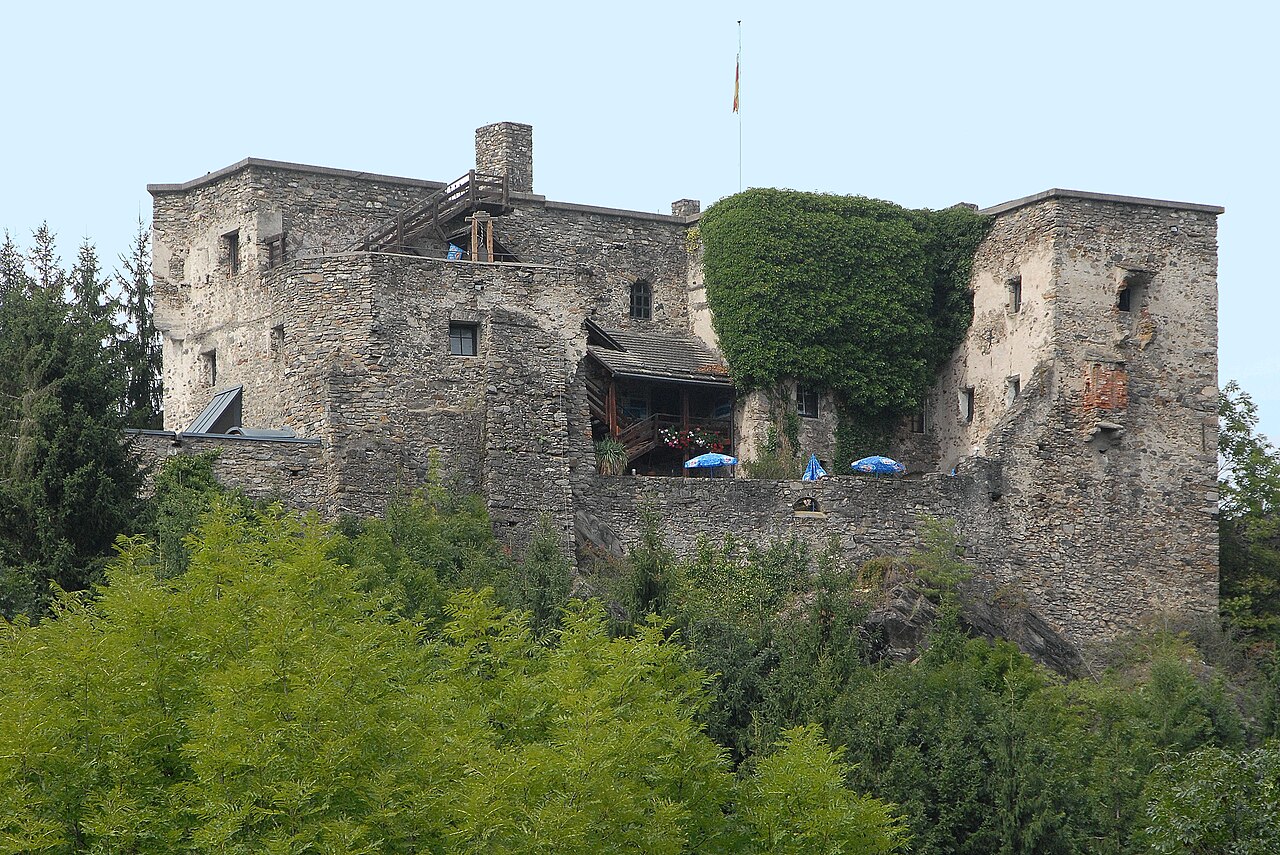
Ortenburg Castle Ruins
Ortenburg castle ruins stand as a significant historical site on the northern slope of the Gailtal Alps, overlooking the Drava valley in Baldramsdorf, Austria. Built in the late 11th century, this high medieval fortress was established by the ministeriales of the Bavarian Prince-Bishops of Freising, who controlled extensive lands within the Duchy of Carinthia. The castle became the ancestral seat of the noble family who took the name Counts of Ortenburg.
Historical origins and early significance
The construction of Ortenburg castle was part of the strategic efforts by the Prince-Bishops of Freising to consolidate their power in Carinthia during the high medieval period. The ministeriales, a class of unfree knights serving ecclesiastical lords, were granted authority to build and manage the fortress. The castle's location on a steep hillside provided a commanding view of the surrounding landscape, crucial for defense and control over the Drava valley trade routes.
Architectural features and layout
The castle complex originally featured typical high medieval fortification elements including a keep (donjon), curtain walls, and defensive towers. The stone masonry construction utilized local materials, with thick walls designed to withstand sieges and natural disasters. The layout included a central courtyard surrounded by residential and service buildings, with battlements and arrow slits for archers. The steep northern slope contributed to the castle's natural defenses, augmented by man-made fortifications.
Defensive structures
The castle's curtain walls were reinforced with towers at key points to provide overlapping fields of fire. The main gate was likely protected by a gatehouse and possibly a drawbridge, though specific details are scarce due to the ruinous state. A moat or ditch may have been present on the more accessible sides to deter attackers.
Impact of the 1348 Friuli earthquake
In 1348, the Friuli earthquake caused significant damage to Ortenburg castle, compromising its structural integrity. The earthquake was a major seismic event affecting large parts of the Eastern Alps and northern Italy. Following this natural disaster, the castle's military and administrative importance declined, as repairs were costly and the region's political landscape shifted.
Decline and change of ownership
The extinction of the Ortenburg family line in 1418 marked a turning point for the castle. The estates passed to Count Hermann II of Celje, a powerful noble who expanded his influence in Carinthia and surrounding territories. Later, in 1456, the castle and its lands were seized by the Imperial House of Habsburg, integrating the property into their growing domains.
By 1524, the comital title associated with Ortenburg was transferred to Gabriel von Salamanca, a prominent statesman and financier of the Habsburg court. Gabriel commissioned the construction of Porcia castle in the nearby town of Spittal an der Drau, which became his principal residence, signaling the final decline of Ortenburg castle as a noble seat.
Current condition and cultural significance
Today, the Ortenburg castle ruins are classified as archaeological ruins. Visitors can explore the remains of the castle's walls, foundations, and defensive structures, which offer insights into high medieval castle architecture and the feudal history of Carinthia. The site is valued for its scenic views and historical context, attracting those interested in medieval fortifications and Austrian heritage.
Access and preservation efforts
The ruins are accessible to the public, though no modern restoration has returned the castle to a fully preserved state. Preservation efforts focus on stabilizing the remaining structures to prevent further decay. Interpretive signage and guided tours help contextualize the castle's history for visitors.
Frequently asked questions (FAQ)
- How do I get to Ortenburg castle ruins in Baldramsdorf?
- Ortenburg castle ruins are located on the northern slope of the Gailtal Alps near Baldramsdorf, Austria. Visitors can reach the site by car or local transport, followed by a hike up the hillside to the ruins.
- What is the historical significance of Ortenburg castle?
- Ortenburg castle was a key stronghold of the Bavarian Prince-Bishops of Freising in Carinthia during the high medieval period. It served as the ancestral seat of the Counts of Ortenburg and played a role in regional power dynamics until the 15th century.
- Can I explore the ruins of Ortenburg castle?
- Yes, the castle ruins are open to the public and provide an opportunity to see the remains of medieval fortifications and enjoy panoramic views of the Drava valley and surrounding Alps.
- When was Ortenburg castle built?
- Ortenburg castle was built in the late 11th century by ministeriales of the Bavarian Prince-Bishops of Freising.
- Why did Ortenburg castle lose its importance?
- The castle was heavily damaged by the 1348 Friuli earthquake, and its significance declined after the extinction of the Ortenburg family in 1418 and subsequent changes in ownership.
Information
Loading map...
Visitor reviews
No reviews yet. Been here? Write the first review and help other travelers!
Write the first reviewVisited this castle? Share your experience
Your review helps other travelers and adds first-hand knowledge to our encyclopedia.