Burg Sommeregg
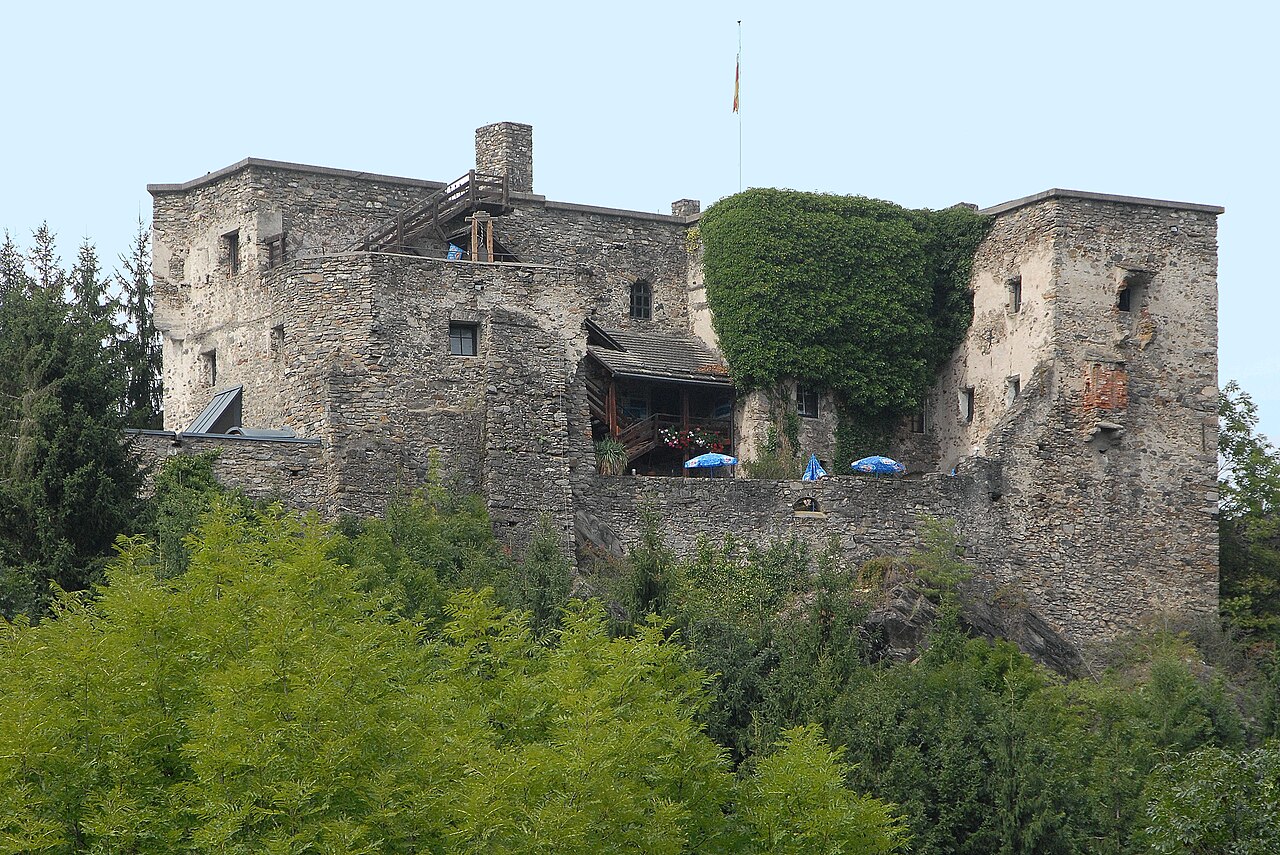
Burg Sommeregg is a striking medieval hill castle located near Seeboden in the Austrian state of Carinthia. Perched at an altitude of 749 meters in the foothills of the Nock Mountains, it commands a strategic position overlooking the surrounding landscape. The castle's origins trace back to the 12th century, making it a significant example of High Medieval fortification architecture in the region.
The castle was initially constructed by local nobility serving under the powerful Counts of Ortenburg, who controlled extensive estates in Upper Carinthia. Throughout its history, Burg Sommeregg functioned as an administrative seat and residence for various noble families, including the von Graben and Khevenhüller dynasties. These families were ministeriales—knightly officials appointed by the Austrian House of Habsburg—entrusted with military defense and estate management duties.
Historic significance and noble lineage
The earliest documentary mention of the castle dates to 1187, referencing a noble named Witemarus de Sumereke. This establishes the castle's status as a seat of local power during the High Medieval period. In 1275, the castle gained regional prominence when it hosted the marriage contract between Euphemia of Ortenburg-Hardegg and Count Albert I of Gorizia, underscoring its role in noble alliances and diplomacy.
Following the extinction of the Ortenburg family line in 1418, ownership of the castle passed to the Counts of Celje. They delegated stewardship to local noble families such as the von Hallegg and von Graben. In 1442, Andreas von Graben married Barbara von Hallegg and secured the castle's burgraviate as a hereditary fief from Count Frederick II of Celje. This event marked the establishment of the Sommeregg district court's independence from Ortenburg authority.
After the assassination of the last Celje count in 1456, the Habsburg dynasty inherited the Ortenburg lands, including Burg Sommeregg. The von Graben family maintained their feudal rights under Habsburg rule, with Virgil von Graben succeeding Andreas in 1463. The castle's strategic importance was highlighted during the Hungarian-Habsburg conflicts, when in 1487, forces led by King Matthias Corvinus captured and destroyed the fortress.
Architectural evolution and reconstruction
The destruction in 1487 necessitated significant reconstruction under Virgil von Graben. The rebuilding process resulted in an irregular ground plan that reflects adaptations to the terrain and evolving defensive needs. The castle exemplifies typical features of a hill castle in the Millstätter Berge region, positioned prominently on a hilltop above the village of Schloßau.
Today, only one original round tower from the medieval structure remains intact, serving as a visual reminder of the castle's fortified past. The rest of the castle has undergone various modifications through the centuries, blending medieval elements with later architectural influences.
Layout and defensive features
The castle's layout includes terraced lower floors and courtyards adapted to the hillside. Defensive structures such as stone walls, battlements, and strategically placed towers contributed to its resilience against sieges. The irregular shape of the fortress is a result of the reconstruction efforts post-1487 and the need to maximize natural topography for defense.
Ownership transitions and social history
After the von Graben male line ended, the lordship passed through heiress Rosina von Graben von Rain to the Bavarian Lords of Rain zu Sommeregg in the early 16th century. In 1550, the estate was acquired by Christoph Khevenhüller, whose family held it until 1628. Subsequently, the property changed hands several times, including ownership by the merchant Hans Wittmann.
In 1651, Countess Katharina von Lodron took possession of the castle, marking its transition from feudal tenure to private ownership. The Lodron family maintained the estate until 1932. The 1848 peasant emancipation ended the castle's manorial functions, leading to a gradual decline in its administrative importance.
Modern use and preservation
Despite periods of decline and damage from storms in the 1930s, Burg Sommeregg remained inhabited. Restoration efforts commenced in 1969 to preserve the castle's structural integrity and historical character. Today, the castle serves multiple functions that blend heritage tourism with cultural education.
Torture museum and visitor experience
The castle's upper floor houses a renowned torture museum featuring approximately 70 historically accurate replicas of medieval and Inquisition-era instruments. Exhibits include thumbscrews, stretching racks, Spanish boots, nail chairs, and pillories. This collection is among the largest of its kind in Central Europe, attracting visitors interested in medieval justice and penal history.
The lower floors and terraces have been adapted to accommodate a restaurant, providing a unique dining experience within the historic setting. An external wooden staircase leads visitors to the castle roof, which serves as a viewing platform. From this vantage point, panoramic views extend across the Dobratsch and Karawanks mountain ranges on clear days, enhancing the visitor experience with breathtaking natural scenery.
Strategic location and territorial oversight
Burg Sommeregg's location was chosen for its commanding oversight of a lordship territory naturally bounded by the Millstätter See, Seebach, Lieser, Pleßnitzgraben, Tschiernock, and Tangerner Bach. The castle's design and positioning reflect its historical role as a fortified administrative center controlling these lands.
Its enduring presence offers valuable insight into the medieval feudal system and the architectural adaptations necessary for defense in a mountainous environment. The castle stands today as a well-preserved cultural monument that combines medieval heritage with modern tourist amenities.
Frequently asked questions (FAQ)
- How do I get to Burg Sommeregg?
- Burg Sommeregg is located near Seeboden in Carinthia, Austria. It is accessible by car via local roads from Seeboden, with parking available nearby. Public transportation options include regional buses that connect to Seeboden, from where the castle is a short taxi or walk.
- What can I see at Burg Sommeregg?
- Visitors can explore the castle's medieval architecture, enjoy panoramic views from the roof terrace, and visit the extensive torture museum featuring replicas of medieval instruments. The castle also houses a restaurant offering local cuisine in a historic setting.
- When was Burg Sommeregg built?
- Burg Sommeregg was originally constructed in the 12th century during the High Medieval period. It has undergone various reconstructions, especially after destruction in 1487, which shaped its current irregular layout.
- Is Burg Sommeregg accessible for visitors with mobility issues?
- The castle's hilltop location and historic structure may present challenges for visitors with mobility issues. Some areas, including the roof terrace accessed by an external wooden staircase, may not be fully accessible. Visitors are advised to check accessibility details before planning their visit.
- What are the opening hours and ticket prices?
- Opening hours and ticket prices for Burg Sommeregg vary seasonally. It is recommended to check the official website or contact the castle directly for the most up-to-date visitor information.
Information
Sources & official resources
Verify the information above using these authoritative references.
Loading map...
Visitor reviews
No reviews yet. Been here? Write the first review and help other travelers!
Write the first reviewVisited this castle? Share your experience
Your review helps other travelers and adds first-hand knowledge to our encyclopedia.