
Ortenbourg Castle
Ortenbourg Castle, also known as Château de l'Ortenbourg or Burg Ortenberg, is a remarkable medieval fortress located west of the village of Scherwiller in the Bas-Rhin department of France. Nestled in the region historically referred to as Northern Alsace or the Middle Vosges, this hill castle stands prominently on a granite peak of the Rittersberg mountain at an altitude of 443 meters. Its strategic position commands the entrance to the Lièpvre valley and offers clear views of the famous Haut-Kœnigsbourg Castle, another iconic Alsatian stronghold.
The castle's origins trace back to the mid-13th century, with construction dated between 1260 and 1265. It was built by Rudolf of Habsburg on the site of an older fortification, marking a significant phase of expansion and architectural development. The castle features a distinctive pentagonal keep approximately 35 meters high, comprising five floors. This keep is encircled by a high curtain wall equipped with numerous niched loopholes designed for archers and crossbowmen, reflecting the military innovations of the late medieval period.
Architectural features and defensive structures
The pentagonal design of the keep was a sophisticated military architectural choice, allowing for better deflection of projectiles and enhanced defense against sieges. The keep's six levels of defensive fire positions made it a formidable stronghold. Surrounding the keep is a massive shield wall approximately 17 meters high, constructed with five defensive tiers. The lower three levels contain tall arrow slits, while the fourth level features a wooden gallery or hoardings, enabling defenders to observe and repel attackers effectively. The uppermost level is crenellated, providing an additional fighting platform.
Adjacent to the keep lies a two-story residential building characterized by early Gothic windows with tracery, indicating the castle's role not only as a military fortress but also as a noble residence. A large cistern situated between the keep and the living quarters ensured a reliable water supply during prolonged sieges. The castle is further protected by a deep neck ditch separating it from the neighboring Ritterberg massif, adding an extra layer of defense.
Historical context and ownership
The castle's history is closely intertwined with the regional power struggles of medieval Alsace. Initially linked to the Ortenberg family in the 10th and 11th centuries, the castle passed to the Hohenberg family in the early 12th century before coming under Habsburg control through Rudolf of Habsburg's marriage and subsequent rebuilding efforts around 1265. The fortress served as the administrative center for the royal Habsburg family's Alsatian properties, with Otto d'Ochsenstein acting as bailiff.
In 1293, the castle was besieged by Otto IV of Ochsenstein, who, operating from the nearby Ramstein Castle, forced its surrender after a three-week siege. This event underscored the castle's strategic importance and the intense regional conflicts involving the Habsburgs and local nobles. Financial difficulties later compelled the Habsburgs to sell Ortenbourg to the Müllenheim family in 1314.
The castle suffered damage during the 1374 campaign led by Jean I of Lorraine and was occupied by outlawed knights in the 15th century until recaptured by Pierre de Hagenbach in 1470. Strasbourg forces reclaimed it in 1474, after which the castle was restored in collaboration with its owners and the town authorities.
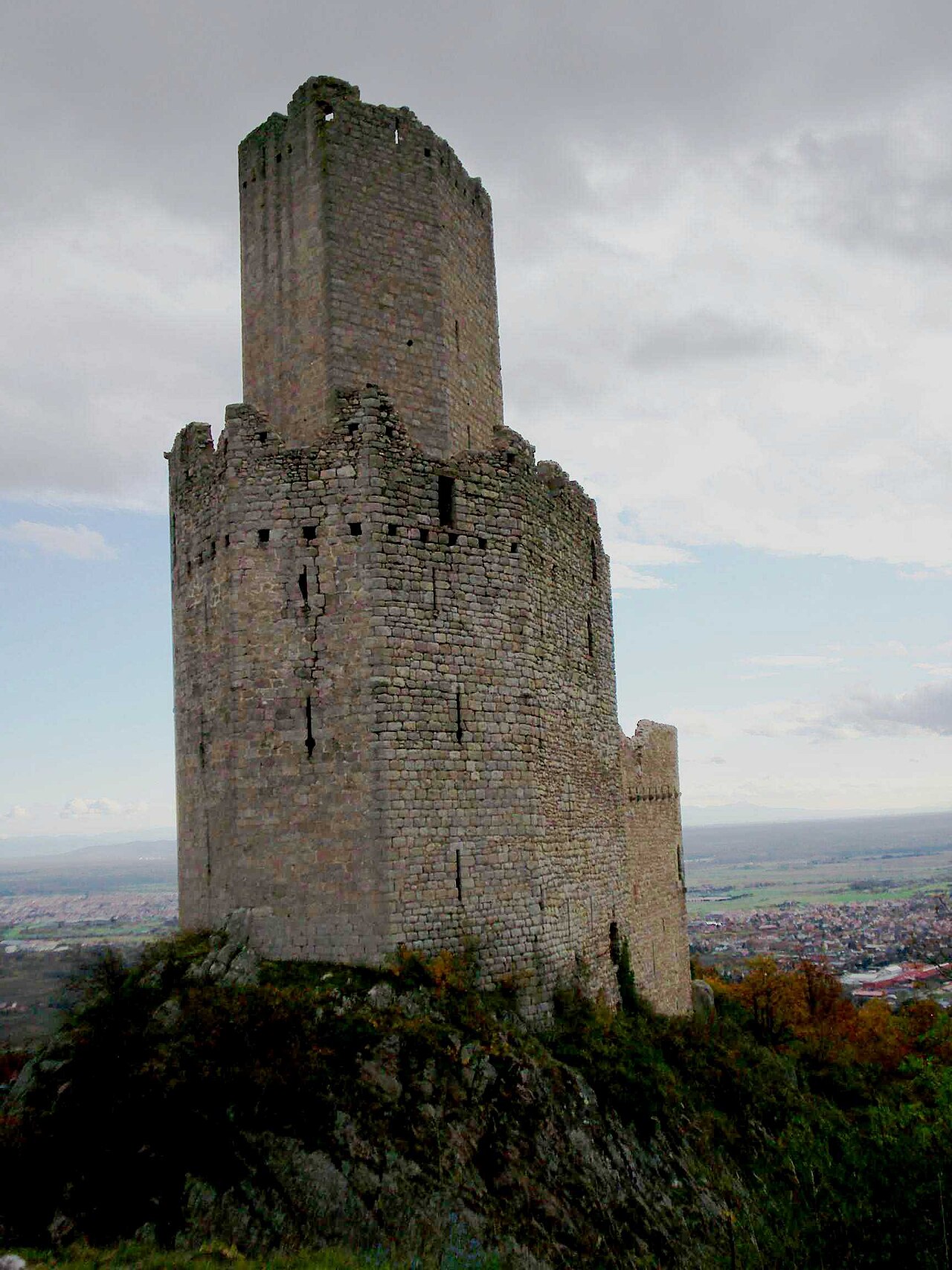
Photo by Dsch67, edited by Ahandrich • CC BY-SA 3.0
Decline and destruction
From the 16th century onward, Ortenbourg Castle began to decline due to neglect and changing military technologies. Despite continued habitation into the early 17th century, the castle's strategic relevance diminished. In 1633, during the Thirty Years' War, Swedish forces set fire to the castle, causing significant destruction and accelerating its abandonment.
Ownership passed through several noble families, including the Bollwiller and Choiseul families, until the upheavals of the French Revolution. Restoration efforts commenced in the 19th century under Baron Philippe-Gaétan Mathieu de Faviers and were later supported by local preservation groups from 1966 onward. The castle has been officially protected as a historic monument since 1923, with formal classification in 1924.
Current condition and visitor experience
Today, Ortenbourg Castle remains a well-preserved ruin and a masterpiece of military architecture. Its imposing pentagonal keep and shield wall are visible from a distance, harmoniously integrated into the surrounding landscape of oak forests and thermophilic plant species. Visitors can access the site via marked hiking trails, though the ascent is steep and demanding, requiring approximately an hour's uphill walk.
The castle's layout and surviving structures offer valuable insights into medieval defensive design and residential arrangements. The presence of armaments such as crossbows, artillery pieces, and culverins recorded in 15th-century documents attests to its military significance. Additionally, records of livestock and food supplies from 1471 reveal aspects of domestic life within the fortress.
Ortenbourg Castle stands as a testament to the turbulent history of Alsace, reflecting centuries of feudal power struggles, architectural innovation, and cultural heritage. It remains a must-see destination for enthusiasts of medieval history and castle architecture.
Frequently asked questions (FAQ)
- How do I get to Ortenbourg Castle?
- Ortenbourg Castle is accessible via marked hiking trails from the village of Scherwiller. The walk is steep and takes about an hour, so visitors should wear suitable footwear and be prepared for a strenuous uphill climb.
- What is the historical significance of Ortenbourg Castle?
- Ortenbourg Castle was built in the 13th century by Rudolf of Habsburg and played a key role in regional conflicts involving the Habsburgs, local nobles, and later during the Thirty Years' War. Its military architecture and strategic location highlight its importance in medieval Alsace.
- Can I explore the interior of Ortenbourg Castle?
- As a ruin, Ortenbourg Castle's interior is partially accessible, with remains of the pentagonal keep, curtain walls, and residential buildings. Visitors can explore the site but should exercise caution due to uneven terrain and limited facilities.
- When is the best time to visit Ortenbourg Castle?
- The best time to visit Ortenbourg Castle is during late spring to early autumn when the weather is favorable for hiking and the surrounding vegetation is lush. Winter visits are possible but may be challenging due to weather conditions.
- Are there any guided tours available at Ortenbourg Castle?
- Guided tours are occasionally offered by local heritage organizations or the municipality. Visitors should check in advance for availability and schedules, especially during peak tourist seasons.
Photo gallery

Information
Sources & official resources
Verify the information above using these authoritative references.
Loading map...
Visitor reviews
No reviews yet. Been here? Write the first review and help other travelers!
Write the first reviewVisited this castle? Share your experience
Your review helps other travelers and adds first-hand knowledge to our encyclopedia.