
Bernstein Castle
Bernstein Castle, also known as Château du Bernstein or Burg Bernstein, is a remarkable medieval fortress located near the village of Dambach-la-Ville in the Bas-Rhin department of Alsace, France. Perched atop a granite rocky outcrop at an altitude of approximately 562 meters, this hill castle offers commanding views over the surrounding landscapes of the Northern Alsace and the Middle Vosges. It stands as one of the oldest castles in the region, with origins dating back to the early 11th century, making it a significant cultural and historical monument.
The castle's earliest known mention appears between 1163 and 1179, linked to a lord named Thietmar of Bernstein. Initially constructed likely from wood, the fortress was rebuilt in stone following destruction at the end of the 12th century. It was originally the possession of the Counts of Eguisheim-Dabo, a powerful noble family in Alsace. The castle later passed through inheritance and conflict to the Bishopric of Strasbourg after a siege in 1227, becoming the seat of episcopal bailiffs until its abandonment in the late 16th century.
Historical significance and ownership
The history of Bernstein Castle is intertwined with the feudal and ecclesiastical power struggles of medieval Alsace. The castle was a strategic stronghold for the Counts of Eguisheim-Dabo, notably housing prominent figures such as Heilwige, mother of Pope Leo IX, during times of conflict in the early 11th century. The fortress was damaged during military campaigns led by Philip of Swabia around the late 12th century, prompting the reconstruction of the stone castle that forms much of the ruins visible today.
Following the death of Gertrude of Eguisheim-Dabo in 1225 without heirs, the castle became the subject of disputes that ended with its capture by the Bishop of Strasbourg in 1227. Emperor Frederick II officially granted the castle to the bishopric in 1236, cementing its role as an episcopal administrative center. It served as the residence for bishops such as Jean de Lichtenberg and Lambert de Burne during the 14th century.
The castle also witnessed episodes of conflict during the Dachstein War in 1421 and later provided refuge for peasant insurgents during the Bundschuh uprisings. Its strategic importance declined after the episcopal bailiwick moved to Benfeld in 1580. The fortress was subsequently looted and burned by Swedish troops during the Thirty Years' War in 1632 and was sold as national property during the French Revolution.
Architectural features and layout
Upper castle and keep
The upper castle is the oldest and best-preserved section of Bernstein Castle, situated on the western ridge of the granite outcrop. Its centerpiece is a pentagonal keep rising approximately 16 to 18 meters high. This keep was designed primarily for defense, featuring two arrow slits oriented southward and an elevated entrance door about 11 meters above ground level, originally accessed via a retractable wooden bridge. Latrines are located on the north side of the tower, indicating attention to hygiene and long-term habitation.
Adjacent to the keep is the lord's residence, or palas, a two-story building with a ground floor pierced by ten arrow slits and an upper floor containing a great hall and living quarters. The southern façade exhibits a blend of four pairs of geminated windows and five single round-arched windows, characteristic of the Romanesque architectural style. The northern wall of the palas is largely ruined but reflects the castle's medieval residential functions.
Romanesque tower and chapel
At the northeast corner of the upper castle stands a four-level Romanesque tower that likely served as the castle chapel. Its vaulted ceiling with pointed arches (ogival vaults) on the second floor and multiple windows reflect Gothic influences layered onto the original Romanesque structure. The battlemented upper floors and variations in masonry illustrate the evolution of the castle's defensive and religious architecture.
Barbican and cistern
The entrance to the upper castle is protected by a tall barbican, a fortified gateway with three levels and a stairway connecting to the lower castle and the St. Marguerite tower. Nearby, a cistern collects rainwater, an essential feature for sustaining the castle's inhabitants during sieges.
Lower castle and St. Marguerite tower
The lower castle lies on the eastern ridge and measures roughly 40 by 13 meters. This area retains fewer medieval structures but includes the prominent St. Marguerite tower, built in the 15th century and named after the chapel it housed. The tower was adapted for artillery defense with staggered gunports and features two entrances: one accessed by a drawbridge elevated about 6.5 meters and another opening into the upper castle's barbican. A postern gate on the northern side allowed discreet access to the lower courtyard.
Two-story buildings once lined the north and south sides of the lower courtyard. The ground floors had no windows facing outward, enhancing defense, while surviving window openings vary from simple to paired round-arched or rectangular shapes.
Advanced works and water supply
At the southern base of the rock are the advanced defensive works, including a curved bastion with a corner tower guarding the well, a vital water source. A garden enclosed by a southern wall and a forecourt accessed via a Romanesque gate with a drawbridge and postern gate complete these outer defenses.
A vaulted underground gallery, roughly 9.2 meters long and partly hewn from rock, connects the forecourt to a spring at the base of the rock. This 13th-century passage, illuminated by four small openings, exemplifies medieval ingenuity in securing water during sieges.
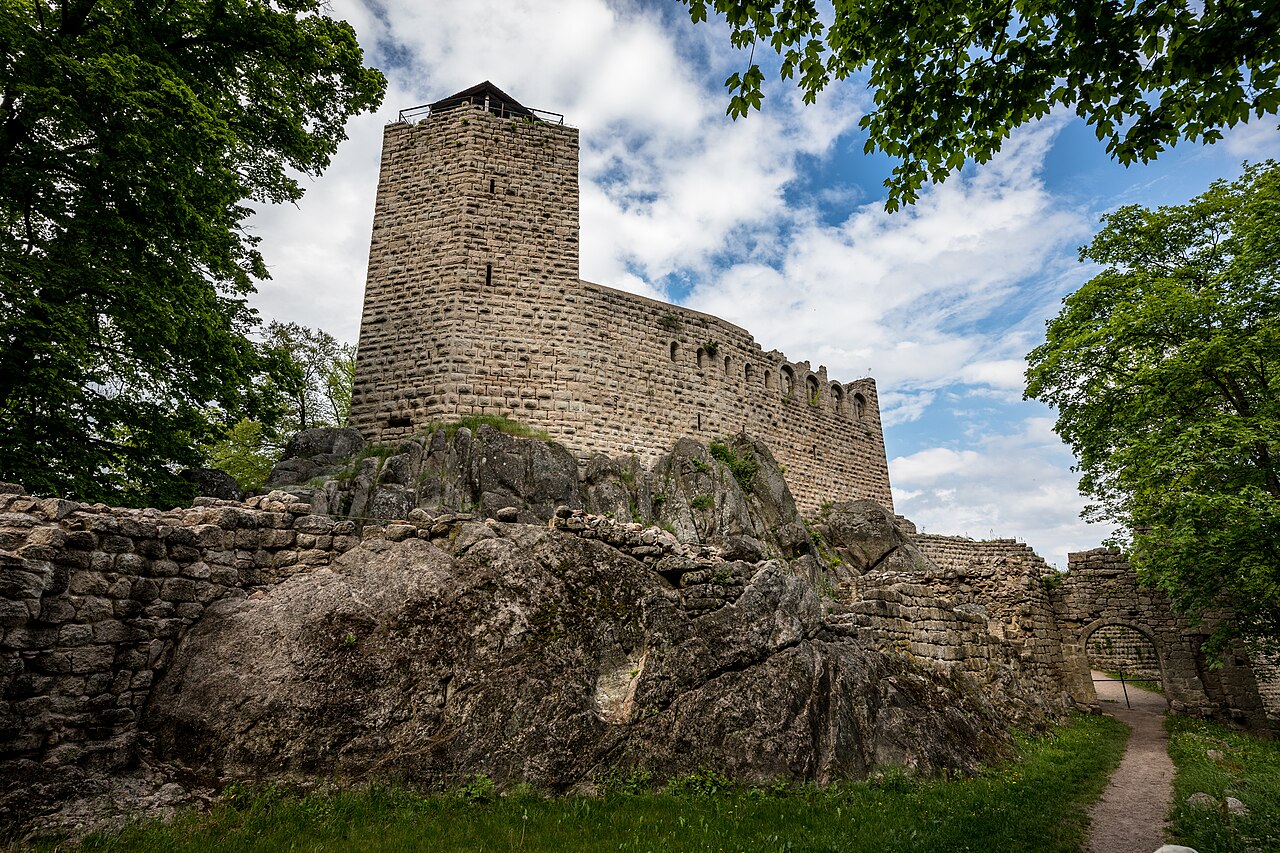
Photo by L'Teigneux • CC BY-SA 2.0
Decline, preservation, and modern significance
With the advent of artillery in the late medieval period, the castle's fortifications became obsolete, leading to its abandonment after the episcopal bailiwick moved in 1580. The fortress suffered damage during the Thirty Years' War and was eventually sold during the French Revolution.
In the 19th century, a hunting lodge was built within the lower castle's northeast corner using stones from the castle ruins; it stood until it was destroyed by fire in 2005. Today, Bernstein Castle is state property and has been protected as a monument historique by the French Ministry of Culture since 1931.
The castle remains partially preserved and is freely accessible to visitors, who can climb the keep and explore the ruins. Access requires a moderate 40-minute hike from the nearest car park, rewarding hikers with panoramic views and a tangible connection to Alsace's medieval heritage.
Bernstein Castle stands as a testament to the region's complex history of feudal power, ecclesiastical authority, and military architecture, offering a unique window into the evolution of medieval fortifications in northeastern France.
Frequently asked questions (FAQ)
- How do I get to Bernstein Castle?
- Bernstein Castle is located in Dambach-la-Ville, France. Visitors can reach the castle by car, with parking available nearby, or by using public transportation options that connect to the local area. It's advisable to check local transit schedules for the most convenient routes.
- What is the historical significance of Bernstein Castle?
- Bernstein Castle dates back to the 12th century and has played an important role in the region's history. It served as a defensive stronghold and has witnessed various historical events that shaped the local culture. Today, it stands as a testament to medieval architecture and history.
- When was Bernstein Castle built?
- Construction of Bernstein Castle began in the 12th century, making it one of the oldest castles in the region. Over the centuries, it has undergone several renovations and restorations, reflecting the architectural styles of different eras. This rich history adds to its charm and allure for visitors.
- Can I visit Bernstein Castle year-round?
- Yes, Bernstein Castle is open to visitors throughout the year, but opening hours may vary by season. It is recommended to check the official website for the most current information on visiting times. Special events may also be held during the year, enhancing your visit.
- Why is Bernstein Castle a popular tourist destination?
- Bernstein Castle attracts visitors due to its stunning views, rich history, and well-preserved architecture. The surrounding landscape offers beautiful hiking trails, making it a perfect destination for nature lovers and history enthusiasts alike. Many visitors enjoy exploring the castle's grounds and learning about its past.
- Is it possible to take guided tours of Bernstein Castle?
- Yes, guided tours are available at Bernstein Castle, offering visitors insights into its history and architecture. These tours are led by knowledgeable guides who share fascinating stories about the castle and its significance. It's advisable to book in advance, especially during peak tourist seasons.
- What are the ticket prices for Bernstein Castle?
- Ticket prices for Bernstein Castle vary depending on age and group size, with discounts often available for children and seniors. Visitors can check the official website for the latest pricing information and any special offers. Group rates are also typically available for educational or large tour groups.
- What are the best times to visit Bernstein Castle?
- The best times to visit Bernstein Castle are during the spring and early autumn when the weather is pleasant and the surrounding scenery is at its most beautiful. These seasons also tend to be less crowded, allowing for a more enjoyable experience. However, special events may draw larger crowds, so planning ahead is recommended.
- Are there any nearby attractions to visit?
- Yes, there are several nearby attractions worth exploring when visiting Bernstein Castle. The charming village of Dambach-la-Ville offers picturesque streets and local shops, while other historical sites and vineyards are within a short drive. Visitors can easily plan a full day of exploration in the area.
Photo gallery

Information
Website
Visit websiteSources & official resources
Verify the information above using these authoritative references.
Loading map...
Visitor reviews
No reviews yet. Been here? Write the first review and help other travelers!
Write the first reviewVisited this castle? Share your experience
Your review helps other travelers and adds first-hand knowledge to our encyclopedia.