Orsini-Colonna Castle
Orsini-Colonna Castle stands as a prominent historical and architectural landmark in the town of Avezzano, located in the heart of Italy's Marsica region. This hill castle traces its origins back to the 12th century, when a sturdy defensive tower was erected in 1181 by Gentile di Palearia, the lord of the Avezzano fiefdom. This medieval tower formed the nucleus around which the extensive castle complex was later developed, reflecting centuries of architectural evolution and noble patronage.
The castle's most transformative period began in the late 15th century, specifically in 1490, when Gentile Virginio Orsini, a member of the influential Orsini family, commissioned a comprehensive remodeling. This renovation marked a shift from the castle's original medieval fortress design towards the emerging Renaissance architectural style. It is widely believed that the renowned military engineer Francesco di Giorgio Martini, who was active with the Orsini family during this era, played a significant role in the redesign. The castle thus became a hybrid residence, combining robust defensive features with the refined aesthetics and spatial concepts of the Renaissance.
Expansion under the Colonna family and cultural significance
In the 16th century, the castle underwent further expansion and transformation under the ownership of Marcantonio Colonna, a distinguished nobleman and military leader. Celebrating his victory at the 1571 Battle of Lepanto, Colonna converted the castle into a fortified palace that embodied both martial strength and aristocratic grandeur. The Colonna family's stewardship of the Marsica area, including Avezzano, lasted for over three centuries until the abolition of feudal privileges in 1806.
During Marcantonio Colonna's tenure, the castle was not only a military stronghold but also a vibrant cultural center. The chambers and underground spaces hosted theatrical performances and other cultural events, reflecting the Renaissance ideal of blending art and power within noble residences.
Architectural features and layout
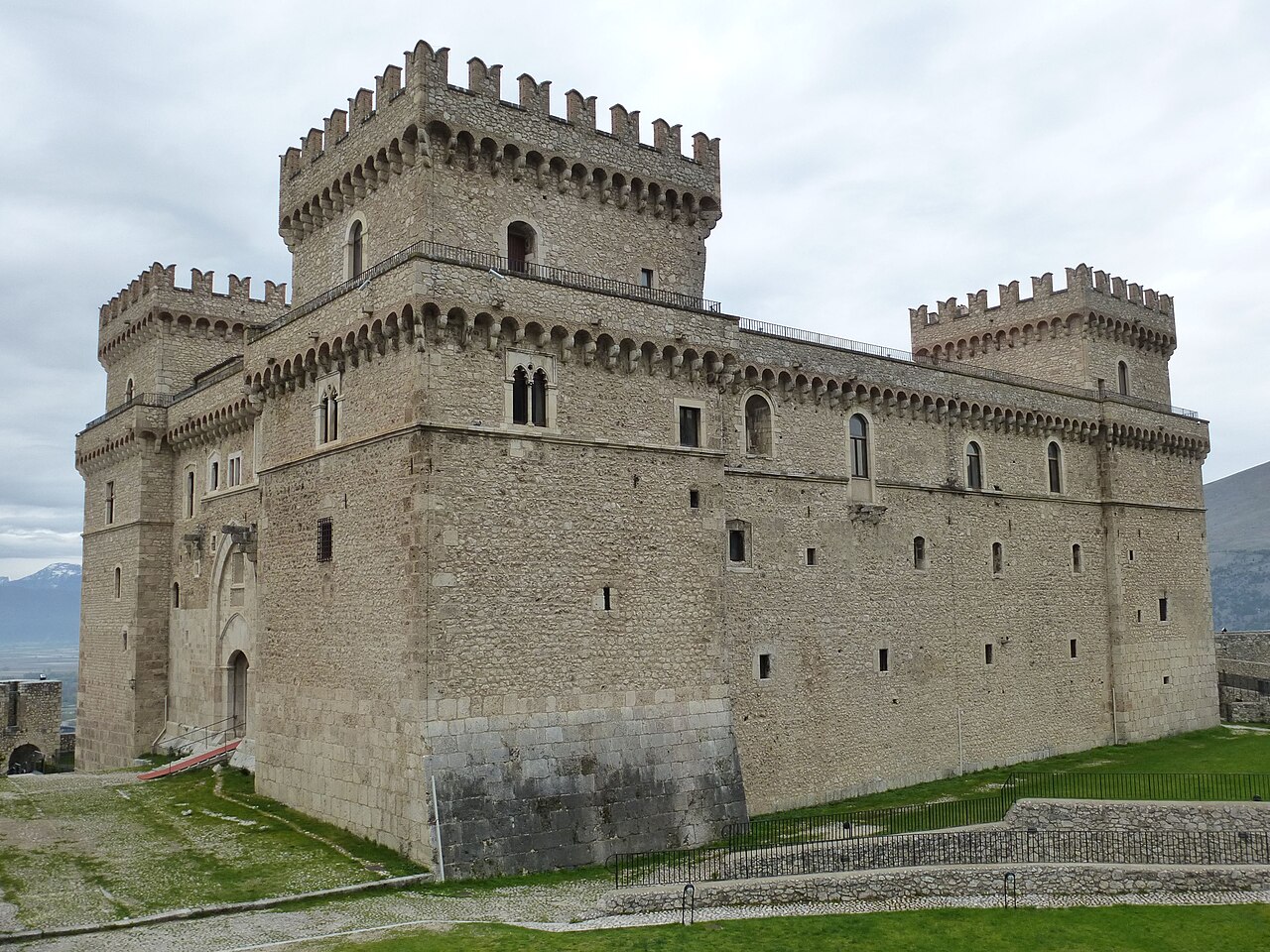
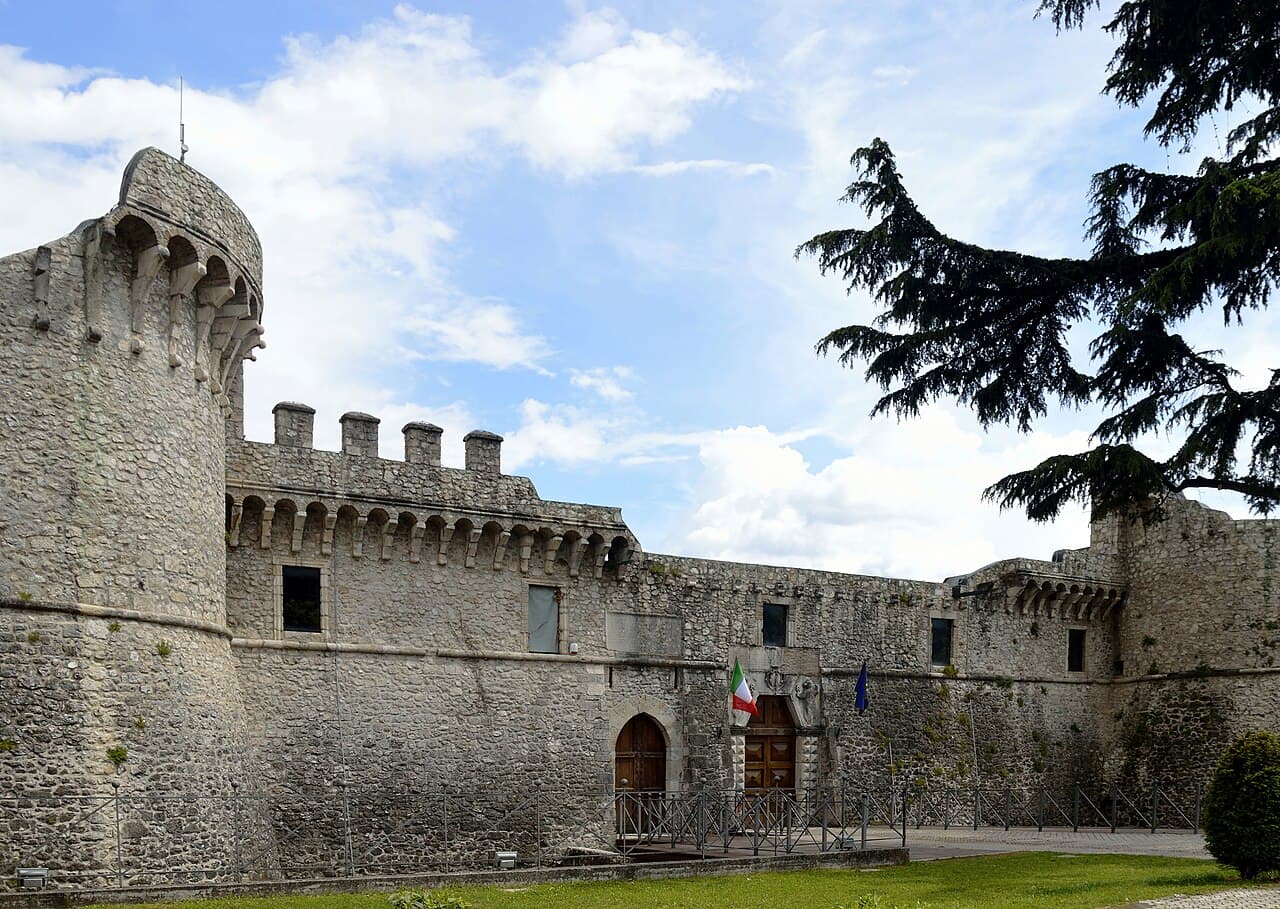
The castle is characterized by a roughly square plan fortified by four circular towers at each corner. Originally, these towers featured three tiers separated by horizontal cornices, though much of their detailed masonry survives only in fragments today. The main facade is notable for its flat surface divided into two horizontal levels by a continuous projecting cornice that runs along the walls and towers, providing a unifying visual element.
The principal entrance is marked by a large rectangular portal adorned with two rows of small pyramid-shaped decorations. Flanking this portal are two life-sized bas-relief sculptures of bears, emblematic of the Orsini family; one bear wields a sword, symbolizing martial prowess. Above the entrance, the Colonna family coat of arms is prominently displayed, encircled by the collar of the Order of the Golden Fleece. Inscriptions commemorate the conquests of Avezzano by both the Orsini and Colonna families, underscoring the castle's historical significance.
The upper level of the facade features symmetrically placed pairs of windows flanking a central window above the portal. The south side of the castle is distinguished by the greatest number of windows and is crowned by a loggia, an open gallery that enhances both the aesthetic and functional qualities of the building.
Originally, the castle was surrounded by a dry moat serving as a defensive barrier, with a drawbridge controlling access to the main portal. The moat area was partially occupied by a Renaissance-style garden and vineyard established by Marcantonio Colonna, integrating natural beauty with the castle's defensive architecture.
Interior remains and distinctive features
The interior suffered extensive damage during the 1915 Marsica earthquake, which destroyed the upper floors and much of the residential quarters where the Colonna family once lived. These areas contained valuable 16th-century frescoes that have since been lost. However, near the central entrance, remnants of the original 12th-century tower's perimeter walls remain, constructed from massive stone blocks that reveal medieval building techniques.
Columns from the castle's well shaft also survive, offering insight into the medieval water supply system essential for sustaining the fortress during sieges. A secondary entrance on the castle's east side provides additional access to the interior spaces.
The castle's roofs were distinctive for their crenellations and coverage with curved tiles resembling traditional pagoda designs, a rare feature in European castle architecture. A taller, slender turret on the right side of the main facade featured classical arched openings and was topped with a circular tile roof, adding vertical emphasis and architectural interest.
Damage, restoration, and modern cultural use
The castle was declared a national monument in 1902, recognizing its historical and architectural importance. Unfortunately, it suffered severe damage not only from the 1915 earthquake but also from Allied bombings in 1944 during World War II, which reduced much of the structure to ruins.
Restoration efforts began in the latter half of the 20th century, including archaeological excavations in the 1970s that uncovered previously hidden internal walls and underground chambers. These efforts have allowed the castle to serve new cultural functions. Since the late 20th century, it houses a modern art gallery featuring the Ernesto Pomilio collection and functions as a multifunctional cultural space. An auditorium was added in 1994 to support these activities, enhancing the castle's role as a center for contemporary arts and community events.
Renaissance garden and park restoration
The surrounding Renaissance garden and park, originally created by Marcantonio Colonna, suffered damage from both natural disasters and wartime bombings. Recent restoration has involved replanting with species such as field maples and Japanese cherry trees, refurbishing hedges, renewing the moat, and installing modern irrigation and lighting systems.
Commemorative monuments have been installed within the garden to honor local historical figures and events, preserving the site's layered heritage and enhancing its appeal as a cultural and historical destination.
Historical significance and legacy
Orsini-Colonna Castle embodies the complex history of feudal Italy, showcasing the evolution of military architecture from medieval fortifications to Renaissance palatial residences. Its association with powerful noble families like the Orsini and Colonna highlights the castle's role in regional politics, military campaigns, and cultural patronage over several centuries.
Despite the damage it has endured, the castle remains a vital cultural landmark in Avezzano, symbolizing resilience and adaptation through its restoration and contemporary use. It offers visitors a unique glimpse into Italy's feudal past, Renaissance artistry, and modern cultural life, making it an essential destination for those interested in history, architecture, and the arts.
Frequently asked questions (FAQ)
- How do I get to Orsini-Colonna Castle in Avezzano?
- Orsini-Colonna Castle is located in the town center of Avezzano, Abruzzo. It is accessible by car and public transportation, with nearby parking and bus stops.
- What are the opening hours of the castle?
- The castle is open daily from 9:00 to 18:00, allowing visitors ample time to explore the site and its exhibitions.
- Is there an entrance fee to visit the castle?
- Yes, the entrance fee is €5 for adults and €3 for children, supporting the maintenance and cultural activities of the castle.
- What architectural styles are visible in the castle?
- The castle features a blend of <strong>medieval defensive architecture</strong> and <strong>Renaissance</strong> elements, including circular towers, crenellations, and a Renaissance loggia.
- Can I visit the Renaissance garden and park?
- Yes, the Renaissance garden and park surrounding the castle have been partially restored and are open to visitors, offering a scenic complement to the historic fortress.
- What cultural events are held at the castle?
- The castle hosts a modern art gallery, cultural exhibitions, and performances in its auditorium, making it a vibrant center for arts and community events.
- Is the castle accessible for people with disabilities?
- Efforts have been made to improve accessibility, including ramps and adapted facilities, but some historic areas may have limited access due to structural constraints.
Photo gallery

Information
Opening hours
9:00-18:00, daily
Ticket prices
€5 adult, €3 child
Current owner
Municipality of Avezzano
Loading map...
Visitor reviews
No reviews yet. Been here? Write the first review and help other travelers!
Write the first reviewVisited this castle? Share your experience
Your review helps other travelers and adds first-hand knowledge to our encyclopedia.