Oron Castle
Oron Castle stands as a remarkable example of a high medieval hill castle in the municipality of Oron-le-Châtel, Switzerland. Constructed originally in the 13th century, it has witnessed centuries of architectural evolution, political change, and cultural enrichment. The castle’s strategic location on a hill spur between the Le Flon stream and an ancient Roman road made it a vital stronghold in the region from its earliest days. Today, it is celebrated not only for its well-preserved medieval fortifications but also for housing one of Europe’s most significant private collections of 18th-century French literature.
Early history and medieval significance
The origins of Oron Castle date back to the late 12th or early 13th century, built as the center of the seigneurie of Oron. It first appears in historical records in 1261, serving as the residence of the noble d’Oron family. This family held the castle as castellans under the Counts of Geneva and later the Counts of Savoy, reflecting the shifting feudal allegiances of the period. The d’Oron family’s influence extended over multiple lordships, and they maintained joint land ownership with the Abbey of Saint-Maurice until the 16th century.
Following the extinction of the d’Oron male line in 1388, the castle passed through several hands, including the Counts of Gruyère. In 1557, the castle and its lordship came under the control of the city of Bern, which transformed Oron into the seat of a third-class bailiwick. This administrative district was governed by bailiffs, forty-three of whom resided in the castle until the political upheavals of 1798.
Architectural evolution and defensive features
Oron Castle underwent significant reconstruction in the late 15th century, between 1475 and 1485. This renovation modernized its defenses and living quarters, adapting the castle to the military and residential needs of the time. Further renovations took place during the 17th century, reflecting changing tastes and functions.
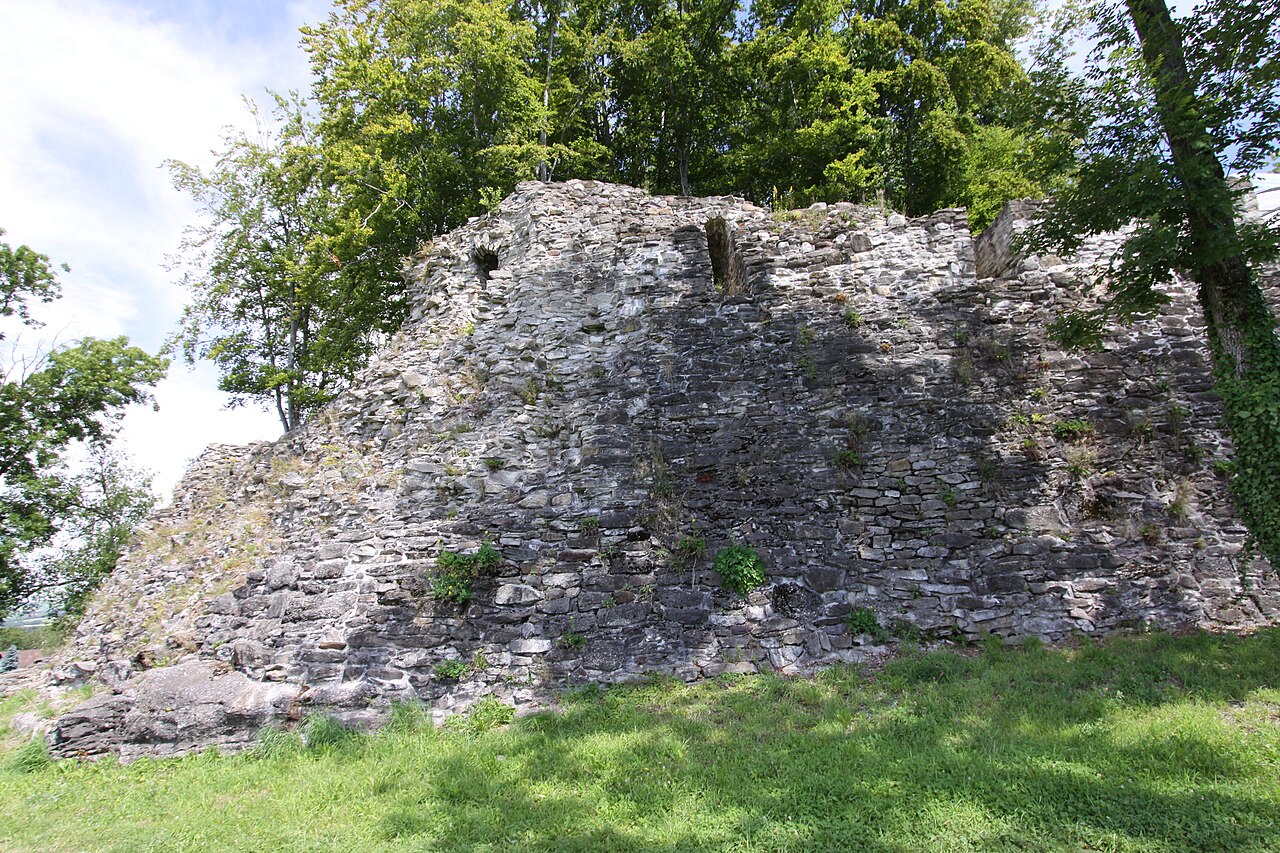
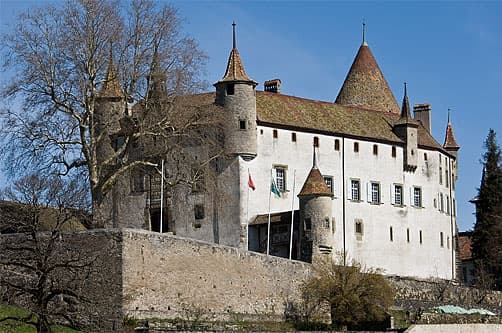
The castle’s layout is an elongated oval shape, conforming to the hill’s contours. The core of the complex is a 13th-century bergfried on the eastern side, a tall central tower topped with a conical roof that served as the main defensive lookout. Surrounding this tower are residential wings on the eastern and western sides, punctuated by several towers and turrets.
Among the defensive elements are distinctive pepperpot turrets, small rounded towers with narrow keyhole and slit windows designed for archers. Some turrets have round bases, while others are square with machicolations—openings in the floors for dropping objects on attackers. The south-east corner features a notable gatehouse with a right-angled entrance, a stone bearing a coat of arms, and slender defensive slits, accessed by a wooden staircase.
The castle’s outer bailey was once protected by a zwinger, a narrow passage between walls intended to trap attackers. Access to the bailey is via a stone arch bridge that replaced an earlier drawbridge spanning a moat or ditch. Part of the ditch was later converted into gardens, illustrating the shift from military to residential and aesthetic functions.
The defensive perimeter originally included seven towers and turrets, several of which remain intact. The south-west corner is marked by a latrine tower with a distinctive three-sided pyramidal roof, likely a later addition.
Residential and interior features
The castle’s residential wings display multiple rows of windows that vary by floor. The ground floor includes small slit windows and cross-shaped arrow slits for defense, while upper floors feature larger segmental-arched windows. Decorative brick friezes adorn parts of the northern palace (palas), indicating artistic enhancements from later periods.
Inside, the castle preserves a late Gothic coffered ceiling in the former knights’ hall, which today houses the Potocki library. This library contains approximately 18,000 volumes, primarily French novels published between 1775 and 1825, including unique editions. The interiors also feature 18th-century stoves decorated with thematic motifs, reflecting refined tastes of the castle’s later inhabitants.
Cultural significance and modern use
In 1801, following its use as a prison after the end of Bernese bailiwick rule, the castle was acquired by the Roberti family of Moudon. Later, in 1870, it was purchased by Adolphe Gaiffe, who began assembling the extensive library collection in 1880. This collection, known as the Potocki Collection, is one of the largest private libraries dedicated to 18th-century French literature in Europe.
To preserve the castle, the Association pour la Conservation du château d’Oron was founded in 1934 and bought the property in 1936. The castle is recognized as a cultural property of national significance in Switzerland and has undergone careful restoration to maintain its historical integrity.
Today, the castle hosts various cultural events such as banquets, weddings, and themed evenings like "Murder & Mystery" nights, allowing visitors to experience its rich history and ambiance. The courtyard has been fitted with a glass roof to facilitate these events while preserving the castle’s original spatial qualities.
Location and strategic importance
Oron Castle is strategically perched on a hill spur overlooking the surrounding landscape. Its position between the Le Flon stream and a former Roman road connecting Vevey and Avenches highlights its historical role in controlling important transit routes. The castle’s polygonal layout and natural defenses made it a formidable fortress during the medieval period.
Architectural style and preservation status
The castle’s architecture is primarily high medieval with elements of late Gothic style visible in interior details such as the coffered ceiling. The structure has been well preserved through successive restorations, maintaining much of its original defensive and residential character. The castle’s combination of military fortifications and refined living spaces exemplifies the evolution of medieval castles into multifunctional estates.
Oron Castle remains a significant heritage site, offering insights into medieval fortification techniques, noble residence life, and the cultural history of the region. Its extensive library collection adds a unique dimension, linking architectural heritage with literary and intellectual history.
Frequently asked questions (FAQ)
- How do I get to Oron Castle?
- Oron Castle is located in Oron-le-Châtel, Switzerland, and can be easily reached by car or public transportation. The nearest train station is Oron, from where you can take a short bus ride or walk to the castle. Parking facilities are available nearby for those traveling by car.
- What is the historical significance of Oron Castle?
- Oron Castle dates back to the 12th century and played a crucial role in the defense of the region during the Middle Ages. It served as a residence for the local nobility and has witnessed many historical events, making it an important landmark in Swiss history. Today, it stands as a symbol of the rich cultural heritage of the area.
- When was Oron Castle built?
- Construction of Oron Castle began in the late 12th century, with various modifications made over the centuries. The castle's architecture reflects the styles of different periods, showcasing its long and varied history. It was strategically built to oversee the surrounding area and protect against invasions.
- Can I visit Oron Castle?
- Yes, Oron Castle is open to visitors throughout the year, allowing you to explore its beautiful architecture and scenic views. Guided tours are available, providing insight into the castle’s history and significance. Be sure to check the official website for any special events or exhibitions during your visit.
- Why is Oron Castle popular among tourists?
- Oron Castle is popular due to its stunning medieval architecture and picturesque location overlooking the countryside. Visitors are drawn to its historical significance and the beautiful surrounding landscape, making it a perfect spot for photography and exploration. Additionally, the castle often hosts cultural events and exhibitions that enhance the visitor experience.
- Is it possible to access Oron Castle with mobility challenges?
- The castle has made efforts to improve accessibility for all visitors, including those with mobility challenges. While some areas may be difficult to navigate due to the historic architecture, certain paths and facilities are designed to accommodate wheelchair users. It is recommended to contact the castle administration beforehand for specific accessibility inquiries.
- What are the opening hours for Oron Castle?
- Oron Castle typically opens from 10 AM to 5 PM, but hours may vary depending on the season and special events. It’s best to check the official website for the most current information on opening hours before planning your visit. During holidays, the castle may have different visiting hours.
- What are the ticket prices for Oron Castle?
- Ticket prices for Oron Castle vary based on age and group size, with discounts available for students and seniors. Generally, adult tickets range from 8 to 12 Swiss Francs, while children under 12 may enter for free. Group rates and family packages are also offered, making it an affordable destination for all.
- What nearby attractions can I visit while at Oron Castle?
- While visiting Oron Castle, you can also explore the charming village of Oron-le-Châtel, known for its beautiful landscapes and local shops. The nearby Lake Geneva offers stunning views and recreational activities, including hiking and boating. Additionally, the city of Lausanne is just a short drive away, providing a rich cultural experience with museums and dining options.
Photo gallery

Information
Website
Visit websiteSources & official resources
Verify the information above using these authoritative references.
Loading map...
Visitor reviews
No reviews yet. Been here? Write the first review and help other travelers!
Write the first reviewVisited this castle? Share your experience
Your review helps other travelers and adds first-hand knowledge to our encyclopedia.