(Old) Fort Boise
Old Fort Boise stands as a significant historic site in the early 19th century fur trade era of the American West. Established in 1834 by Thomas McKay, a seasoned leader of the Hudson's Bay Company (HBC) Snake Country brigades, the fort was strategically located in what is now Canyon County, Idaho. Its location was deliberately chosen on the same site as an earlier fort built by Reid and Mackenzie, underscoring the importance of this area along the Snake River for trade and territorial influence.
The fort's establishment was part of a broader competition between British and American interests in the Pacific Northwest. Though McKay had retired in 1833, the HBC's Chief Factor John McLoughlin dispatched him to construct Fort Boise to counter the expansion of American influence symbolized by the newly built Fort Hall further east on the Snake River. Fort Boise thus played a crucial role in asserting British trading dominance and maintaining control over key trade routes during a period of intense rivalry.
Historical context and strategic importance
During the early 19th century, the fur trade was a dominant economic activity in the region. The Hudson's Bay Company, a British enterprise, sought to control the lucrative fur markets by establishing a network of forts and trading posts. Fort Boise was a vital link in this network, serving as a trading hub and supply depot for trappers and indigenous peoples.
The fort's location on the Snake River was particularly strategic. The river served as a major transportation corridor, facilitating the movement of goods and people. By controlling Fort Boise, the HBC could monitor and influence trade flows and territorial claims in the contested Snake River basin.
Architecture and layout of Fort Boise
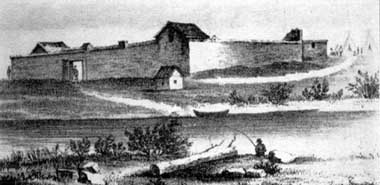
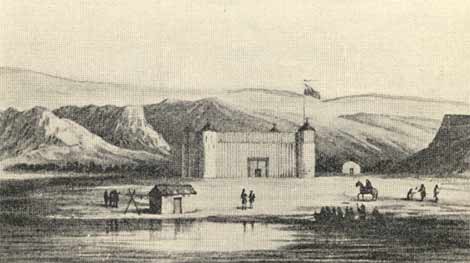
Unlike the large stone castles of Europe, Fort Boise was a typical early 19th-century trading post constructed primarily of wood. The fort featured a palisaded enclosure with log walls designed to provide defense against potential attacks. Inside the enclosure were various buildings including living quarters, storehouses, and workshops.
The fort's defensive features included palisade walls made from vertical logs sharpened at the top, a common design for frontier forts of the period. Watchtowers were positioned at corners to provide vantage points for surveillance. The gate was reinforced and served as the main controlled entry point.
Facilities and daily life
The interior of Fort Boise contained essential facilities for the fur trade and daily living. The storehouses held furs, trade goods, and supplies. Living quarters accommodated the fort's employees, including trappers, traders, and support staff. Workshops were used for repairing equipment and preparing goods for trade.
Life at the fort was demanding and isolated, with harsh winters and the constant need to maintain security. The fort also served as a social center where indigenous peoples and traders exchanged goods, information, and cultural practices.
Legacy and decline
Fort Boise's significance waned as American settlers and government presence increased in the region following the Oregon Treaty of 1846, which resolved territorial disputes between Britain and the United States. The fort was eventually abandoned in favor of a new American Fort Boise established further west near the Boise River in 1863.
Today, the original site of Old Fort Boise is recognized for its historical importance in the fur trade era and early western expansion. Although the fort itself no longer stands, archaeological investigations have revealed the layout and artifacts that illuminate life at this frontier trading post.
Preservation and public access
The site of Old Fort Boise is preserved as an archaeological site, offering valuable insights into early 19th-century frontier life and the complex dynamics of colonial competition in the American West. Visitors interested in the history of the fur trade and early Idaho settlement can explore interpretive displays and nearby museums that contextualize Fort Boise's role in regional history.
Frequently asked questions (FAQ)
- When was Old Fort Boise established and by whom?
- Old Fort Boise was established in 1834 by Thomas McKay, a leader of the Hudson's Bay Company Snake Country brigades.
- What was the strategic purpose of Fort Boise?
- Fort Boise was built to assert British trading dominance and counter American expansion along the Snake River during the fur trade era.
- What materials were used to construct Fort Boise?
- Fort Boise was primarily constructed of wood with palisade walls and watchtowers typical of early 19th-century frontier forts.
- Is Old Fort Boise accessible to the public today?
- The original site of Old Fort Boise is preserved as an archaeological site, with interpretive displays available nearby, but the fort itself no longer stands.
- How did Fort Boise influence regional trade?
- Fort Boise served as a key trading post and supply depot, facilitating fur trade and controlling trade routes in the Snake River basin.
Information
Loading map...
Visitor reviews
No reviews yet. Been here? Write the first review and help other travelers!
Write the first reviewVisited this castle? Share your experience
Your review helps other travelers and adds first-hand knowledge to our encyclopedia.