Fort Boise
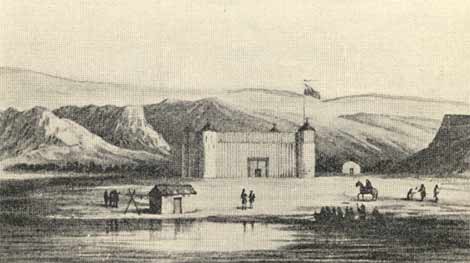
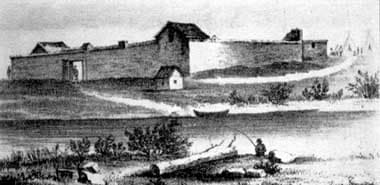
Fort Boise refers to two historically significant sites in southwestern Idaho, each playing distinct roles in the region's development during the 19th century. The first Fort Boise was established as a Hudson's Bay Company (HBC) trading post near the Snake River on what is now the Oregon border, within present-day Canyon County, Idaho. This fort was part of the British fur company's Columbia District and was integral to the fur trade economy of the Pacific Northwest during the early to mid-1800s. It underwent several reconstructions before being ultimately abandoned in 1854 following the resolution of the northern boundary dispute that brought the territory under United States control in 1846.
The second Fort Boise was founded by the United States government in 1863 as a military post situated approximately fifty miles east along the Boise River. This fortification was a bastioned fortress designed to provide defense and support for settlers and military operations during the period of western expansion and regional conflicts. The establishment of this fort was a catalyst for the growth of the nearby settlement, which evolved into the city of Boise, now the capital of Idaho.
Historical context and significance
The original Fort Boise trading post was strategically placed to facilitate the fur trade, which was a dominant economic activity in the Pacific Northwest during the early 19th century. Operated by the Hudson's Bay Company, the fort served as a hub for trapping, trading, and supply distribution, connecting indigenous trappers, European traders, and settlers. Its location near the Snake River allowed for transportation and communication across a vast territory that spanned parts of present-day Idaho, Oregon, and Washington.
Following the Oregon Treaty of 1846, which settled the boundary between British North America and the United States at the 49th parallel, the original Fort Boise lost its strategic importance to the British fur trade. The fort was eventually abandoned in 1854 as American settlers and military forces established control over the region.
The second Fort Boise, established in 1863, was part of the United States military's efforts to secure its new western territories. This fortification was constructed during a period marked by increased migration along the Oregon Trail and conflicts with Native American tribes. It served as a protective outpost and a center for military operations aimed at maintaining peace and order in the region.
Architectural features and military design
The 1863 Fort Boise was designed as a bastioned fortress, a style characterized by angular bastions projecting from the walls to provide defensive coverage against attackers. This design allowed defenders to cover all approaches with overlapping fields of fire, reducing blind spots and enhancing the fort's defensive capabilities.
The fort's layout typically included earthwork walls reinforced with timber, bastions at the corners for artillery placement, and enclosed courtyards housing barracks, storage facilities, and command buildings. Defensive features such as moats or ditches may have been incorporated to hinder enemy advances, although specific details about these features at Fort Boise are limited.
As a military installation, the fort was equipped to support a garrison of soldiers tasked with protecting settlers and maintaining control over the surrounding territory. Its construction reflected military engineering principles of the mid-19th century, adapted to the frontier conditions of the American West.
Legacy and impact on the region
The establishment of the second Fort Boise directly influenced the development of the city of Boise. The fort provided security that encouraged settlement and economic growth, eventually leading to Boise becoming the capital of Idaho. The military presence helped stabilize the area during a time of significant change, including the transition from Native American lands to organized American territories.
Today, the original trading post site and the later military fort represent important chapters in Idaho's history. While the original fort near the Snake River no longer exists as a standing structure, its historical significance is recognized in regional heritage. The later fort's location near Boise marks the origins of the city's establishment and its strategic role in the American West.
Visiting fort boise and historical interpretation
Visitors interested in Fort Boise can explore the historical sites and museums in the Boise area that interpret the fort's role in regional history. While the physical remains of the forts are limited, local heritage organizations provide educational resources and exhibits detailing the forts' contributions to Idaho's development.
The story of Fort Boise is intertwined with themes of exploration, trade, military strategy, and settlement. It offers insight into the complex interactions between indigenous peoples, European traders, and American settlers during a transformative era in the American West.
Frequently asked questions (FAQ)
- What is the historical significance of Fort Boise?
- Fort Boise was established in the mid-19th century as a military outpost to protect settlers and travelers in the Oregon Trail region. Its strategic location contributed to the expansion of the American West and played a key role in local commerce and trade during that era.
- When was Fort Boise built?
- Fort Boise was originally constructed in 1863 and served various military purposes until it was decommissioned in 1890. The fort's structures have been preserved to showcase the architectural style and military history of the period.
- How do I visit Fort Boise?
- Visitors can access Fort Boise by traveling to its location in the United States, where guided tours are available. It is recommended to check the official website for tour availability and any special events that may be occurring during your visit.
- What are the opening hours for Fort Boise?
- Fort Boise is typically open to visitors from 9 AM to 5 PM, Wednesday through Sunday. However, hours may vary during holidays or special events, so it’s best to confirm before planning your trip.
- Can I take photographs at Fort Boise?
- Yes, visitors are welcome to take photographs throughout the grounds of Fort Boise. Just be respectful of any areas that may be restricted and follow any posted guidelines to ensure a pleasant experience for everyone.
- Is Fort Boise accessible for individuals with disabilities?
- Yes, Fort Boise is committed to providing access for all visitors. The site includes pathways and facilities designed to accommodate individuals with mobility challenges, ensuring that everyone can appreciate the historic site.
- What is the best time to visit Fort Boise?
- The best time to visit Fort Boise is during the spring and fall when the weather is mild and pleasant for outdoor exploration. Additionally, visiting during these seasons allows you to enjoy the natural beauty of the surrounding area without the summer crowds.
- Are there any nearby attractions to Fort Boise?
- Yes, there are several attractions near Fort Boise, including local museums, parks, and historical sites. Exploring the surrounding area can enhance your visit and provide insight into the region's rich history.
- What are the ticket prices for Fort Boise?
- Admission to Fort Boise is often free, but special events or guided tours may have a nominal fee. It's recommended to check the official website for the most current pricing information and any available discounts.
Photo gallery

Photo by Sketch by William H. Tappan•Public domain
Information
Loading map...
Visitor reviews
No reviews yet. Been here? Write the first review and help other travelers!
Write the first reviewVisited this castle? Share your experience
Your review helps other travelers and adds first-hand knowledge to our encyclopedia.