Old Falkenstein Castle
Old Falkenstein Castle stands as a significant medieval ruin near the modern town of Falkenstein/Harz in Germany. Constructed in the 11th century during the period of the medieval German Empire, this hill castle played a strategic role amid the territorial conflicts that shaped the region's early medieval history. Its location atop a rocky ridge at an elevation of 335.6 meters provided commanding views over the Selke valley, making it a formidable stronghold in its time.
The origins and historical context
The castle's establishment is closely linked to the reign of Emperor Henry IV, a pivotal figure in the High Medieval era. The design and construction of Old Falkenstein are attributed to Benno II, a Swabian cleric who later rose to prominence as the bishop of Osnabrück. Under Benno II's direction, the castle was conceived as a defensible residence, reflecting the intense power struggles and military threats of the 11th century within the Holy Roman Empire.
Old Falkenstein's military significance is underscored by its involvement in the aftermath of the Battle of Welfesholz on February 11, 1115. This battle was a key conflict between the forces of the Saxon duke Lothair of Süpplingenburg and the imperial army. Following the Saxon victory, Lothair ordered the deliberate slighting of Old Falkenstein Castle, a controlled demolition intended to prevent its future military use. This decisive act marked the end of Old Falkenstein as an active fortress.
Architectural layout and fortifications
The castle's original layout was adapted to the natural rocky terrain, a common feature of hill castles built during the medieval period. The site encompassed an oval-shaped inner ward measuring approximately 25 by 65 meters, which formed the core defensive and residential area of the castle. Surrounding this was a narrow outer ward extending about 85 meters, providing additional layers of defense.
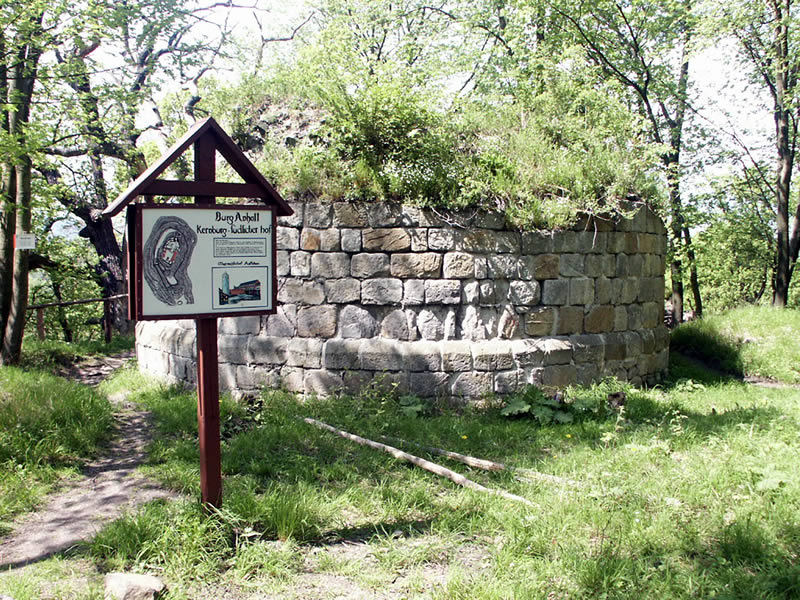
The entire complex stretched roughly 200 meters along the ridge, showcasing a strategic use of the natural landscape to enhance its defensive capabilities. Among the surviving features are remnants of a circular moat known as a Ringgraben, which would have served as a protective ditch encircling the castle. Additionally, parts of the Vorwall—an advanced earthwork rampart—are still visible, illustrating the castle's multi-tiered fortification system.
Further remains include sections of the northern ring wall (Ringmauer), which once enclosed the castle's inner defenses. These surviving earthworks and stone fragments provide valuable insights into 11th-century medieval fortification techniques, emphasizing the integration of natural topography with man-made defensive structures.
Abandonment and archaeological significance
Following its slighting in 1115, Old Falkenstein Castle was never rebuilt. Instead, a new fortress, known as New Falkenstein Castle, was established approximately 1.8 kilometers to the east-northeast. Archaeological excavations at the Old Falkenstein site have uncovered artifacts such as pottery shards, which indicate that the location was abandoned early in the 12th century and did not see subsequent occupation.
Today, Old Falkenstein remains an important archaeological site within the Harz district of Saxony-Anhalt. The ruins serve as a tangible link to the region's medieval past and provide valuable information for historians and archaeologists studying castle construction and medieval military history.
A commemorative cross near the ruins honors Hans Reißmann, a local historian who tragically died in an accident at the site in 2003. This memorial symbolizes the ongoing connection between the castle's historical legacy and the present-day community.
Medieval castle construction and defensive strategy
The combination of the oval inner ward, outer ward, and extensive earthworks reflects typical 11th-century castle architecture aimed at maximizing natural defenses. The use of a rocky ridge for the castle's foundation provided natural protection and a vantage point for surveillance of the surrounding territory.
The ring moat (Ringgraben) and Vorwall earthworks exemplify medieval defensive innovations designed to slow and deter attackers. The castle's fortifications were constructed to withstand sieges and raids common during the volatile political climate of the High Middle Ages.
Although the castle was ultimately destroyed and abandoned, its remains offer a clear example of the strategic military architecture of its time and contribute to our understanding of medieval fortification methods in the German-speaking regions of Europe.
Frequently asked questions (FAQ)
- When was Old Falkenstein Castle built and by whom?
- Old Falkenstein Castle was constructed in the 11th century during the reign of Emperor Henry IV. Its design is attributed to Benno II, a Swabian cleric who later became bishop of Osnabrück.
- What led to the destruction of Old Falkenstein Castle?
- The castle was deliberately slighted in 1115 by the Saxon duke Lothair of Süpplingenburg following the Battle of Welfesholz to prevent its further military use. It was never rebuilt after this event.
- What remains can be seen at the Old Falkenstein Castle site today?
- Visitors can see remnants of the oval inner ward, outer ward, a circular moat called the Ringgraben, parts of the Vorwall earthwork rampart, and sections of the northern ring wall (Ringmauer).
- Is Old Falkenstein Castle accessible to visitors?
- As an archaeological site, Old Falkenstein Castle is accessible for visitors interested in medieval history and archaeology, though facilities and guided tours may be limited due to its ruinous condition.
- How does Old Falkenstein Castle reflect medieval defensive architecture?
- The castle's design, including its elevated rocky ridge location, oval inner ward, outer ward, ring moat, and earthwork defenses, exemplifies 11th-century strategies to maximize natural terrain for fortification against military threats.
Information
Architect
Benno II
Loading map...
Visitor reviews
No reviews yet. Been here? Write the first review and help other travelers!
Write the first reviewVisited this castle? Share your experience
Your review helps other travelers and adds first-hand knowledge to our encyclopedia.